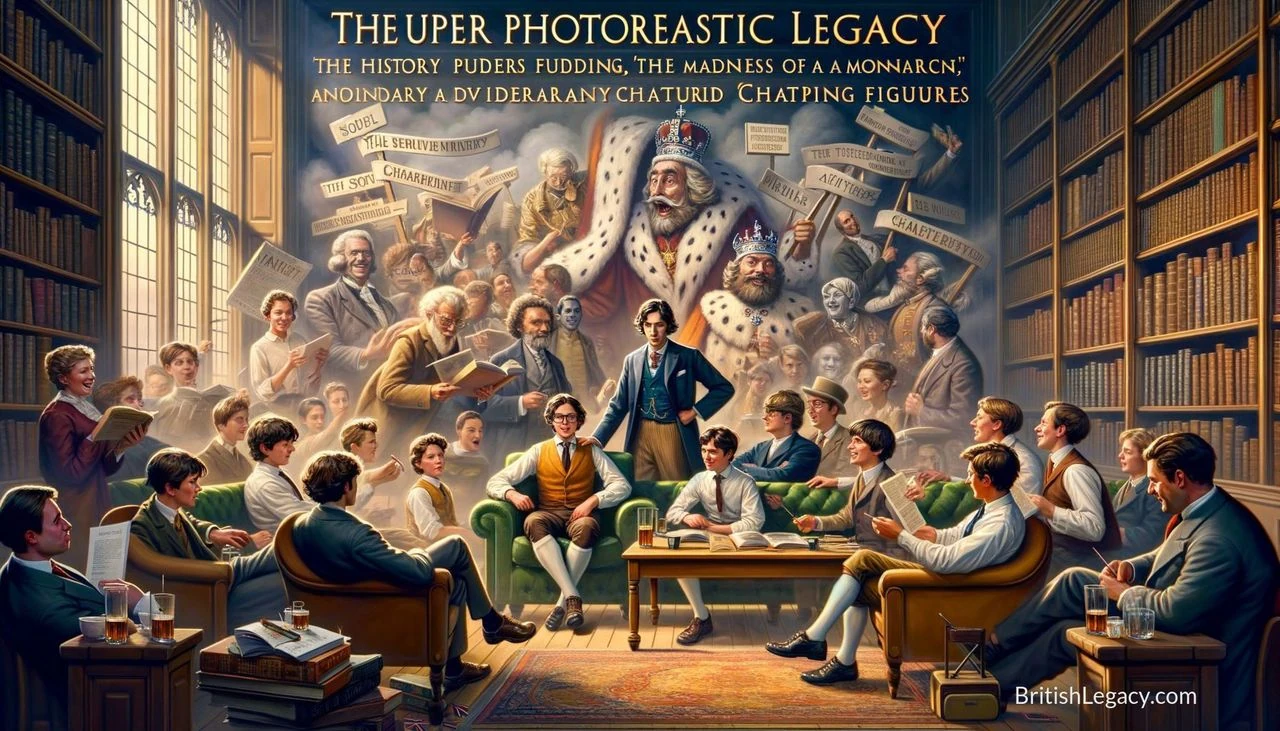
Alan Bennett’s characters include unruly schoolboys, overlooked neighbours and a king whose illness unsettles a nation. Across stage, television, film and prose, he has made private lives and public institutions equally compelling: funny, awkward and often more complicated than they first appear. His career began in the exuberant satire of Beyond the Fringe and developed into a body of writing attentive to education, class, power and the ordinary business of getting by.
From Leeds to Beyond the Fringe
Bennett was born in Armley, Leeds, on 9 May 1934, the younger son of Walter, a Co-op butcher, and Lilian Mary Bennett. He attended Christ Church, Upper Armley, and Leeds Modern School, now Lawnswood School. After National Service, during which he learnt Russian at the Joint Services School for Linguists, he won a scholarship to Exeter College, Oxford. He graduated with a first-class degree in history and performed comedy in the Oxford Revue.
For several years Bennett remained at Oxford as a junior lecturer in medieval history at Magdalen College. In 1960, he decided academic life did not suit him. That August, he appeared at the Edinburgh Festival with Peter Cook, Dudley Moore and Jonathan Miller in Beyond the Fringe. The revue’s satire brought the four performers immediate attention; it went on to play in London and New York. Bennett’s career would range far beyond sketch comedy, but the show established a lasting interest in the institutions and habits that shape public life.
He continued to write for stage, radio and television, as well as acting. His first stage play, Forty Years On, directed by Patrick Garland and starring John Gielgud, was produced in 1968. Getting On followed in 1971, then Habeas Corpus in 1973 and The Old Country in 1977. His television work included A Day Out (1972), An Englishman Abroad (1983) and, in 1988, the first series of Talking Heads. Bennett later said he did not write on commission: he preferred to write what interested him and accept that a work might not find an audience.
Speaking parts for the overlooked
Talking Heads brought Bennett’s gift for the sustained, intimate voice to television. Its monologues give their characters space to speak directly to the camera, revealing the loneliness, self-deception and resilience underneath everyday conversation. A second set of six monologues followed a decade later. The pieces also reached the stage: they were performed at London’s Comedy Theatre in 1992. Rather than turn ordinary lives into simple lessons, Bennett lets his characters’ accounts disclose their own contradictions.
That attention to private experience also runs through The Lady in the Van. Bennett based the story on Miss Shepherd, an eccentric woman who lived in a succession of dilapidated vans on his driveway for more than 15 years. First published as an essay in the London Review of Books in 1989, it appeared as a book the following year. Bennett adapted it as a stage play in 1999, with Maggie Smith in the lead role, and later wrote the screenplay for the 2015 film directed by Nicholas Hytner. The story’s unusual subject becomes an occasion to examine what it means to live beside another person without ever fully knowing them.
Bennett’s writing for television and film extended beyond adaptations of his stage work. He wrote the screenplay for A Private Function (1984) and Prick Up Your Ears (1987), among other projects. His 1995 BBC documentary series The Abbey, which he presented, offered a personal tour of Westminster Abbey. These different forms gave him room to move between comedy, observation and more direct reflection on history and culture.
History, education and public institutions
In The Madness of George III, first staged in 1991, Bennett puts the illness of a monarch in the middle of political conflict. The play became the film The Madness of King George in 1994. Its title change for the screen distinguishes it from the stage work, while the story retains its interest in the relationship between a person’s health and the demands placed on a ruler. The film received four Academy Award nominations, including one for Bennett’s writing, and won for art direction.
The History Boys, first staged in 2004, brought a school and its competing ideas about education to a wide audience. Set in the 1980s, the play follows a group of sixth-form boys preparing for university entrance, taught by three teachers with sharply different approaches. Bennett gives questions of ambition, sexuality and the purpose of learning a dramatic life through the pupils’ arguments and relationships. In 2005, the play won three Laurence Olivier Awards, including Best New Play; it went on to win six Tony Awards on Broadway. The film adaptation was released in the UK in October 2006.
His work continued to address the institutions that structure people’s lives. The Habit of Art (2009) imagines a meeting between poet W. H. Auden and composer Benjamin Britten. People opened at the National Theatre in 2012, the same year that Bennett’s autobiographical play Cocktail Sticks was presented there alongside the monologue Hymn. In 2018, Allelujah!, a comic drama about a National Health Service hospital threatened with closure, opened at the Bridge Theatre.
Prose, memory and public life
Bennett’s prose gives another form to the sharp observation found in his plays. Writing Home (1994) brought together memoir, essays and diaries. Untold Stories, published in 2005, combined autobiographical writing with essays and diaries, drawing on his memories and on the social world around him. Later books included the memoir A Life Like Other People’s (2009) and Keeping On Keeping On (2016). His writing crosses between the personal and the public without treating either as separate: a recollection can illuminate a family, a school or a wider change in British life.
Education was not just a subject for Bennett’s fiction. In 2008, he announced that he would give his archive of working papers, unpublished manuscripts, diaries and books to the Bodleian Library. He described the donation as a way of repaying a debt to the British welfare state, which had provided educational opportunities that his family background might otherwise have made difficult to reach. In 2011, he returned to Lawnswood School to unveil its renamed Alan Bennett Library. He said he had loosely based The History Boys on his experiences at the school and his admission to Oxford, and spoke against local library closures.
Bennett has also declined prominent honours. He turned down a CBE in 1988 and a knighthood in 1996. His career has brought substantial recognition nonetheless, including four BAFTA Awards, four Laurence Olivier Awards and two Tony Awards. In 2005, he received the Society of London Theatre Special Award. These accolades mark the reach of a career that has been recognised in both British theatre and international performance.
Why Alan Bennett deserves a place in British Legacy
Alan Bennett deserves a place in British Legacy because his work has made British institutions legible through the people who live and work within them. The History Boys turns university admissions and ideas about teaching into a contest of voices, not an abstract argument about education. The Madness of George III sets a king’s illness against the demands of politics. Talking Heads makes room for characters who might otherwise remain at the edge of the story. In each case, comedy does not cancel the seriousness of the subject; it helps expose how power, class and social expectation operate in ordinary lives.
His contribution also reaches beyond the work itself. Bennett’s writing has travelled between stage, television, cinema and prose, and has been performed and honoured in Britain and abroad. His gift of his archive to the Bodleian Library connects that creative career to the educational opportunities he valued. His return to Lawnswood and his public objection to library closures show a specific concern with access to books and learning, rather than a generic attachment to national culture. Together, the plays, monologues, memoirs and acts of public support leave a record of how British life can be questioned with humour, attention and sympathy.
Sources
Alan Bennett — revision 1374774130 · Alan Bennett
Adapted in part from Alan Bennett by Wikipedia contributors, under CC BY-SA 4.0. Text has been edited and combined with the existing article; this adapted text is shared under the same licence. Contributor history.