
Isaac Newton
The Lincolnshire mathematician connected motion on Earth with the movements of the heavens, transformed the study of light and served at the Royal Mint.
Read the entryBRITISH LEGACY / THE COLLECTION
British scientists have pioneered numerous breakthroughs across various fields, contributing significantly to global knowledge. Their work has laid foundational principles in everything from physics to genetics. The UK's scientific community continues to lead innovations that address some of the world's most pressing challenges.
26 entriesThe Lincolnshire mathematician connected motion on Earth with the movements of the heavens, transformed the study of light and served at the Royal Mint.
Read the entry
From Shrewsbury and Cambridge to years of work at Down House, Charles Darwin built an evidence-based explanation of how species change—and transformed the study of life.
Read the entry
From Cambridge’s deepest questions to the bestseller lists, Stephen Hawking brought black holes and cosmology into public life.
Read the entry
From a London bookbinder’s shop to the Royal Institution, Faraday used careful experiment to reshape physics and chemistry—and brought science to public audiences.
Read the entry
The Scottish bacteriologist recognised penicillin’s potential at St Mary’s Hospital in London. Turning that observation into a treatment took years of work by a wider scientific team.
Read the entry
From the limits of calculation to Bletchley Park and early computers, Turing’s ideas and wartime work left a lasting mark on Britain and the world.
Read the entry
The Scottish physicist whose theories connected electricity, magnetism and light—and helped lay foundations for modern physics.
Read the entry
The London-born chemist’s X-ray research helped clarify DNA’s structure. Her work on coal, carbon and viruses reveals a scientific career much wider than one famous image.
Read the entry
The Bristol-born physicist helped shape quantum mechanics, founded key parts of quantum electrodynamics and left a lasting mark on British science.
Read the entry
The London-born computer scientist who created the World Wide Web and has continued to argue for a more open, useful digital world.
Read the entry
Working in Glasgow, Edinburgh and London, Joseph Lister turned an explanation of infection into a practical system that made surgery safer.
Read the entry
How a Cambridge partnership, informed by Rosalind Franklin’s X-ray evidence, revealed DNA’s double helix and changed biology.
Read the entry
The New Zealand-born physicist whose work at Manchester and Cambridge changed the study of matter and helped establish Britain as a centre of nuclear research.
Read the entry
Educated in London and long based in Edinburgh, Peter Higgs helped frame a question that took nearly half a century to test.
Read the entry
A Quaker teacher gave the ancient idea of atoms a practical role in chemistry, linking measured quantities to the unseen structure of matter.
Read the entry
The Edinburgh-born student of speech whose telephone changed communication, while his later experiments ranged from light to flight.
Read the entry
Continuing the legacy of his namesake, Newton II's work in fluid dynamics has enhanced our understanding of turbulent flow patterns, which are essential in various engineering applications.
Read the entry
The Oxford chemist who revealed the structures of penicillin, vitamin B12 and insulin
Read the entry
The Viennese-born scientist who revealed haemoglobin’s structure and helped build Cambridge’s Laboratory of Molecular Biology
Read the entry
The Gloucestershire-born biochemist established the sequence of insulin and devised a method that made DNA sequencing practical, transforming biological research from his Cambridge laboratories.
Read the entry
An American theorist, Feynman changed how physicists calculate and explain the quantum world. His documented British connection was through scientific recognition and a lasting public audience, not a reported Birmingham tenure.
Read the entry
The Cambridge radio astronomer who made distant aerials work together to map the universe
Read the entry
At the University of Manchester, a deceptively simple experiment brought graphene into view and opened a new field of materials research.
Read the entry
How a Danish physicist’s Manchester years helped make the modern atom intelligible
Read the entry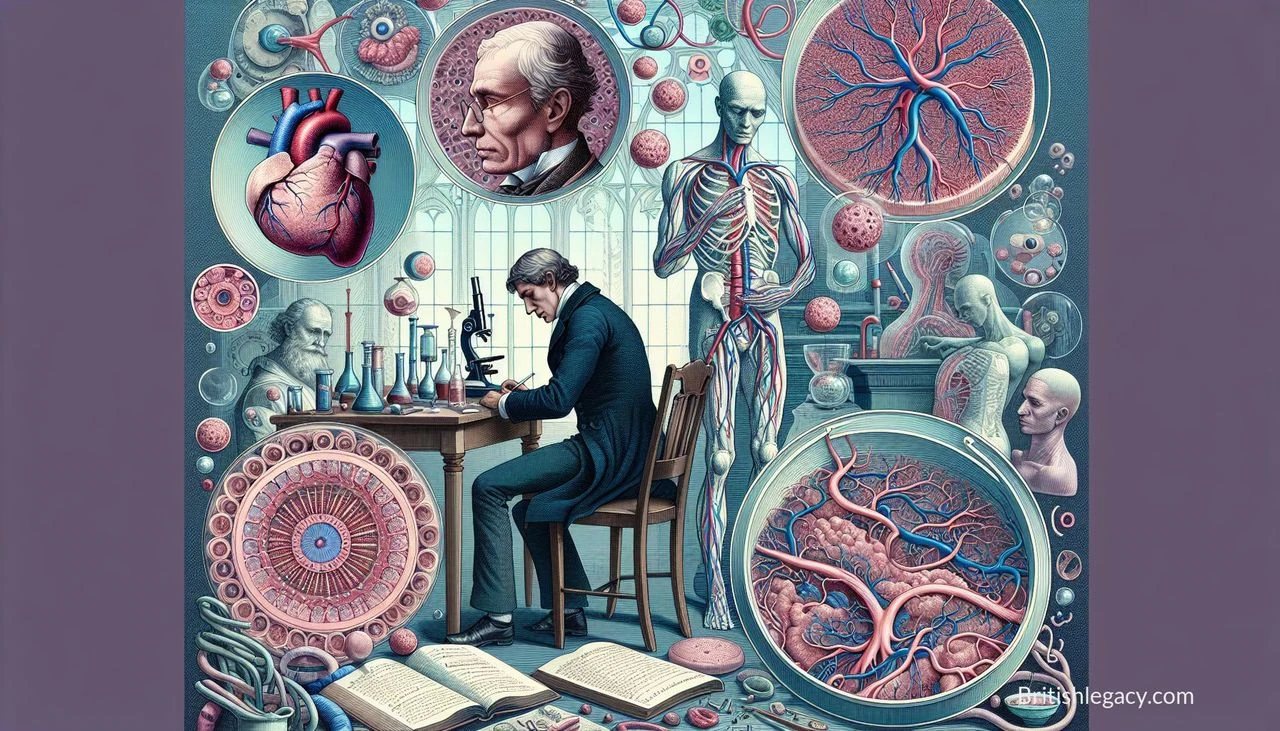
The physician from Folkestone who made the movement of blood a question of observation, experiment and proof.
Read the entry
The English physicist whose X-ray measurements gave atomic number a firm physical basis.
Read the entry