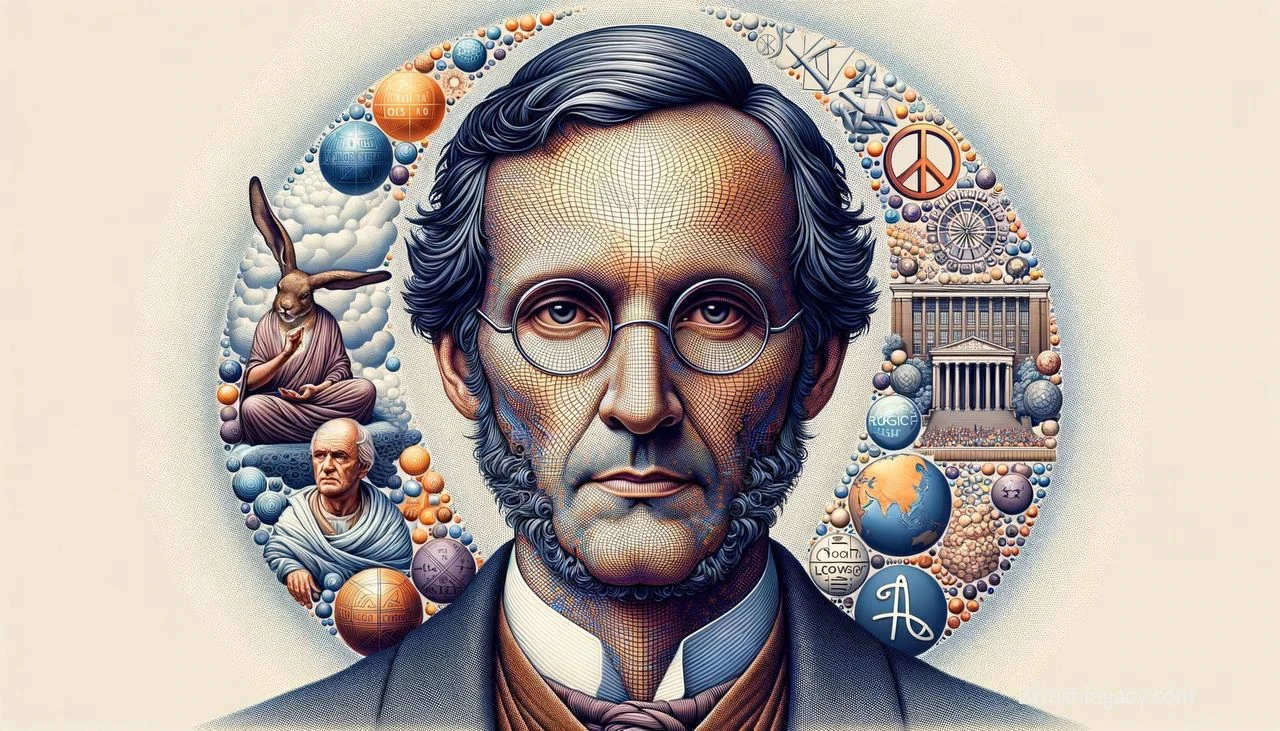
Bertrand Russell made precision a public matter. In philosophy, he pressed arguments towards exact language and explicit reasoning; beyond the university, he wrote for general readers, spoke to the nation on the BBC and campaigned against war and nuclear weapons. His work in logic and the foundations of mathematics helped establish analytic philosophy, while his 1905 essay On Denoting showed how careful analysis could resolve a puzzle about language. Russell’s career joined technical inquiry to an unusually broad engagement with the world around him.
A childhood shaped by books and mathematics
Bertrand Arthur William Russell was born on 18 May 1872 in Trellech, Monmouthshire, into an aristocratic family with political connections. Orphaned while still young, he was brought up largely by his grandmother, Frances, at Pembroke Lodge in Richmond Park. His early life combined privilege with grief and solitude. Books and mathematics became important to him, and an introduction to Euclid by his brother proved decisive: geometry offered a form of reasoning whose certainty did not depend on custom or authority.
Russell went up to Trinity College, Cambridge, in 1890 to study mathematics and philosophy. There he encountered British Idealism, a major philosophical tendency that sought to understand reality through large, interconnected metaphysical systems. Russell initially absorbed this outlook, but came to resist its expansive abstractions. With G. E. Moore, and in intellectual exchange with Alfred North Whitehead, he helped turn British philosophy towards analysis: separating claims into their constituent parts and asking what, precisely, they asserted.
This was not simply a preference for a spare style. Russell argued that philosophical clarity could reveal when a question rested on a confusion in language or reasoning. His approach helped make analysis a defining feature of twentieth-century philosophy in Britain and the English-speaking world. It also established a demanding standard: a claim should be examined, not accepted because it sounds profound or comes from an authoritative source.
Logic, mathematics and a paradox
Russell’s work in logic grew from the ambition to show how mathematics could be grounded in logical principles. In The Principles of Mathematics (1903), he set out this project. He then worked with Whitehead on the three-volume Principia Mathematica, published between 1910 and 1913. The work attempted to build mathematics from explicitly stated logical foundations, rather than leaving its basic assumptions unexamined.
The effort was shaped by a difficulty Russell helped expose. His paradox challenged naive set theory by asking whether the set of all sets that do not contain themselves contains itself. If it does, it should not; if it does not, it should. The contradiction revealed that apparently straightforward ways of talking about sets could lead to trouble at the foundations of mathematics. Russell’s theory of types was one response, designed to avoid such contradictions by imposing restrictions on how sets and other logical objects could be treated.
Principia Mathematica did not settle every foundational question. Later results, including Gödel’s incompleteness theorems, showed limits to what formal systems of this kind could establish. That qualification matters: Russell and Whitehead’s achievement was not a final proof that every mathematical truth could be derived from logic. Their work helped create modern mathematical logic as a distinct and highly exact field, and made foundational questions impossible to ignore. The importance of the project lies in its ambition, its technical influence and the scrutiny it brought to the language of mathematics.
Russell’s impact was not confined to mathematical logic. His insistence that symbolic form matters helped shape later work in areas including formal semantics and theoretical linguistics. The broader reach of his method is equally significant: careful distinctions can expose the assumptions hidden inside an argument, whether the subject is a mathematical foundation or a claim about the world.
What a sentence says
In On Denoting, published in 1905, Russell applied logical analysis to ordinary language. He considered how a sentence can seem to refer to something that does not exist. His familiar example was the statement that the present King of France is bald. There was no present King of France for the sentence to describe, yet it appeared to make a meaningful claim.
Russell’s answer was to distinguish a sentence’s grammatical appearance from its logical structure. A phrase can look like the name of an object without functioning as a straightforward name. By analysing the proposition as a whole, he could explain how a statement of this kind might be false rather than meaningless. The solution became known as the theory of descriptions.
The example mattered because it illustrated a method, not because philosophers needed a special theory of bald kings. Russell asked what a proposition commits its speaker to, and what its parts are doing. His approach influenced the philosophy of language, logic, metaphysics and epistemology. Ludwig Wittgenstein’s early work developed in conversation with Russell’s search for logical clarity; later philosophers often disputed Russell’s answers while retaining the sharpness with which he framed the questions.
Russell’s work made clarity more than a matter of style. If a debate depended on a sentence being read in a misleading way, analysing its structure could change the problem itself. That is one reason his influence extended well beyond the specific arguments he advanced. He encouraged philosophers to treat language as something to investigate and to regard the exposure of confusion as a genuine intellectual result.
Writing for readers beyond Cambridge
Russell produced technical philosophy, but he also wrote extensively for general readers. More than seventy books are associated with his career, covering philosophy, science, history and questions of personal and social life. Among the works supplied here are The Problems of Philosophy, The ABC of Atoms, The ABC of Relativity, The Conquest of Happiness and A History of Western Philosophy.
Published in 1945, A History of Western Philosophy became an international bestseller and brought Russell financial independence later in life. Its success reflected an important part of his public achievement: he could address complicated ideas directly without making them merely simplistic. His writing combined argument with a distinctive wit, and helped bring philosophical discussion to readers who were not specialists.
In 1950, Russell received the Nobel Prize in Literature. The award recognised his varied and significant writings in which he championed humanitarian ideals and freedom of thought. He was not honoured as a novelist or poet, but as a writer whose philosophical and public prose had reached a wide audience. The prize recognised the literary force of argument when it is made lucid, memorable and accessible.
Education was another area in which Russell tried to put ideas into practice. In 1927, he and Dora Russell founded Beacon Hill School, an attempt to apply freer and more humane principles to children’s education. The experiment was not presented as a perfect solution; it reflected Russell’s interest in how society shapes character and in the effects of fear and dogma. He was prepared to test educational ideas in an institution, rather than confining them to argument on the page.
His public engagement with questions of freedom and social organisation also reached a national audience through the BBC. In 1948, Russell delivered its inaugural Reith Lectures, later published as Authority and the Individual. He examined the tension between individual initiative and the cohesion societies need to function. The lectures carried his interest in liberty, institutions and responsibility beyond the university and into the homes of listeners across Britain.
Conscience, war and nuclear protest
During the First World War, Russell opposed the conflict and campaigned against it. His pacifist activity brought him into conflict with wartime regulations: he was convicted, lost his lectureship at Trinity College and, in 1918, served a prison sentence in Brixton. While in prison he wrote Introduction to Mathematical Philosophy. His opposition to war had consequences for his work and standing, rather than remaining an abstract position.
Russell’s views on war were not an unchanging commitment to absolute pacifism. In the face of Hitler and the prospect of a Europe dominated by Nazi Germany, he concluded that war could be the lesser of two evils. He later described his position as relative political pacifism. That change forms part of the record of a thinker trying to make moral judgements under changing circumstances; it would misrepresent his political life to suggest that he held an uncomplicated, identical position in every crisis.
After the Second World War, Russell became a prominent British voice warning about the danger of nuclear weapons. In 1955, he was associated with the Russell–Einstein Manifesto, which urged people to confront the consequences of weapons of mass destruction. The manifesto helped lead to the Pugwash movement. Russell later became the first president of the Campaign for Nuclear Disarmament (CND), and supported more direct protest through the Committee of 100 when he judged conventional campaigning insufficient.
His activism brought the possibility of arrest into his later life. Russell’s public argument against nuclear catastrophe drew on a conviction that scientific and technical power carried political responsibilities. The contrast with his work in logic is striking, but the underlying habit was related: claims about the consequences of policy should be tested against what they mean in practice. He did not regard scholarship as a reason to withdraw from urgent public questions.
Across these different roles, Russell’s contribution was not that he always reached an uncontested answer. It was that he carried inquiry into public life, where conclusions could be challenged and positions revised. His philosophical precision, public writing and protest belonged to a career in which reason was meant to inform decisions, not merely decorate them.
Why Bertrand Russell deserves a place in British Legacy
Bertrand Russell deserves a place in British Legacy because his work altered both the practice of philosophy and the range of people who could take part in it. At Cambridge, he helped drive British thought away from sweeping but imprecise systems and towards arguments whose structure could be examined. His work with Whitehead, his response to the paradox that bears his name and his theory of descriptions all helped establish a more exact approach to logic, mathematics and language. He did not settle every question, but he made foundational assumptions visible and gave later thinkers tools—and problems—that remain part of intellectual life.
His British legacy also lies in the connections he made between ideas and public responsibilities. Russell wrote books that brought difficult subjects to general readers, received the Nobel Prize in Literature for writings championing humanitarian ideals and freedom of thought, and delivered the BBC’s inaugural Reith Lectures. He opposed the First World War at personal cost, later revised his position on war in response to political circumstances, and spent his later years campaigning against nuclear danger. These are specific contributions, not a general claim that he embodied Britishness. Together, they show a British thinker carrying rigorous argument from Cambridge into publishing, broadcasting, education and national debate. His example remains useful because it joins intellectual discipline with a willingness to test ideas against public consequences.