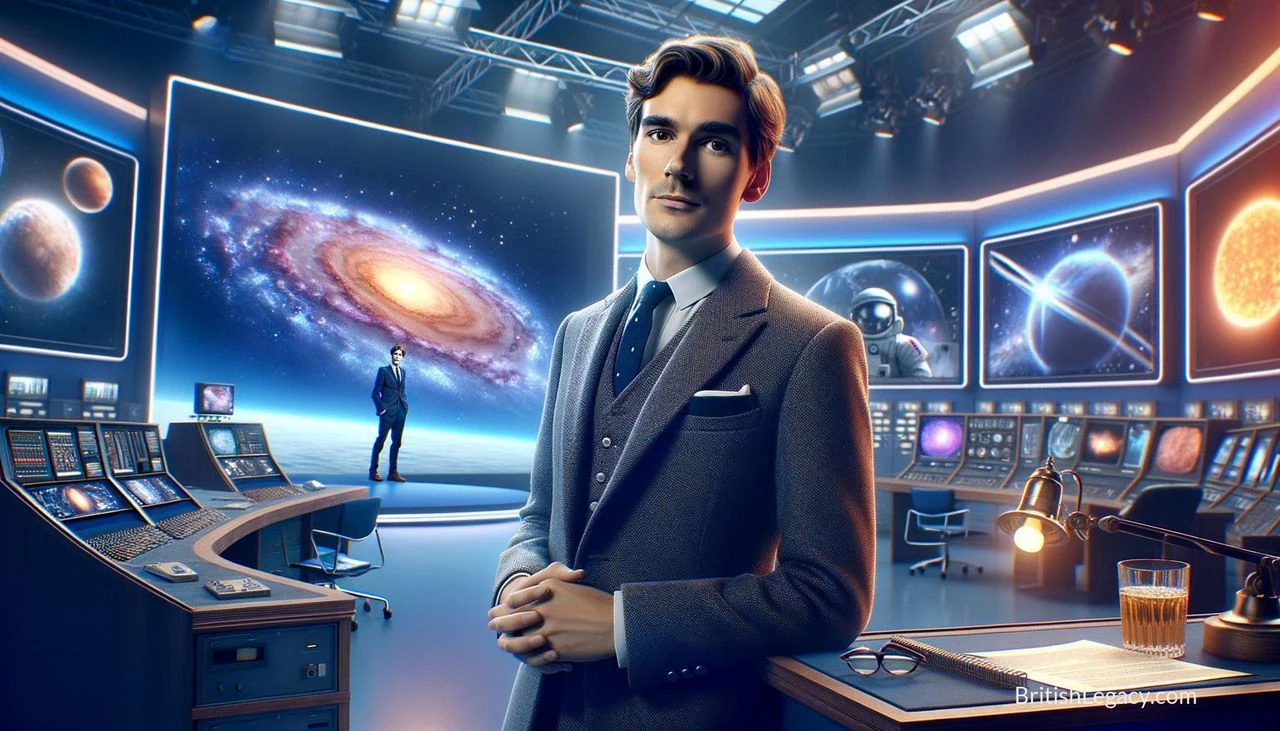
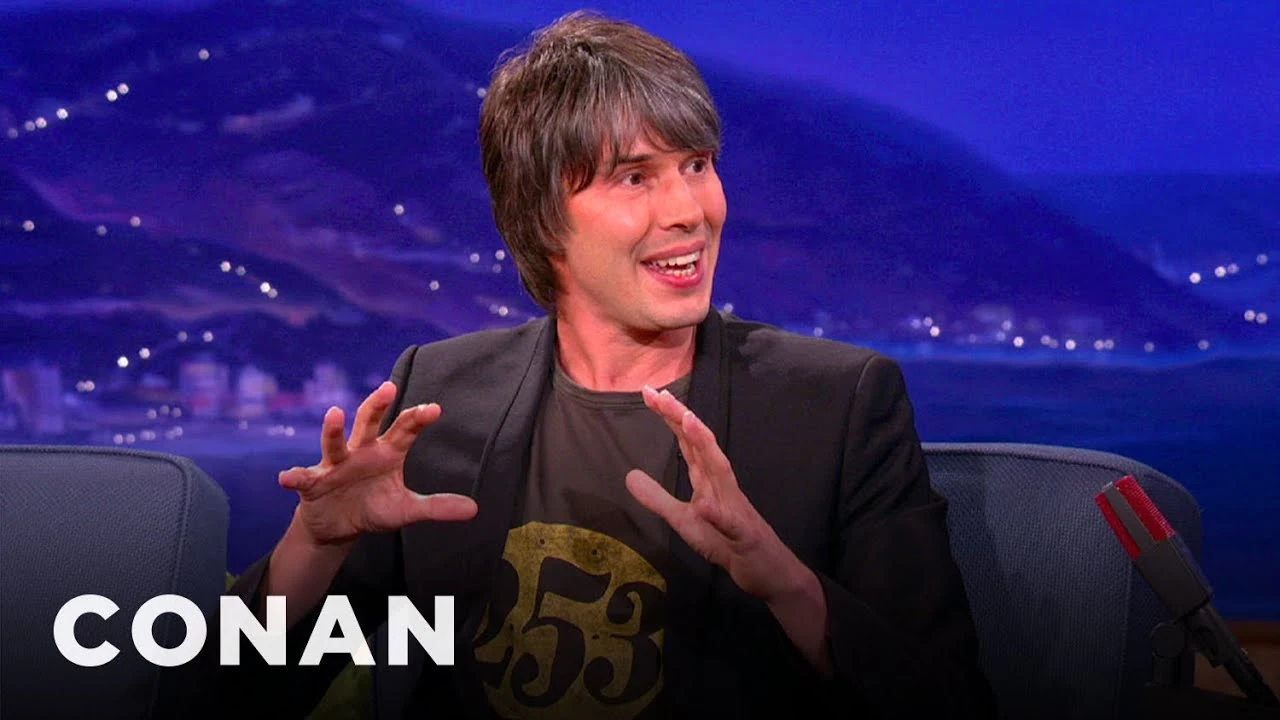
Brian Cox’s route to science communication ran through two very different kinds of stage. Before he became a familiar presenter of BBC programmes about the universe, he played keyboards with rock band Dare and pop group D:Ream. Alongside music, he studied physics at the University of Manchester; after completing a doctorate in high-energy particle physics, he worked on CERN’s Large Hadron Collider. His career has joined research to broadcasting without making one a footnote to the other.
Music alongside physics
Cox was born in Oldham on 3 March 1968. He attended Hulme Grammar School and later studied physics at the University of Manchester. The musical chapter began before his academic work was complete: during the 1980s and early 1990s he played keyboards for Dare, appearing on the band’s albums Out of the Silence (1988) and Blood from Stone (1991). He subsequently worked as a live and session keyboardist for D:Ream.
That move between music and university was not simply a change of identity. Cox earned a first-class BSc in physics in 1995 while still involved in music. D:Ream disbanded in 1997, and he completed his PhD the following year. His thesis, Double Diffraction Dissociation at Large Momentum Transfer, concerned high-energy particle physics and was supervised by Robin Marshall. The research was based on work on the H1 experiment at DESY’s HERA accelerator in Hamburg.
The sequence matters: Cox did not leave physics for a later return to it, nor did he become an academic only after a successful broadcasting career. His degree and doctoral research developed alongside and after his years as a working musician. The contrast between those fields would later make a neat headline, but the underlying story is one of sustained work in both.
Research at Manchester and CERN
Cox is a particle physicist at the University of Manchester, where he is a professor in the Department of Physics and Astronomy. His research career has also included work at CERN and DESY. At CERN, near Geneva, he worked on the ATLAS experiment at the Large Hadron Collider. He previously held a Royal Society University Research Fellowship and an advanced research fellowship from the Particle Physics and Astronomy Research Council.
Those roles place his public explanations of particle physics in the context of professional research rather than presenting him simply as a television personality. His academic work has included supervising or co-supervising doctoral students, among them Tamsin Edwards. He has also written books with fellow physicists: Why Does E=mc? (And Why Should We Care?) and The Quantum Universe with Jeff Forshaw, and several books accompanying television series with Andrew Cohen.
The supplied record of Cox’s research identifies his work on ATLAS, but does not establish a specific personal role in the discovery of the Higgs boson. His contribution is better described precisely: he worked on the experiment, while his research and public communication have helped bring particle physics into wider view.
Making science a broadcast subject
Cox’s television work grew into a substantial body of programmes for the BBC. In 2010 he presented the five-part Wonders of the Solar System; a four-part follow-up, Wonders of the Universe, began in 2011. He went on to present Wonders of Life, which he described as a physicist’s perspective on life and natural history, and later series including Human Universe, Forces of Nature and The Planets. The programmes made scientific subjects the focus of prime-time factual television, rather than restricting them to specialist audiences.
His broadcasting has not been confined to television. Since 2009 he has co-presented BBC Radio 4’s The Infinite Monkey Cage with comedian Robin Ince, a science programme that uses conversation and comedy alongside scientific discussion. He has also appeared in BBC radio and television programmes including Horizon, presented the live astronomy series Stargazing Live with Dara Ó Briain, and contributed to BBC Bitesize revision programmes. In Science Britannica, he explored the contribution of British scientists over several centuries and the relationship between science and public understanding.
Other work has carried science communication into different settings. Cox has given talks at TED and delivered the Royal Television Society’s 2010 Huw Wheldon Memorial Lecture, addressing how television covers science and science news. He served as science adviser on the science-fiction film Sunshine, discussing scientific accuracy in the DVD commentary. His popular-science books, including Wonders of the Solar System, Human Universe and Black Holes: The Key to Understanding the Universe, extend that explanatory work beyond the screen.
Recognition and public engagement
Recognition for Cox’s communication has come from scientific and broadcasting institutions. He received the Institute of Physics’ Kelvin Medal and Prize in 2010 for communicating the appeal and excitement of physics to the public, and the Royal Society’s Michael Faraday Prize in 2012 for science communication. In 2011, the Royal Television Society recognised Wonders of the Universe with awards for Cox as presenter and for science or natural-history programming. He was elected a Fellow of the Royal Society in 2016.
His honours include appointment as an Officer of the Order of the British Empire in 2010 for services to science, followed by promotion to Commander in 2020 for services to the promotion of science. He has also received honorary degrees, including awards from the University of Huddersfield and the Open University in 2012. These distinctions recognise different aspects of the same career: research, teaching and the work of making scientific ideas accessible to people beyond universities and laboratories.
Music remains part of that career rather than a discarded prelude. Cox has continued to perform occasionally, including guest appearances with New Order and D:Ream. His path between the two disciplines is unusual, but it has not required him to choose between them: he has remained an academic physicist while appearing regularly in public as a presenter and performer.
Why Brian Cox deserves a place in British Legacy
Brian Cox’s British legacy rests on a combination of work with a clear national setting and an unusually public form of scientific communication. Born in Oldham and educated at Hulme Grammar School and the University of Manchester, he went on to conduct research associated with Manchester, CERN and DESY. His work on CERN’s ATLAS experiment connects him to international particle physics; his university career, books and BBC programmes have made scientific subjects part of British public life. That record is more concrete than broad claims that he represents a national character: it shows a researcher and teacher making science visible through institutions and media audiences in Britain.
His programmes have taken subjects from the Solar System and the universe to life, natural history and the forces of nature, while The Infinite Monkey Cage has brought science into a conversational radio format. Awards from the Institute of Physics and Royal Society, alongside broadcasting recognition and national honours for services to science, reflect the public value placed on that work. Cox’s career also demonstrates how science communication can complement research rather than replace it. From the laboratory and lecture room to television and radio, he has helped audiences encounter physics as a subject to explore. That sustained connection between research, education and public understanding is why his contribution belongs in British Legacy.
Sources
Brian Cox (physicist), revision 1377594720 · Brian Cox (physicist)
Adapted in part from Brian Cox (physicist) by Wikipedia contributors, under CC BY-SA 4.0. Text has been edited and combined with the existing article; this adapted text is shared under the same licence. Contributor history.