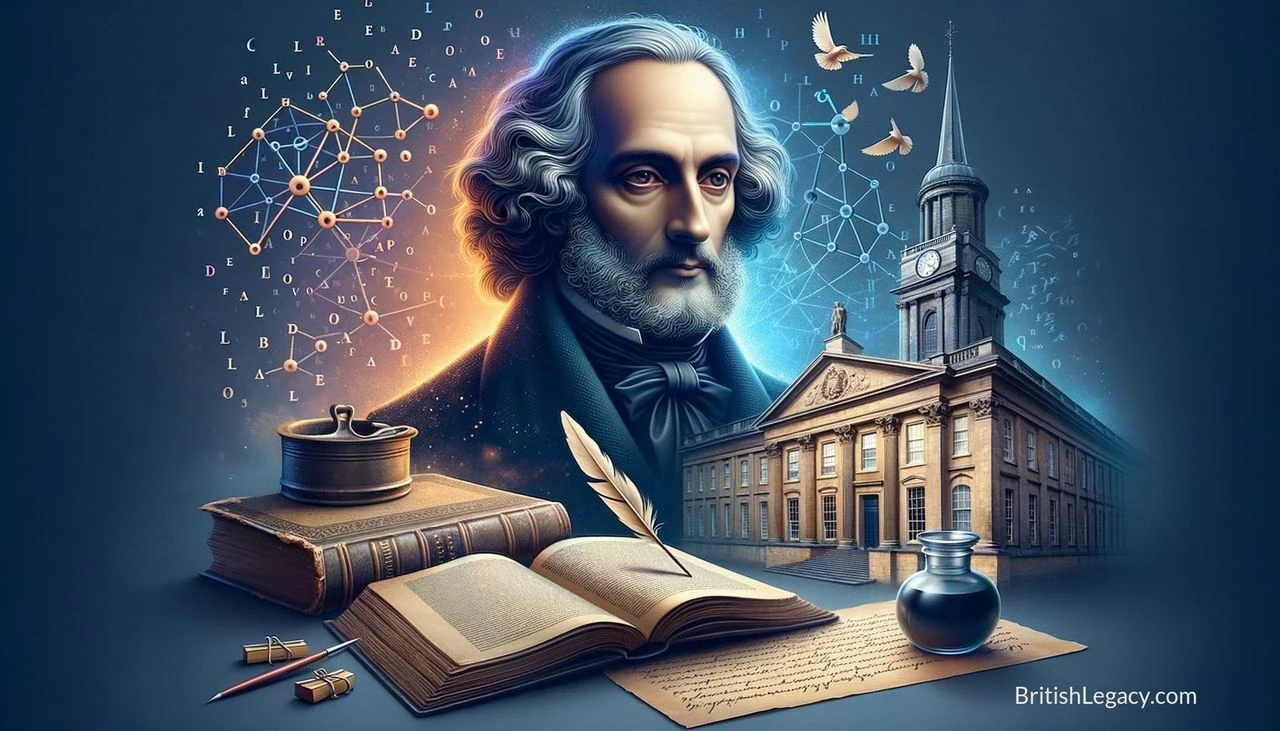
Bertrand Russell helped reshape the study of logic, but he never confined himself to the lecture room. He co-wrote Principia Mathematica, a landmark attempt to establish mathematics on logical foundations; campaigned against war and nuclear weapons; and helped found an experimental school with the writer and campaigner Dora Black. His career connected the rigorous analysis of arguments with an equally persistent interest in how people should live together.
A Cambridge education and a new kind of philosophy
Bertrand Arthur William Russell was born at Ravenscroft, Trellech, Monmouthshire, on 18 May 1872. His grandfather, John Russell, had twice been Prime Minister. Orphaned while still young, Bertrand was raised principally by his grandmother, Frances. He was educated at home, where his brother introduced him to Euclid when he was eleven. Russell later described that encounter as one of the great events of his life.
In 1890 he won a scholarship to Trinity College, Cambridge, to study mathematics. He graduated with first-class honours in mathematics in 1893 and became a Fellow of Trinity in 1895. At Cambridge he turned increasingly towards philosophy, first engaging with British idealism and then rejecting it. With the philosopher G. E. Moore, he became associated with a revolt against idealist approaches to knowledge and reality. Russell’s preferred tools were careful argument and logical analysis: he wanted philosophical problems broken down into their simplest parts.
That approach took shape in his work on the foundations of mathematics. The Principles of Mathematics, published in 1903, advanced the view that mathematics could be derived from logic. In 1905, his essay “On Denoting” offered an influential analysis of how sentences containing descriptions work. His treatment of the sentence “The present king of France is bald” showed how a statement could be meaningful even when its apparent subject did not exist. The essay became a major contribution to the philosophy of language.
Russell’s ideas about logical atomism also sought to analyse complex propositions into simpler ones, while his thinking changed over time. His work was not a single settled system, but an ongoing attempt to clarify what can be said and what grounds our claims to knowledge.
Principia Mathematica and the limits of logic
Russell’s best-known technical collaboration was with his former teacher Alfred North Whitehead. Their three-volume Principia Mathematica appeared between 1910 and 1913. It set out an ambitious formal system intended to show how mathematics could be built from logical principles. Its dense arguments made it a demanding work, but it became a milestone in the development of mathematical logic.
The project grew from Russell’s investigation of set theory and the foundations of arithmetic. In the course of this work he identified a contradiction in a basic assumption about classes, now known as Russell’s paradox. His attempt to address such problems contributed to the development of the theory of types. Principia Mathematica did not settle every question it raised: its original plan for a fourth volume on geometry was never completed, and later work showed that its formal system could not decide every mathematical proposition. Its importance lies partly in the scale of the attempt and partly in the questions that attempt exposed.
Russell also wrote for readers beyond specialist philosophy. His books included The Problems of Philosophy, The ABC of Atoms, The ABC of Relativity and A History of Western Philosophy. Through books, essays and broadcasts, he made philosophical and scientific questions part of public discussion. He was a prolific writer, producing more than sixty books as well as a large number of articles, pamphlets and letters.
War, imprisonment and changing political judgements
Russell’s public convictions brought him into conflict with institutions as well as ideas. During the First World War, he campaigned against Britain’s participation. His opposition cost him his Trinity fellowship in 1916, and a conviction that year brought a fine. In 1918, after a further prosecution over his public opposition to the United States entering the war, he was imprisoned for six months in Brixton Prison. He used the time to read and write, including work on mathematical philosophy.
His pacifism was not an unchanging refusal to distinguish between conflicts. Before the Second World War he supported appeasement, but by 1940 had concluded that Hitler had to be defeated to preserve democracy. He later described his position as “relative political pacifism”: war remained a great evil, but in extreme circumstances could be the lesser of two evils. The change illustrates a recurring feature of Russell’s politics: he continued to revise positions as he weighed principles against events.
After the Second World War, nuclear weapons became a central concern. Russell initially made arguments about the possible diplomatic use of the United States’ atomic advantage, a position that has been interpreted in different ways. He subsequently advocated the abolition of nuclear weapons. In 1955, he and Albert Einstein issued the Russell–Einstein Manifesto with nine other scientists and intellectuals, warning of the dangers of nuclear war. The manifesto helped lead to the Pugwash Conferences on Science and World Affairs. Russell became the first president of the Campaign for Nuclear Disarmament, and later supported direct protest through the Committee of 100. In 1961, he was imprisoned for a week after refusing to call off a demonstration against nuclear weapons.
His interventions extended beyond disarmament. Russell opposed imperialism, chaired the India League from 1932 to 1939, and criticised the United States’ involvement in the Vietnam War. He and Jean-Paul Sartre organised the Russell Tribunal, which examined allegations of war crimes in Vietnam. His views were not always consistent across his long life, and his political record is best understood as a sequence of arguments and shifts rather than a fixed platform.
Beacon Hill and education
Russell’s interest in education became especially practical after the birth of his children. He and Dora Black, whom he married in 1921, were dissatisfied with traditional schooling and also saw shortcomings in progressive education. In 1927 they founded Beacon Hill School, an experiment in education that reflected their interest in children’s intellectual and emotional development. The school operated at several locations, beginning at the Russells’ home, Telegraph House, near Harting in West Sussex.
Russell set out his educational ideas in On Education, Especially in Early Childhood, published in 1926. He argued for an approach that made room for curiosity and individual development rather than relying on rote learning and conformity. The school was not a permanent institution: after Russell left in 1932, Dora continued to run it until 1943. Its significance lies in the attempt to put educational convictions into practice, not in a claim that one school transformed education by itself.
Russell’s family life and his public writing were closely intertwined. His second marriage ended in divorce in 1935, and his later career included further marriages and a growing public profile. He lectured, wrote and broadcast on subjects ranging from philosophy and religion to politics and social questions. In 1948 he delivered the BBC’s inaugural Reith Lectures, “Authority and the Individual”, examining the relationship between personal initiative and social organisation.
Honours, Wales and his final years
Russell’s achievements received formal recognition. He was elected a Fellow of the Royal Society in 1908, received the Order of Merit in 1949 and won the Nobel Prize in Literature in 1950. The Nobel citation recognised his varied writings in which he championed humanitarian ideals and freedom of thought. Other honours included the De Morgan Medal and the Sylvester Medal for mathematical work, the Kalinga Prize and the Jerusalem Prize.
He became the third Earl Russell after his elder brother’s death in 1931 and held a seat in the House of Lords. In later life he lived at Plas Penrhyn, near Penrhyndeudraeth in Wales. He died there on 2 February 1970, aged 97. His final political statement, issued days before his death, condemned Israeli actions in the Middle East. His ashes were later scattered over the Welsh mountains.
Why Bertrand Russell deserves a place in British Legacy
Russell belongs in British Legacy because his work joined two forms of influence that are often treated separately. In logic and philosophy, he helped establish analytic methods that demanded clarity about the structure of arguments. His collaboration with Whitehead on Principia Mathematica was a formidable attempt to clarify the foundations of mathematics, while his work on descriptions and logical analysis shaped later philosophical debate. He also made complex questions accessible to general readers through books, essays and broadcasting. His British significance is not simply that he was born into a prominent family or held an inherited title: his intellectual career was formed in institutions including Trinity College, Cambridge, and the London School of Economics, and became part of the country’s public life.
His legacy also rests on the uses to which he put his public standing. His opposition to the First World War led to dismissal and imprisonment; decades later, his work on nuclear disarmament helped give a new international movement a public voice. Through the Russell–Einstein Manifesto and the Campaign for Nuclear Disarmament, he pressed scientists, politicians and citizens to confront the consequences of nuclear weapons. Beacon Hill School, meanwhile, made education a practical concern as well as a subject for books. Russell could be controversial, and his political judgements changed. That complexity is part of the record: he argued publicly, revised some positions and remained engaged with questions of liberty, education and the risks governments posed to human life.
Sources
Adapted in part from Bertrand Russell by Wikipedia contributors, under CC BY-SA 4.0. Text has been edited and combined with the existing article; this adapted text is shared under the same licence. Contributor history.