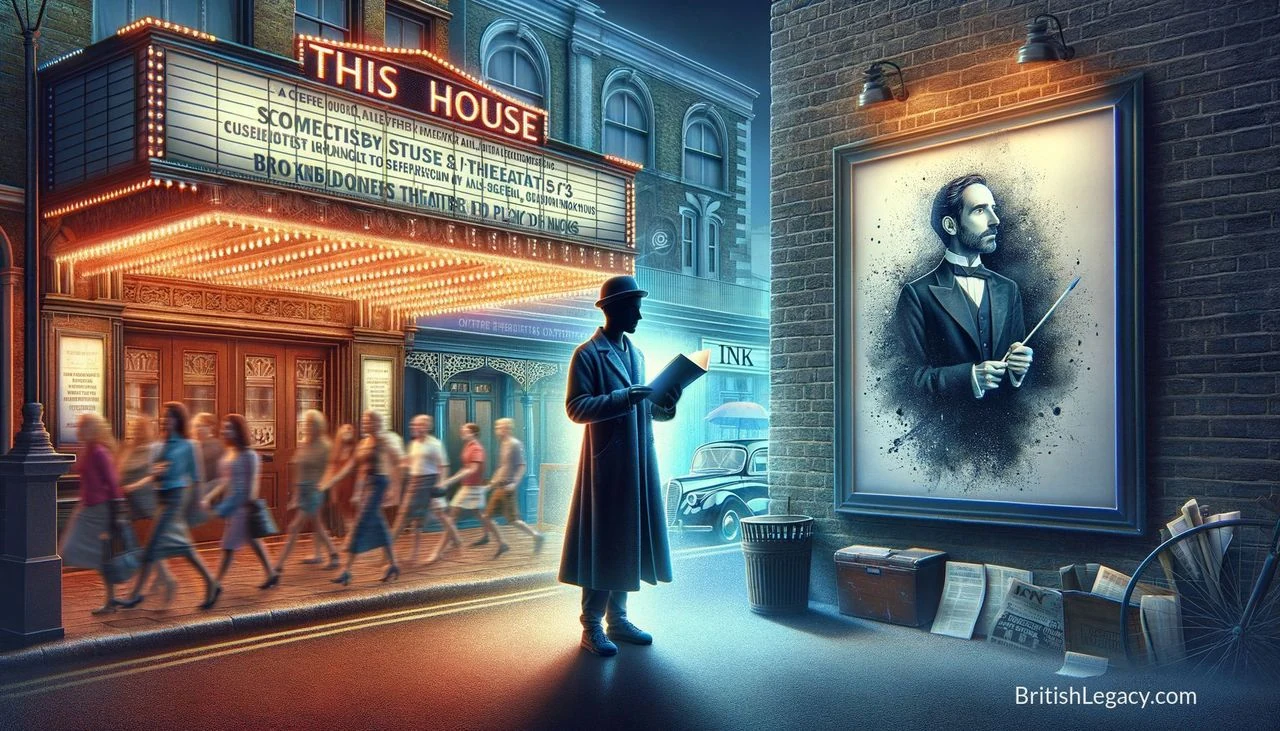
James Graham writes about institutions under pressure: a hung parliament counting votes, a newspaper changing hands, a football manager trying to steady a team. His plays and screen work turn public events into human conflict, bringing the people who make decisions—and those affected by them—into the same dramatic frame. From the National Theatre production of This House to television dramas including Brexit: The Uncivil War and Sherwood, his career has moved between stage and screen while remaining closely engaged with British political and social life.
Growing up in Nottinghamshire
Graham was born in Mansfield, Nottinghamshire, on 8 July 1982, and grew up in Kirkby-in-Ashfield. He attended Ashfield School before studying drama at the University of Hull. His early professional play, Albert’s Boy, was produced at the Finborough Theatre in west London, where he became playwright-in-residence. The Finborough also staged Eden’s Empire, Little Madam and Sons of York, as Graham developed a body of work across historical and contemporary subjects.
His early plays also reached other stages around the country. Tory Boyz premiered at Soho Theatre; A History of Falling Things was produced by Clwyd Theatr Cymru; and The Whisky Taster opened at the Bush Theatre. These productions established a varied career rather than a single-track route into political drama. Graham wrote for different companies and settings, including the National Theatre Connections programme, and continued to test how public questions could be shaped into theatrical stories.
Parliament becomes theatre
This House, commissioned by the Royal National Theatre, brought Graham’s interest in political machinery into the Commons. It premiered at the National Theatre in 2012, portraying the Labour government’s precarious position between 1974 and 1979. The play focuses on close votes, parliamentary tactics and personal manoeuvring during a period in which no party had a secure majority. Rather than treating procedure as background, Graham makes the work of MPs, whips and backbenchers the source of dramatic pressure.
The production transferred to the larger Olivier Theatre and received an Olivier Award nomination for Best New Play. A revival in 2016 ran first in the West End and then on a national tour. In 2019, a public vote organised by Bloomsbury Publishing named it Play of the Decade in its “60 Years of Modern Plays” poll. Its continued life on stage reflects the usefulness of Graham’s approach: parliamentary arithmetic may be specific to its moment, but the people trying to secure a vote give the history its momentum.
Graham returned to Westminster politics in The Vote, staged at the Donmar Warehouse on polling night in 2015, and later in Labour of Love, a comedy about political change and party loyalties. Labour of Love premiered at the Noël Coward Theatre and won the 2018 Olivier Award for Best New Comedy. In the same year, Ink was nominated for Best New Play.
Ink, television and changing audiences
First staged at the Almeida Theatre in 2017, Ink looks back to the late 1960s and the transformation of The Sun under Rupert Murdoch. Its subject is not simply newspaper history: the newsroom offers a setting in which ambition, commercial competition and questions of journalistic conduct can collide. The play transferred to the West End and Broadway. It received an Olivier nomination for Best New Play and Graham’s first Tony Award nomination. A film adaptation, directed by Danny Boyle, is listed among his screen work.
His television writing has also taken up political events directly. The television film Coalition won a Royal Television Society award for Best Single Film. Brexit: The Uncivil War was nominated for a Primetime Emmy Award for Outstanding Television Movie. Graham wrote for The Crown, and adapted his stage play Quiz as a three-part television drama, which aired in 2020. The movement between formats has allowed him to address contemporary politics for audiences beyond the theatre.
In television drama, Sherwood draws on a place and its history to tell a story of division and community. Other screen projects include The Way, Brian and Maggie and Dear England, the television adaptation of his play about England football manager Gareth Southgate. His theatre work has ranged just as widely: Best of Enemies, which moved from the Young Vic to the West End, and Tammy Faye, first staged at the Almeida and later transferred to Broadway, demonstrate the breadth of subjects and forms in his writing.
Recognition, access and new work
Graham’s work has been staged across the UK and internationally, with productions at venues including the Bush, Soho Theatre, Almeida, Royal Court, Liverpool and the National Theatre. He has had multiple plays in the West End and five Broadway productions. His Olivier Awards include Best New Comedy for Labour of Love in 2018, Best New Play for Dear England in 2024 and Best New Play for Punch in 2026. He was elected a Fellow of the Royal Society of Literature in 2018 and appointed OBE in the 2020 New Year Honours for services to drama and young people in British theatre.
Graham has also spoken about who gets the opportunity to work in British television. In the James MacTaggart Memorial Lecture at the 2024 Edinburgh TV Festival, he criticised the lack of opportunities for people from working-class backgrounds, citing a figure of 8 per cent of people in the industry. His lecture led to the development of the Class and Social Equality Working Group, made up of television professionals seeking practical ways to address the imbalance.
Further stage work has continued to bring public figures and institutions into the theatre. Dear England premiered at the National Theatre in 2023, transferred to the West End and went on a UK tour. Punch, first produced at Nottingham Playhouse and the Young Vic in 2024, later opened on Broadway. In 2025, Make It Happen, about former Royal Bank of Scotland chief executive Fred Goodwin and economist Adam Smith, was performed at Dundee Rep and the Edinburgh International Festival. The National Theatre announced that Major, Graham’s play about John Major’s rise to the premiership, would premiere in its spring/summer 2027 season.
Why James Graham deserves a place in British Legacy
James Graham’s place in British Legacy rests on the specificity of the worlds he brings to the stage and screen. This House makes the Commons of the 1970s—not an abstract symbol of government—the setting for a tightly contested human drama. Its transfer to the Olivier, West End and a national tour, followed by its public-vote recognition as Play of the Decade, shows how a detailed account of parliamentary procedure can travel beyond specialist audiences. Ink similarly turns a landmark in British newspaper history into a story about the people and choices behind a changing media institution. Together, the plays make political and historical subjects available as live, contested experience.
His contribution also crosses forms and reaches into the conditions of cultural work itself. Award-winning plays sit alongside television films and series that examine coalition politics, Brexit and communities shaped by industrial and social change. Graham’s MacTaggart lecture and the working group that followed connect his public profile to a practical concern: who is able to enter and remain in British television. This combination of craft, subject matter and attention to access gives his career a distinct British significance. He has made institutions, political choices and their consequences sustained material for popular drama, while arguing that the industry telling those stories should open its doors more widely.
Sources
James Graham (playwright), revision 1378734599
Adapted in part from James Graham (playwright) by Wikipedia contributors, under CC BY-SA 4.0. Text has been edited and combined with the existing article; this adapted text is shared under the same licence. Contributor history.