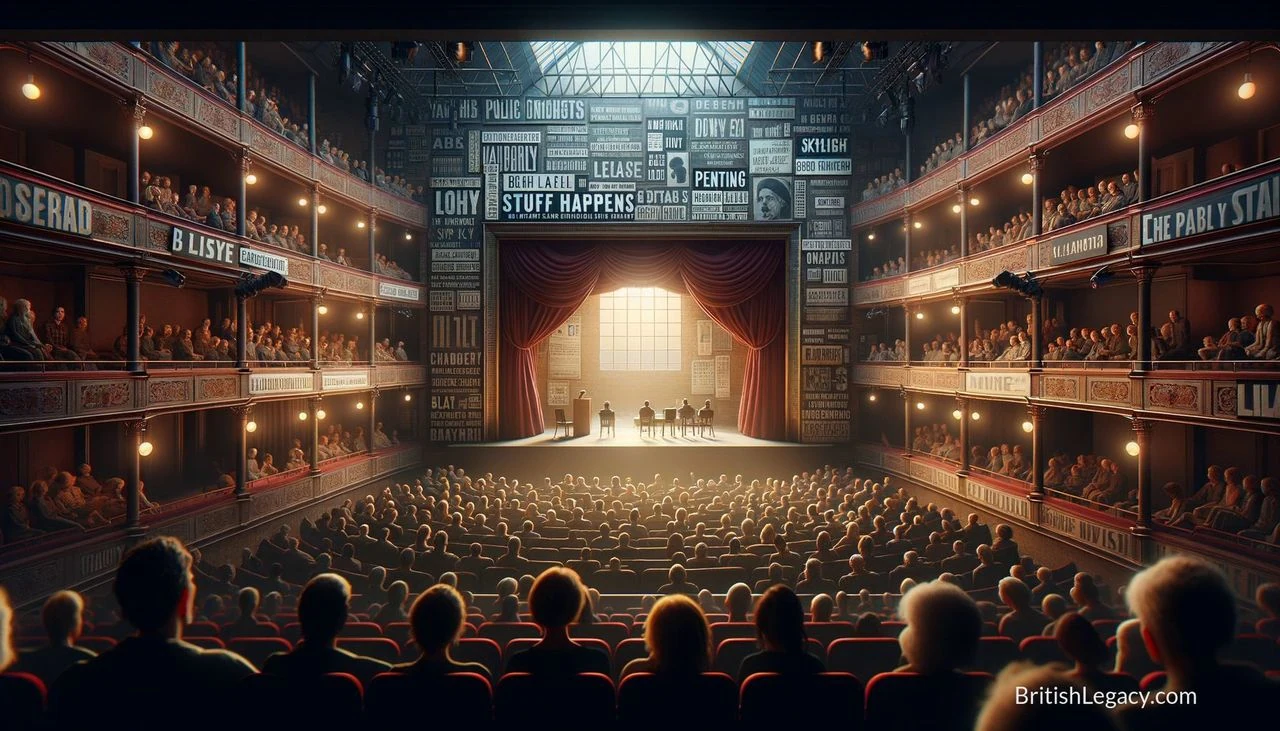
David Hare’s plays make public affairs personal. A political institution, a newspaper empire or an approaching war is not merely a subject to be explained; it becomes a pressure on characters whose private lives are already in motion. From Plenty to Skylight and Stuff Happens, Hare has repeatedly used the stage to examine how people understand their responsibilities, their loyalties and the world around them. His work has also travelled between theatre, film and television, giving a career rooted in British drama a reach well beyond the stage.
From early theatre to the National
Born in St Leonards-on-Sea, Sussex, on 5 June 1947, Hare was educated at Lancing College and Jesus College, Cambridge, where he studied English literature. At Cambridge he took part in the university’s amateur dramatic society. His professional career began with the Portable Theatre Company, which he worked with from 1968 to 1971. His first play, Slag, was produced in 1970, the same year he became resident dramatist at the Royal Court Theatre in London.
After a period as resident dramatist at Nottingham Playhouse, Hare helped found the Joint Stock Theatre Company in 1975 with David Aukin and Max Stafford-Clark. The work of these early years established his interest in theatre as a place to test political and social ideas through drama. Plenty, first produced at the National Theatre in 1978, brought that approach into focus. Its central character, Susan Traherne, is a former secret agent whose wartime sense of purpose cannot easily be carried into post-war life. Hare’s subject is not simply disillusionment: the play sets one person’s fractured expectations against a society adjusting to peace.
Hare’s relationship with the National Theatre developed over decades. He became its associate director in 1984, and many of his plays were produced there. In the 1980s he also wrote for film and founded Greenpoint Films. His screenplays included Wetherby, which he also directed, and adaptations of Plenty and Strapless. Moving between forms did not displace his stage work; it gave him further ways to tell stories about institutions, power and individual choices.
Institutions, conflict and private lives
Some of Hare’s most substantial theatre work examines institutions directly. Racing Demon, first produced at the National Theatre in 1990, concerns the Church of England, including arguments about gay ordination and the role of evangelism in inner-city communities. It won the Laurence Olivier Award for Best New Play. Together with Murmuring Judges and The Absence of War, it forms a trilogy about major British institutions: the Church, the legal system and the Labour Party. Rather than treating institutions as abstractions, these plays explore the people who work within them and the conflict between public purpose and practical limits.
That combination of public argument and intimate drama is also central to Skylight. Hare wrote the play in 1996. It brings together Kyra Hollis, a teacher, and Tom Sergeant, a successful restaurateur, whose former relationship gives their political disagreement personal stakes. Questions of money, work and social responsibility emerge through a reunion, not a debate staged at a distance from ordinary life. In that way, the play makes ideological conflict legible as something experienced between two people.
Hare’s range as a dramatist includes adaptations as well as original plays. His work on Bertolt Brecht’s Mother Courage and Her Children was produced in London in 1995. Other notable plays include A Map of the World, Pravda, Amy’s View, The Permanent Way and The Power of Yes. In Pravda, co-written with Howard Brenton, the target is the newspaper industry of the mid-1980s, including the influence of media ownership. The subjects differ, but a recurring concern is how power is exercised and how people explain or resist it.
From the stage to screen
Stuff Happens, produced in 2004, takes on the events leading up to the Iraq War. The play combines material drawn from public speech with fictionalised scenes. That mixture allows it to dramatise political decision-making while asking what can be known, represented and held to account. Its title refers to a remark by Donald Rumsfeld. The play belongs to Hare’s wider body of work not because it offers an uncomplicated verdict, but because it makes political rhetoric and its consequences available for scrutiny.
Hare’s screenwriting has brought the same interest in public life to film and television. His screenplay for The Hours (2002), adapted from Michael Cunningham’s novel, earned him the Writers Guild of America Award for Best Adapted Screenplay, as well as Academy Award and BAFTA nominations. He was nominated again for those two awards for The Reader (2008). He also wrote and directed the BBC films Page Eight, Turks & Caicos and Salting the Battlefield, known together as the Worricker Trilogy.
Television has offered another setting for his state-of-the-nation stories. Collateral, broadcast by the BBC in 2018, follows the implications of the murder of a pizza delivery driver across a wider community. In the same year, I’m Not Running premiered at the National Theatre, bringing political choice into a story about a local politician. Roadkill, a BBC One series that premiered in 2020, follows a Conservative politician under pressure from political and family life. These projects show the variety of Hare’s work across media, while retaining his attention to how individual decisions intersect with larger systems.
Recognition and continuing work
Hare’s stage writing has received major recognition in Britain and abroad. He won the Olivier Award for Best New Play for Racing Demon in 1990 and for Skylight in 1996. His plays Plenty, Racing Demon and Skylight were also nominated for the Tony Award for Best Play when they reached Broadway. He was elected a Fellow of the Royal Society of Literature in 1985 and was knighted in 1998 for services to theatre.
His work has continued into the 2020s. Straight Line Crazy, about New York urban planner Robert Moses, premiered in London in 2022 before transferring to New York. Grace Pervades, which explores the lives of actors Henry Irving and Ellen Terry and their family, premiered in 2025. These plays look beyond Britain, but continue a career in which theatre serves as a means of examining the uses and limits of power.
Why David Hare deserves a place in British Legacy
David Hare deserves a place in British Legacy because his work has made British public institutions and political arguments subjects of sustained dramatic attention. The trilogy of Racing Demon, Murmuring Judges and The Absence of War turns the Church of England, the legal system and the Labour Party into places where competing responsibilities are lived out. That approach gives audiences more than a list of positions: it shows how public structures depend on people, and how their ideals can be tested by the demands of practice.
His achievement also lies in bringing political questions into close human relationships. Plenty links the aftermath of war with one woman’s loss of purpose; Skylight makes economic and ideological differences part of a former couple’s encounter. Stuff Happens uses public speech and fictional scenes to stage the decisions preceding the Iraq War. Across the stage, cinema and television, Hare has developed different forms for examining how power operates and what follows from its use. His British legacy is therefore not a general claim that theatre changes society, but a substantial body of work that has given audiences ways to question institutions, public language and personal responsibility—and that has carried those questions from British theatres to international screens and stages.
Sources
David Hare (playwright), revision 1371383787
Adapted in part from David Hare (playwright) by Wikipedia contributors, under CC BY-SA 4.0. Text has been edited and combined with the existing article; this adapted text is shared under the same licence. Contributor history.