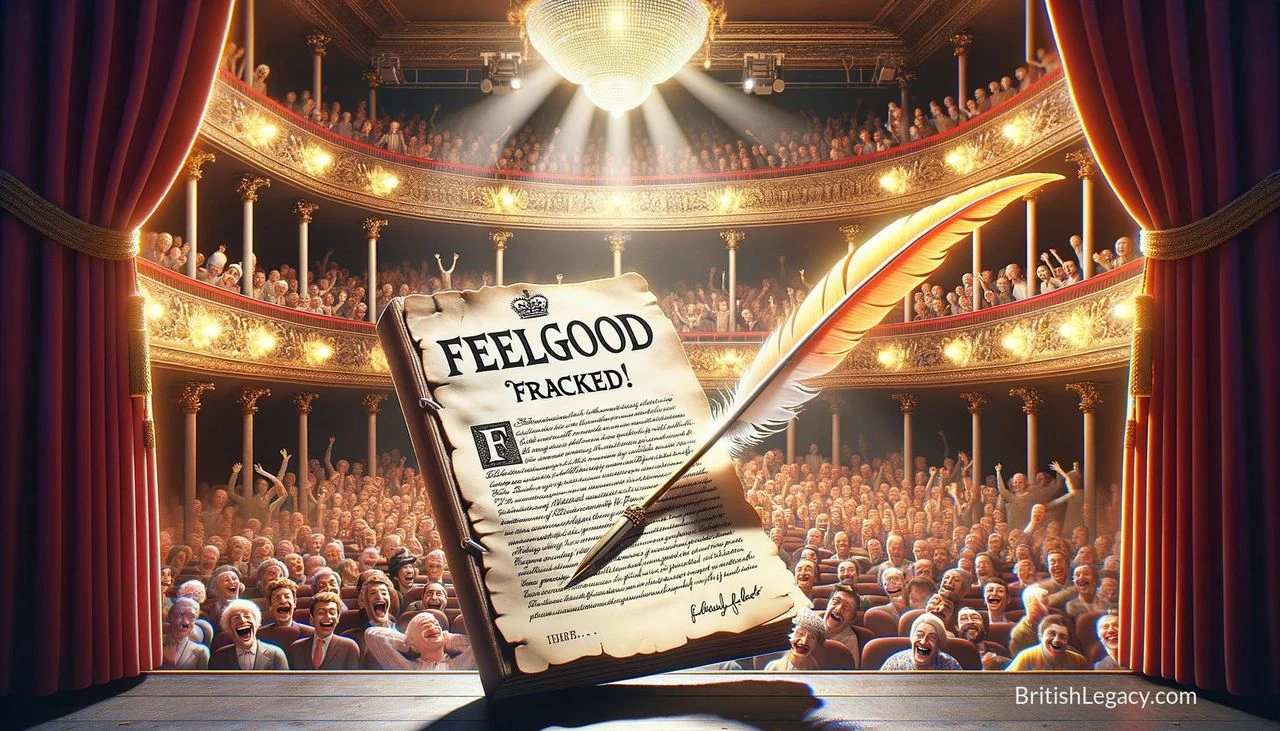
Alistair Beaton has made political language a source of comedy and a subject for scrutiny. A playwright and satirist whose work ranges from the stage to television and radio, he is best known for plays including Feelgood and Fracked: Or Please Don’t Use The F Word. His writing has also taken in novels, translations, musicals and non-fiction, often returning to the ways institutions and their public faces are made.
From Glasgow to political writing
Beaton was born in Glasgow in 1947. He studied at the universities of Edinburgh, Moscow and Bochum, graduating from Edinburgh with first-class honours in Russian and German. His work across languages and forms became a defining feature of his career: he has written for theatre, television and radio, translated plays and published both fiction and political non-fiction.
His subjects have included the language of political management. Beaton was a speechwriter for Gordon Brown at one point in his career, a role that placed him close to the political communication his satire examines. He also wrote a series of books using the word “bollocks” to challenge inflated or empty rhetoric, including The Thatcher Papers (1980), The Little Book of Complete Bollocks (1999), The Little Book of New Labour Bollocks (2000), The Little Book of Management Bollocks (2001) and The Little Book of Brexit Bollocks (2019).
Spin and the theatre
Feelgood, first staged in 2001, is a satire on New Labour spin doctors. Set in the run-up to an election, the play turns political image-making into theatrical conflict, examining how those in power try to shape the story told about them. It won the Evening Standard Award for Best Comedy. The production played at Hampstead Theatre and later transferred to the Garrick Theatre in the West End.
Beaton’s stage writing extends well beyond that single success. With Ned Sherrin, he co-wrote The Ratepayers’ Iolanthe, staged at the South Bank and the Phoenix Theatre in 1984, and The Metropolitan Mikado for the South Bank in 1985. He also co-wrote lyrics with Maya Angelou for King the Musical, which played at the Piccadilly Theatre in 1985.
Later plays took on different political and social subjects. Follow My Leader, a musical about the Iraq War with music by Richard Blackford, was staged at Birmingham Repertory Theatre and Hampstead Theatre in 2004. King of Hearts, a satire on the monarchy, followed at Hampstead in 2007. In Caledonia (2010), a musical satire about the Royal Bank of Scotland and the seventeenth-century Darien Scheme, Beaton brought financial history to the Edinburgh International Festival.
From fracking to the screen
Fracked: Or Please Don’t Use The F Word carried Beaton’s satirical attention to a contemporary argument over energy and climate. The play, staged at Chichester Festival Theatre and taken on a national tour in 2016 and 2017, places debate about fracking on stage. Its title signals Beaton’s interest in the words and evasions used when contentious public issues are discussed.
Other plays have ranged from political leadership to historical and moral questions. The Accidental Leader appeared in the West End in 2016. In 2020, Alone in Berlin was staged by Royal & Derngate and York Theatre Royal. His translations and adaptations include Nikolai Gogol’s The Government Inspector and The Nose, Jacques Offenbach’s La Vie parisienne, and Johann Strauss’s Die Fledermaus. He also adapted Max Frisch’s The Arsonists, Bertolt Brecht’s The Caucasian Chalk Circle and The Resistible Rise of Arturo Ui.
Beaton’s television writing includes Not The Nine O’Clock News, Spitting Image, Downwardly Mobile and A Very Social Secretary. He wrote the screenplay for At Fifty Men Kiss Differently (1998), based on a novel by Dorit Zinn, and later wrote The Trial of Tony Blair (2007). His radio work includes Electric Ink, a BBC Radio 4 series starring Robert Lindsay, and Fourth Column, a BBC Radio 4 programme for writers and journalists. The earlier account of his radio work also names Week Ending and The News Quiz.
Writing across forms and countries
Beaton has written fiction as well as plays and screen work. His novels include Don Juan on the Rocks (1994), Drop the Dead Donkey 2000 (1994), co-written with Andy Hamilton, and A Planet for the President (2004). His work has also crossed into international theatre: his satirical comedy Kardinalfehler, or Cardinal Error, was in repertory at Theater Trier in Germany in 2023.
His work outside writing includes consultancy for Columbia TriStar Pictures from 1991 to 1995 and for the Cologne production of the musical Himmel und Kölle in 2020–21. He also wrote additional lyrics for a 2003 Chichester Festival Theatre production of Gilbert and Sullivan’s The Gondoliers. Beaton lives in London, while his career has taken his plays to theatres across the UK and beyond.
Why Alistair Beaton deserves a place in British Legacy
Beaton’s place in British cultural life rests on the range of his work and the specificity of its subjects. Feelgood takes political spin and image-making as its dramatic material; Fracked brings an argument about energy and climate to the stage. Other plays have examined the monarchy, the Iraq War and the Royal Bank of Scotland. These are not simply topics placed behind a comedy: they are questions about how power is exercised, defended and explained to the public. The Evening Standard Award for Best Comedy for Feelgood also records the recognition that one of these political works received as theatre.
His contribution is not confined to one play or one medium. Beaton has written for British television and BBC radio, published fiction and political books, and translated or adapted European dramatists for the stage. His studies in Russian and German connect directly with a body of translation work that includes Gogol and Brecht, while his British stage writing has moved between London, regional theatres and the Edinburgh International Festival. That combination of political comedy, theatrical craft and work across languages gives his career a distinctive place in the story of modern British writing. It also leaves audiences with a practical reason to revisit his work: the words used to describe public affairs, and the interests those words may conceal, remain fit subjects for scrutiny.
Sources
Alistair Beaton — revision 1376737674 · Alistair Beaton
Adapted in part from Alistair Beaton by Wikipedia contributors, under CC BY-SA 4.0. Text has been edited and combined with the existing article; this adapted text is shared under the same licence. Contributor history.