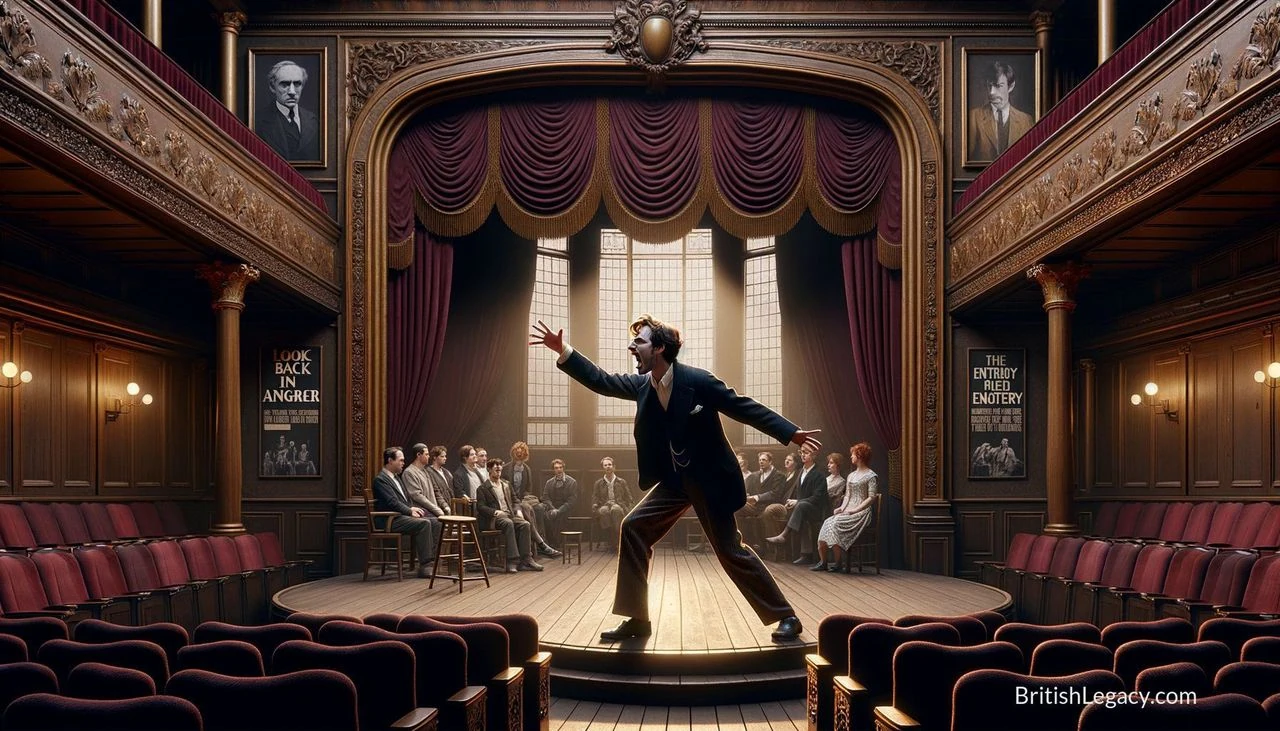
John Osborne’s breakthrough came with a play about a cramped home, a strained marriage and a young man furious with the world. When Look Back in Anger reached the Royal Court Theatre in 1956, its domestic setting and volatile language offered a striking alternative to the more formal conventions of British theatre. Osborne became the most prominent figure associated with the Angry Young Men, but his work ranged from music-hall tragedy to a screenplay that won an Academy Award. His career was restless, politically contentious and difficult to separate from the theatrical changes he helped set in motion.
A route into the theatre
Osborne was born in Fulham, London, on 12 December 1929. His father, Thomas, was a commercial artist and advertising copywriter; his mother, Nellie, worked as a barmaid. After the family moved to Stoneleigh in Surrey, Osborne attended Belmont College in Devon, having received an insurance settlement following his father’s death in 1940. He left the school in 1945 without completing his education there. The details of his departure were later disputed: Osborne said he had been expelled for hitting the headmaster, while another former pupil gave a different account.
After a brief attempt at trade journalism, Osborne found work with a touring company of young actors. He became a stage manager and actor, and began writing plays. His first, The Devil Inside Him, was written with Stella Linden and performed at Huddersfield’s Theatre Royal in 1950. He later worked with Anthony Creighton on Personal Enemy and Epitaph for George Dillon. These early years placed Osborne inside the practical, itinerant world of provincial theatre before national attention arrived.
The anger on the Royal Court stage
Osborne wrote Look Back in Anger in 17 days while performing in Morecambe. Its setting drew on his own experience of living with his first wife, Pamela Lane, in cramped accommodation in Derby. Several London agents rejected the play before George Devine, artistic director of the English Stage Company at the Royal Court, accepted it. Tony Richardson directed the production, which starred Kenneth Haigh, Mary Ure and Alan Bates.
The first-night response was mixed. More favourable reviews from Kenneth Tynan and Harold Hobson, together with a television broadcast of the second act, helped the play find an audience. It moved to the Lyric Theatre in Hammersmith and later to Broadway; a film version followed in 1959, with Richard Burton and Mary Ure. The play earned Osborne the Evening Standard Drama Award as the most promising playwright of 1956.
Jimmy Porter’s arguments gave voice to frustration with class, authority and the apparent narrowness of post-war life. But the play’s importance lies not only in what its central character says. Its domestic setting, emotional directness and forceful language helped establish a new theatrical emphasis on social realism. The phrase “angry young man” was coined by Royal Court press officer George Fearon while promoting the production. It soon became a label for a wider group of writers, rather than a precise description of a single shared programme.
From Archie Rice to international recognition
Osborne’s next major play, The Entertainer, opened in 1957. Laurence Olivier played Archie Rice, a failing music-hall performer whose declining act parallels the fading influence of the music hall itself. Against the background of the Suez Crisis, the play connects that decline with Britain’s diminishing imperial power and the growing cultural influence of the United States. Its mixture of family drama, performance and national unease showed that Osborne’s interests extended beyond the anger of Jimmy Porter.
His writing in the 1960s moved across stage and screen. Luther, first performed in 1961, won the 1964 Tony Award for Best Play. Inadmissible Evidence followed in 1964. Osborne also wrote the screenplay for Tom Jones, the 1963 period comedy based on Henry Fielding’s novel, and received both the Academy Award for Best Adapted Screenplay and the BAFTA Award for Best British Screenplay. His 1965 play A Patriot for Me, drawing on the Austrian Redl case and addressing homosexuality and espionage, became part of a challenge to theatrical censorship under the Lord Chamberlain.
In 1958 Osborne joined Richardson and producer Harry Saltzman in forming Woodfall Film Productions. The company made Richardson’s film of Look Back in Anger and became associated with the British New Wave. Osborne’s screen work included adaptations of The Entertainer and Inadmissible Evidence. His film appearances included the role of gangster Cyril Kinnear in Get Carter (1971), as well as parts in Tomorrow Never Comes and Flash Gordon.
Changing fortunes and a country life
Osborne’s later stage work received a less consistent response. Plays including West of Suez, A Sense of Detachment and Watch It Come Down attracted criticism, and his standing as a playwright no longer rested on a sequence of unchallenged successes. The uneven reception did not mean that he stopped writing. His last play, Déjàvu, returned to Look Back in Anger as a sequel and was staged in 1992.
His public politics also shifted over time. As a young man he was drawn to socialism and took part in the Campaign for Nuclear Disarmament and the Committee of 100, which used civil disobedience to protest against nuclear weapons. His public writing could be fiercely critical of political leaders and the British establishment. Later, commentators noted a more conservative strain in his views and work. Osborne’s politics resisted a simple label, as did the plays themselves: their social criticism coexisted with a powerful sense of attachment to the past.
Osborne married five times. His final marriage was to arts journalist and critic Helen Dawson in 1978. From 1986, they lived in rural Shropshire, where Osborne wrote for The Spectator and opened his garden to raise money for the local church roof. The contrast with Jimmy Porter’s attack on church bells was a pointed one. Osborne also published two volumes of autobiography, A Better Class of Person (1981) and Almost a Gentleman (1991), offering his own account of a turbulent life and career.
Death, writing and remembrance
Osborne died at his home in Clunton, Shropshire, on 24 December 1994, aged 65, from complications of diabetes. He was buried in the churchyard at Clun. His writing career had included plays, screenplays, television work and acting, but the first production of Look Back in Anger remains the event most closely associated with his name.
The continuing record of his work is extensive. The Harry Ransom Center at the University of Texas holds a substantial archive of his papers, including manuscripts, correspondence, articles, programmes and business documents. In 2003, his former home became a residential retreat for writers run by the Arvon Foundation. These are different kinds of afterlife: the preservation of working papers and the practical provision of space for people to write.
Why John Osborne deserves a place in British Legacy
Osborne deserves a place in British Legacy because his work changed what audiences could expect to hear and see on a British stage. Look Back in Anger moved theatrical conflict into a recognisable domestic space and made class, frustration and private relationships central dramatic material. Its Royal Court production did not receive universal acclaim on its first night, but subsequent reviews and performances carried the play well beyond that initial reception. The story captures how theatre can shift not through instant agreement, but through the lasting force of a work that audiences and critics continue to argue over.
His contribution was not confined to one play or one theatrical label. The Entertainer used the declining music hall to examine a nation’s changing cultural and political position; Luther won international recognition on Broadway; and Tom Jones brought Osborne’s writing to film audiences, earning major British and American awards. His work with Woodfall Film Productions also connected his theatre career to the British New Wave. The mixed reception of his later plays is part of the record, not a reason to reduce that achievement. Osborne’s influence is visible in a lasting repertoire of plays, films and writing, and in the continued study of how British theatre represents ordinary lives, public power and social change.
Sources
John Osborne — Wikipedia revision 1379782186
Adapted in part from John Osborne by Wikipedia contributors, under CC BY-SA 4.0. Text has been edited and combined with the existing article; this adapted text is shared under the same licence. Contributor history.