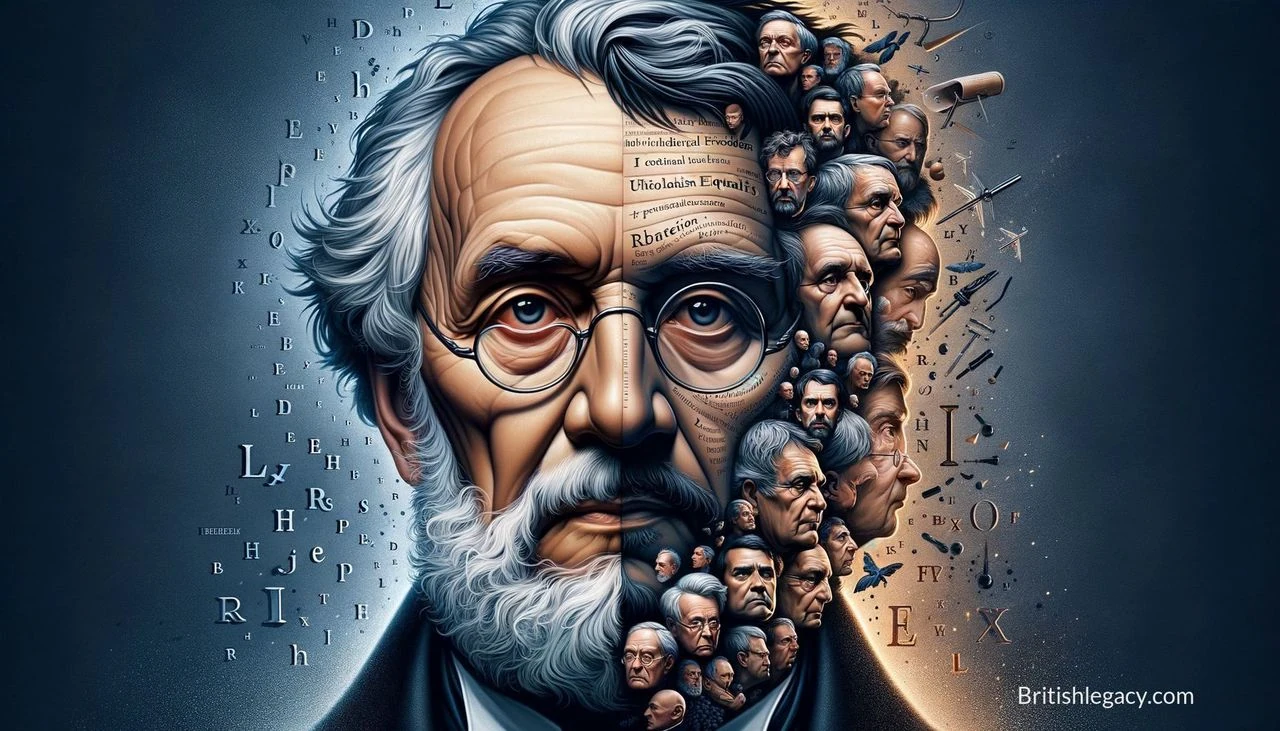
John Stuart Mill’s arguments about free speech and individual liberty were not written from a life apart from public affairs. He worked for the East India Company for 35 years, sat as a Liberal MP for Westminster and served as Rector of the University of St Andrews. His books asked how much power society could rightly exercise over a person; his parliamentary career showed him carrying some of those questions into political argument. His commitment to liberty and equality was forceful, but not universal: his defence of British rule in India remains a significant contradiction in his thought.
A childhood built around ideas
Mill was born in Pentonville, London, on 20 May 1806, the eldest son of James Mill, a Scottish philosopher, historian and economist, and Harriet Barrow. His father, a follower of Jeremy Bentham, set out to educate him with exceptional intensity. Mill later recalled being taught Greek at three and beginning Latin at eight. By then, he had read widely in ancient history; he went on to study logic, mathematics and political economy while still young. James Mill’s ambition was to prepare a mind capable of advancing the utilitarian cause.
This education brought formidable knowledge, but it was also an upbringing organised around discipline and intellectual work. At 14, Mill spent a year in France with the family of Sir Samuel Bentham. He studied science and mathematics in Montpellier, encountered a different social atmosphere and developed a lasting taste for mountain landscapes. The experience widened the world beyond his father’s programme. Mill’s later thought would give more space than that programme did to feeling, character and the varied ways people might live.
In his early twenties, he experienced a mental crisis. As he described it in his Autobiography, he questioned whether achieving the reforms he had been taught to pursue would, by itself, make him happy. Poetry, especially the work of William Wordsworth, helped him recover and attend to beauty, compassion and inner life. The crisis did not lead him to abandon reform. It altered what he thought human flourishing involved: political improvement mattered, but so did the emotional and imaginative capacities of the people who might benefit from it.
Mill did not follow the conventional route through Oxford or Cambridge. He would not subscribe to the religious tests required of students there. Instead, he attended lectures by the legal philosopher John Austin at University College London. This was an early connection to an institution outside the old university establishment, and part of a career in which reading, administration and politics would remain closely joined.
Liberty and the case for open argument
In On Liberty (1859), Mill addressed the proper limits of authority over the individual. His harm principle holds that coercion is justified to prevent harm to others, not simply because a person’s conduct seems unwise or offensive to the majority. This is not a case for the absence of law or social responsibilities. It is a demand that interference be justified, and a warning that custom and popular opinion can constrain people as effectively as government.
Mill was especially concerned with what he called the tyranny of the majority. A society might allow formal freedoms while making dissent costly through ridicule, ostracism or pressure to conform. His argument therefore takes social power seriously alongside the power of the state. The question is not only whether officials may prohibit an action, but whether prevailing opinion makes people afraid to think or speak differently.
His defence of free expression rests on the possibility that a suppressed opinion may be true, partly true or useful in making an accepted belief clearer. Even a mistaken opinion can force people to explain why they believe what they do, rather than letting conviction decay into unexamined dogma. For Mill, open argument was not an indulgence for contrarians. It was a condition for the testing of ideas and the development of judgement.
The principle has limits and difficulties, including the question of what constitutes harm. Mill distinguished between expressing an opinion and expressing it in circumstances that could make it an immediate instigation to harmful action. His writing has continued to prompt debate partly because it does not offer an easy rule for every dispute. Instead, it insists that a society must give reasons for restricting liberty and take seriously the cost of silencing dissent.
Utility, human development and equality
Mill inherited utilitarianism from his father and Bentham, but his account did not treat all pleasures as equivalent. In Utilitarianism, first published as a book in 1863, he argued that moral judgement should consider happiness while recognising differences in the quality of human experience. Intellectual and moral capacities, imagination and affection matter; a life cannot be assessed by counting pleasant sensations alone. His famous comparison—“better to be Socrates dissatisfied than a fool satisfied”—expresses the distinction between mere contentment and the exercise of more developed human faculties.
This approach helps explain why education, self-command and sympathy mattered in Mill’s political thought. If people are capable of development, then institutions should not merely control them or distribute benefits. They should also help them form judgement and participate in shaping their lives. His utilitarianism remained concerned with consequences, but the consequences worth pursuing included a richer and more capable human life.
That concern for development informs The Subjection of Women, published under Mill’s name in 1869. He argued that women’s legal subordination was not a natural arrangement but an injustice and an obstacle to human improvement. Women’s education, independence and citizenship were not peripheral topics to be postponed until other reforms were complete. They tested whether a society’s commitments to liberty and merit applied beyond men.
Harriet Taylor Mill’s intellectual partnership with John Stuart Mill is essential to this history. He credited her with a profound influence on his moral and political thinking, and their discussions helped shape his arguments about individuality, marriage and women’s rights. They married in 1851, after a long friendship; Harriet died in 1858. The precise division of authorship in their shared intellectual work is difficult to establish. The book appeared under John Stuart Mill’s name, and it is more accurate to acknowledge Taylor Mill’s influence than to present the work as straightforwardly co-authored.
Books, administration and political economy
Mill’s writing reached well beyond liberty and ethics. A System of Logic (1843) examined reasoning and scientific inquiry, including how general claims might be formed from observed evidence and tested. It belonged to a larger nineteenth-century debate about the methods by which people could move from particular observations to broader explanations. Mill’s work on logic was one reason his interests extended across philosophy, science and the study of society.
Principles of Political Economy (1848) was among the most widely read economics books of its period. Mill treated economics as a field shaped by human institutions, not as a morally self-sufficient exercise. He considered how wealth was distributed, the consequences of inheritance and the place of worker cooperation. His thinking developed over time: he became more sympathetic to cooperative and socialist proposals, while continuing to take markets and competition seriously. His interest in the possibility of a stationary state also challenged the assumption that economic growth without limit was the same as social progress.
His public employment gave these arguments a particular setting. Mill joined the East India Company in 1823, at 17, and worked there until 1858. He rose through the company’s administrative structure and became Examiner of Indian Correspondence. This was a long career in an organisation central to British government in India. It brought him close to the practical administration of empire, but it also exposes a sharp limit in his liberalism. Mill defended a form of “benevolent despotism” for societies he judged unready for self-government, and supported Company rule. His arguments for liberty at home did not extend consistently to people subject to British rule overseas.
Mill’s views on the economy and representative government were also more complicated than a simple division between liberalism and socialism suggests. He supported labour organisations and farm cooperatives, and argued that the distribution of wealth depended on institutions. In his later thinking he defended cooperative forms of production in which workers collectively owned their capital and chose their managers. At the same time, he did not reject competition outright. He was concerned with how economic arrangements could be changed to improve opportunity and human welfare.
Westminster, women’s suffrage and St Andrews
In 1865, Mill was elected Liberal MP for the City of Westminster. He served until 1868, while also holding the rectorship of the University of St Andrews. Parliament gave him a direct role in debates about reform. He supported easing the burdens on Ireland, advocated proportional representation and took the interests of labour organisations seriously. In 1866, he presented a petition calling for women’s voting rights; in 1867, he moved an amendment to the Reform Bill to replace “man” with “person”, seeking to enfranchise women householders. It failed, but placed women’s suffrage plainly before Parliament.
His election made him an unusual figure: a philosopher who had worked for decades in administration and was now an elected representative. Mill’s political record was not simply the legislative execution of a settled philosophy. He could compromise in Parliament, and his proposals did not all succeed. But the combination matters. The questions he pursued in his books—who should have a voice, what makes authority legitimate, and how political institutions might develop judgement—were also questions he confronted in public office.
His appointment as Rector of St Andrews in 1865 extended his public role into Scottish university life. In his inaugural address, delivered in 1867, he spoke to the value of culture and education. He was not a professor holding a conventional academic chair, but an author and public figure addressing an institution whose purpose included preparing people for public life. Mill regarded education as more than status or vocational preparation: it could help people become informed participants in representative government.
Mill’s record also included opposition to slavery. He supported the Union during the American Civil War and argued against the defence of slavery. These positions belong alongside his advocacy of women’s suffrage and political reform. They do not, however, remove the contradiction between his liberal principles and his support for imperial rule. A full account must hold both aspects together rather than letting one cancel the other.
A legacy across disciplines—and its limits
Mill died in Avignon, France, on 7 May 1873, aged 66. His Autobiography appeared later that year. It gave readers an account of his education, crisis and intellectual development, and showed how his ideas changed through experience and reading. It also helps explain why Mill’s work is difficult to reduce to a single doctrine: his arguments developed as he reconsidered what people need to live well and what social arrangements allow them to do so.
His books continue to speak to different fields. Political philosophers turn to On Liberty and the harm principle; ethicists examine his account of utility and happiness; economists study his arguments about distribution and cooperation; advocates of women’s rights read The Subjection of Women; and scholars of reasoning engage with A System of Logic. His account of representative government and his parliamentary support for women’s suffrage connect abstract questions to the history of political participation.
That range is not a reason to treat every conclusion as settled or exemplary. Mill’s defence of liberty is influential, but the scope he gave it was restricted by assumptions about empire. His work is more useful when read with that conflict in view: the contrast reveals how an argument for universal principles can become selective when it encounters political power and colonial rule. His legacy includes both a resource for challenging coercion and a warning about the limits of his own challenge.
Why John Stuart Mill deserves a place in British Legacy
Mill deserves a place in British Legacy because he gave lasting form to arguments about what public authority may demand of individuals. In On Liberty, he challenged both state coercion and the social pressure of majority opinion, and explained why dissent matters even when it is unpopular or mistaken. His account of utility asked readers to think about the quality of human lives, not simply the quantity of pleasure. His work on political economy connected questions of wealth and work to the institutions that shape opportunity. Together, these ideas made philosophy a practical resource for discussing speech, education, citizenship and social welfare.
His British significance is also visible in the institutions and campaigns through which he worked. Mill was a London-born thinker who served the East India Company, represented Westminster in the Commons and held the rectorship of St Andrews. As an MP, he helped bring women’s suffrage into parliamentary debate, including through his 1867 amendment to the Reform Bill. That intervention did not secure the vote, but it made a clear political demand in a legislature that had excluded women. His argument for women’s equality in The Subjection of Women gave that demand a wider intellectual foundation.
Remembering Mill well requires acknowledging the limits of his achievement as well as its reach. His defence of liberty coexisted with support for British rule in India and a belief in “benevolent despotism” for peoples he judged unready for self-government. That contradiction is not a footnote to his British career; it is part of what makes his work worth examining. Mill’s books and political actions offer tools for challenging exclusion, while his compromises remind readers to ask who is included when liberty is proclaimed. His legacy is therefore not simply a body of famous phrases. It is a continuing invitation to test political principles against the people and institutions they claim to serve.
Sources
John Stuart Mill — Wikipedia revision 1375478147
Adapted in part from John Stuart Mill by Wikipedia contributors, under CC BY-SA 4.0. Text has been edited and combined with the existing article; this adapted text is shared under the same licence. Contributor history.