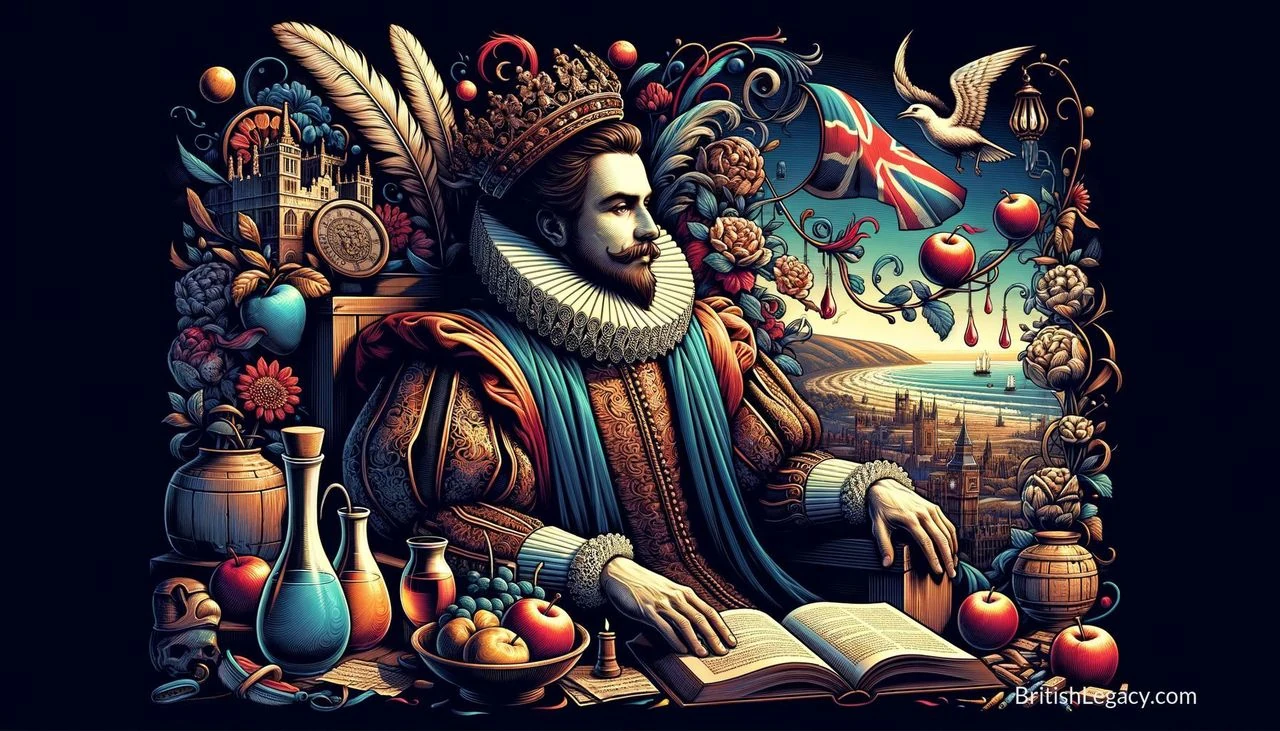
John Webster’s tragedies make violence and political power inseparable from the people forced to live under them. In The Duchess of Malfi, a widow’s decision to marry without her brothers’ consent becomes the starting point for a story of surveillance, cruelty and death. The White Devil turns an Italian scandal into a drama of accusation and moral hypocrisy. These plays have made Webster one of the most distinctive voices of the Jacobean stage, although the surviving record of his life is notably incomplete.
A London life, only partly recorded
Webster was born in or near London, probably around 1578, but neither his birth nor his death date is known with certainty. His father, also named John Webster, was a carriage maker. The family lived in the parish of St Sepulchre’s, and Webster’s father and uncle belonged to the Merchant Taylors’ Company. Webster attended Merchant Taylors’ School in Suffolk Lane. In 1598, a John Webster recently associated with the New Inn was admitted to the Middle Temple; the identification with the playwright is plausible, rather than certain.
Some firmer details emerge with his marriage. On 18 March 1605, Webster married Sara Peniall at St Mary’s Church, Islington. A special licence was required because the wedding took place during Lent; Peniall was seven months pregnant. Their son John was baptised the following March. A neighbour’s will from 1617 suggests that the couple had other children, though the surviving evidence does not establish a complete account of their family life.
Most of what is known about Webster’s working life comes from the theatre. By 1602 he was writing with other playwrights, a common practice in the period. His collaborators included Thomas Dekker, Michael Drayton, Thomas Middleton and Anthony Munday. He worked with Dekker on Sir Thomas Wyatt, Westward Ho and Northward Ho, and adapted John Marston’s The Malcontent for the King’s Men in 1604. This early work ranged across history and comedy; the tragedies for which he is now best known were only part of a broader career.
Two tragedies, two different beginnings
The White Devil, published in 1612, retells the intrigues surrounding Vittoria Accoramboni, an Italian woman who was assassinated at the age of 28. Its first staging at the Red Bull Theatre was unsuccessful. The play’s unusual, intellectually demanding construction may have been difficult for an audience at a venue thought to specialise in more straightforward entertainment. The failure did not prevent the work from becoming one of Webster’s defining achievements.
The Duchess of Malfi was probably first performed by the King’s Men around 1614 and published nine years later. Its Duchess, a widow who secretly remarries against her brothers’ wishes, is set against a court where authority is exercised through coercion and deception. Webster gives her courage and moral clarity amid the violence around her. The brothers’ efforts to control her turn private choice into public catastrophe, making the play’s personal tragedy inseparable from its account of power.
The plays may also have differed markedly in performance. The Red Bull was an open-air theatre, while the King’s Men may have staged The Duchess of Malfi in the smaller, indoor Blackfriars Theatre. The contrast suggests distinct conditions for each work, though the precise staging remains uncertain. Webster’s tragedies use intricate plotting and theatrical effects to make the audience confront the consequences of human actions, rather than offering an easy resolution.
Beyond the famous tragedies
Webster continued to write after the plays that secured his reputation. The Devil’s Law Case, written around 1617–19, was a tragicomedy. Later he returned to collaboration, co-writing Anything for a Quiet Life with Thomas Middleton and A Cure for a Cuckold with William Rowley. He also worked with John Ford, Rowley and Dekker on Keep the Widow Waking, a topical play about a recent scandal. That work is lost, although its plot is known through a court case. A further play, Appius and Virginia, may have been written with Thomas Heywood; its date and authorship remain uncertain.
Webster was still writing in the mid-1620s. Thomas Heywood’s Hierarchie of the Blessed Angels, licensed in 1634, refers to him in the past tense, indicating that he had died by then. The exact year of his death is uncertain: accounts give conflicting dates, so a precise year cannot be stated confidently. The record’s gaps are a reminder that a playwright whose work remains vivid can nevertheless leave little reliable biography behind.
A reputation that changed over time
Webster’s plays were generally dismissed during the eighteenth and nineteenth centuries. Their standing changed in the twentieth century, when critics and theatregoers increasingly valued their poetic quality and their unsparing treatment of human suffering. The violence and pessimism of the tragedies could speak to audiences shaped by the horrors of modern war, though that connection is an interpretation rather than a simple explanation for their revival.
The Duchess of Malfi’s central figure has drawn particular attention. Set against her malevolent brothers, the Duchess meets death with stoic courage. Her prominence as a virtuous woman in a dark and violent world was unusual for her time. The plays remain difficult and intricate, but their layered motives and sharp examination of authority reward close attention. Webster’s reputation rests not simply on darkness for its own sake, but on the tension between cruelty and the people who resist it.
Why John Webster deserves a place in British Legacy
Webster belongs in British Legacy because his work is a substantial part of the history of English theatre. The Duchess of Malfi and The White Devil are not merely examples of Jacobean violence: they examine how power enters private life, how social judgements can be applied unevenly, and what courage looks like when people have little control over their circumstances. The Duchess’s resistance to her brothers gives the tragedy a human centre, while The White Devil’s tangled accusations expose the instability of moral authority. These are specific dramatic achievements, not just a general claim that Webster was an important writer.
His career also shows the collaborative nature of early modern theatre. Webster worked with several fellow playwrights and wrote comedies and tragicomedies as well as the tragedies that later defined his reputation. His changing reception—from neglect in the eighteenth and nineteenth centuries to renewed attention in the twentieth—demonstrates how each generation can find new significance in older drama. The plays’ continued performance keeps that history active: audiences can encounter Webster’s language and difficult moral worlds as theatre, not only as literary heritage. His British legacy lies in helping create a distinctive body of English drama, and in leaving works whose treatment of power, gender and suffering still sustains serious attention.
Sources
John Webster — Wikipedia, revision 1373522632
Adapted in part from John Webster by Wikipedia contributors, under CC BY-SA 4.0. Text has been edited and combined with the existing article; this adapted text is shared under the same licence. Contributor history.