
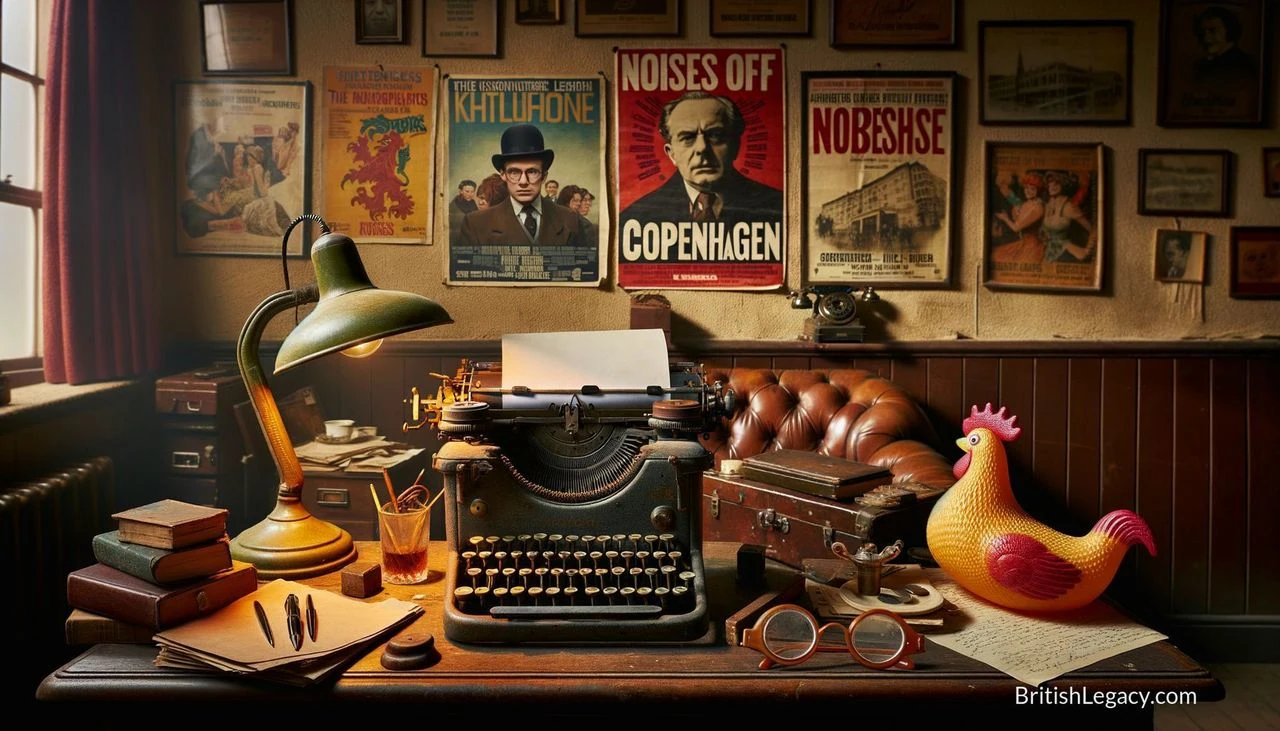
Michael Frayn has made uncertainty, miscommunication and human self-deception fertile ground for both comedy and serious drama. In Noises Off, a theatre company’s increasingly chaotic production becomes a feat of exact comic timing. In Copenhagen, the disputed motives surrounding a wartime meeting between two physicists resist any single, certain explanation. The plays are very different in tone, but both show Frayn turning complicated structures of knowledge and behaviour into compelling theatre.
A London childhood and a Russian education
Frayn was born in Mill Hill, north London, on 8 September 1933, when the area was in Middlesex. His father, Thomas Allen Frayn, worked as an asbestos salesman; his mother, Violet Alice Lawson, had studied violin at the Royal Academy of Music and worked as a shop assistant and occasional model. Frayn grew up in Ewell, Surrey, and attended Kingston Grammar School.
After two years of National Service, he studied Russian at the Joint Services School for Linguists. He then read Moral Sciences, or philosophy, at Emmanuel College, Cambridge, graduating in 1957. The combination of language study and philosophical training would sit naturally alongside a career that moves between translation, fiction, journalism and plays concerned with what people know, remember and mean.
Frayn began work as a reporter and columnist for The Guardian and later The Observer. His journalism established him as a satirist and comic writer before his plays and novels became the best-known parts of his career. Collections of the columns include The Day of the Dog, The Book of Fub, On the Outskirts and At Bay in Gear Street. Some of the columns were adapted for BBC Radio 4 in the 1980s and performed by Martin Jarvis.
Farce built with exacting control
Noises Off, first performed in 1982, is a farce about the making and performance of a farce. Its structure follows a company through rehearsal, a performance seen from backstage and the eventual collapse of the production. The changing viewpoint lets the audience see the same theatrical enterprise from different angles: what looks like a play to the audience becomes a tangle of missed cues, strained relationships and physical mishaps behind the scenes.
The comedy depends on coordination as much as on dialogue. Actors must deliver one performance for the fictional audience within the play and another for the real audience watching the backstage action. Doors, props, entrances and exits have to work with precision even as the characters lose control. Frayn’s design makes disorder the visible result of tightly controlled theatrical machinery.
The play became one of his best-known works, and its success was recognised with the 1982 Laurence Olivier Award for Comedy of the Year and the London Evening Standard Award for Best Comedy. It belongs to a wider body of plays that includes Alphabetical Order, Donkeys' Years, Benefactors and Make and Break. Frayn also wrote short-play collections, including The Two of Us and Alarms and Excursions.
From the uncertainty principle to wartime motives
Copenhagen, which appeared in 1998, takes as its subject a 1941 meeting between Danish physicist Niels Bohr and his former student, the German physicist Werner Heisenberg. Denmark was under German occupation; what Heisenberg intended, and the significance of his visit, remain questions the play examines rather than settles. Frayn connected the difficulty of interpreting the meeting with the limits of certainty in physics, using the uncertainty principle as a parallel for the difficulty of knowing why people act as they do.
That subject gives the play an unusual dramatic engine. Instead of presenting motive as a fact that can simply be recovered, Frayn has his characters return to possible explanations and test them against one another. The result brings questions of scientific responsibility, personal loyalty and memory into the theatre. The play received the 1998 Critics' Circle Theatre Award for Best New Play and the London Evening Standard Award for Best Play; its 2000 honours included the Tony Award for Best Play and the New York Drama Critics' Circle Award for Best Foreign Play.
Frayn continued to draw on history in Democracy, about German chancellor Willy Brandt and his personal assistant, East German spy Günter Guillaume. It ran at the National Theatre in London in 2003–04, transferred to the West End and reached Broadway in 2004–05. Afterlife, a biographical drama about Austrian impresario Max Reinhardt, opened at the National Theatre in 2008.
Fiction, philosophy and translation
Frayn’s work in prose is not a sideline to his theatre career. His novels include The Tin Men, which won the 1966 Somerset Maugham Award; Headlong, shortlisted for the 1999 Booker Prize; and Spies, which won the 2002 Whitbread Prize for Fiction. The breadth of his writing has brought success in both drama and prose fiction. He has also written about philosophy, notably in Constructions and The Human Touch: Our Part in the Creation of the Universe.
His command of Russian, acquired during National Service, also informed a substantial body of translation. Frayn translated Chekhov’s The Seagull, Uncle Vanya, Three Sisters and The Cherry Orchard, as well as other Russian works. He fashioned The Sneeze from Chekhov’s short stories and one-act plays. His translations and adaptations extend to Tolstoy and Yuri Trifonov, among others, bringing plays from other languages into English performance.
Frayn has also written screenplays, including Clockwise, starring John Cleese, and the television drama First and Last, which received an International Emmy Award in 1990. His honours across theatre and literature include the Golden PEN Award in 2003 and an honorary Doctor of Letters from the University of Birmingham in 2005.
Why Michael Frayn deserves a place in British Legacy
Frayn’s place in British cultural life rests on more than the popularity of a single play. Noises Off demonstrates how exact construction can make farce both technically daring and accessible: the audience laughs at a production coming apart while seeing the precision required to stage that apparent disorder. The play’s awards and continuing place among Frayn’s best-known works reflect the reach of that achievement. His serious drama takes comparable care with a different kind of uncertainty. In Copenhagen, a historical encounter becomes a sustained examination of evidence, memory and responsibility, bringing difficult questions about science and wartime conduct to the stage without pretending that motive is easy to establish.
His contribution also crosses the boundaries between forms and languages. Frayn moved from British newspaper journalism into plays and novels, wrote philosophical books and translated major Russian dramatists for English-speaking audiences. These are connected parts of a career: a comic writer attentive to how people describe the world, and a dramatist willing to test what can be known about it. For British Legacy, his work offers a specific cultural inheritance rather than a general claim about national character: British theatre enriched by a playwright who can make intricate ideas performable, make farce depend on craftsmanship, and bring translated drama into English-language repertory.
Sources
Michael Frayn — revision 1379210865
Adapted in part from Michael Frayn by Wikipedia contributors, under CC BY-SA 4.0. Text has been edited and combined with the existing article; this adapted text is shared under the same licence. Contributor history.
_(cropped).jpg)