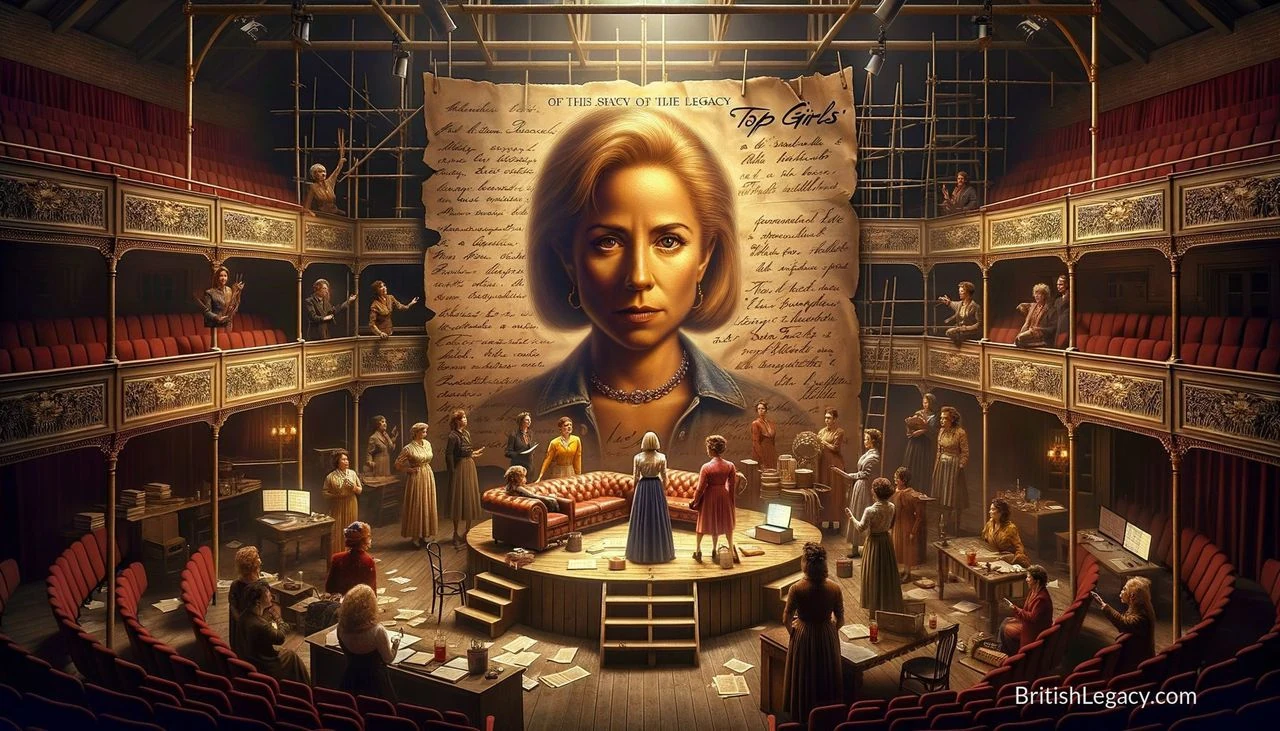
Caryl Churchill’s plays make form part of the argument. A change in casting, a leap across time or a fractured exchange can unsettle familiar assumptions about gender, class, sexuality and authority. In Cloud Nine, a Victorian colonial setting gives way to 1979 London; in Top Girls, a dinner with historical and fictional women opens a play about the costs of professional success. Across a long career in British theatre, Churchill has joined political scrutiny to an inventive, often non-naturalistic stage language.
From student theatre to radio
Caryl Lesley Churchill was born in Finsbury, London, on 3 September 1938. After the Second World War, her family emigrated to Montreal, where she attended Trafalgar School for Girls. She returned to England for university in 1956 and graduated in English literature from Lady Margaret Hall, Oxford, in 1960. At Oxford she received the Richard Hillary Memorial Prize and began writing for student theatre. Downstairs, performed at the National Student Drama Festival in 1958, won first prize.
During the 1960s and 1970s, while raising a family, Churchill wrote short radio dramas for BBC Radio. Among them were The Ants (1962), Not, Not, Not, Not Enough Oxygen (1971) and Schreber’s Nervous Illness (1972). She also wrote for BBC television, including The After-Dinner Joke (1978) and Crimes (1982). These different forms gave her room to write beyond a single stage setting, and some of the radio and television plays were later adapted for the stage.
Owners, produced in London in 1972, was Churchill’s first professionally produced stage play. Its two acts and fourteen scenes centre on an obsession with power. From 1974 to 1975 she was resident dramatist at the Royal Court Theatre, its first female playwright in residence. She also worked with companies including Joint Stock and the feminist theatre collective Monstrous Regiment. Their extended workshops helped shape new plays, and Churchill continued to use improvisational workshops in developing some of her work.
Cloud Nine and Top Girls
Cloud Nine, first staged in 1979, brought Churchill wide notice. Part of the play takes place in a Victorian British colony, where cross-gender casting makes the performance of social roles visible. Its second act moves to London in 1979, a century later in the story’s chronology, although the characters have aged only twenty-five years. The shifts connect the legacy of colonial power to intimate relationships and changing ideas about sexuality. In 1981, the play won an Obie Award for playwriting in New York.
Top Girls, first produced in 1982, also uses structure to sharpen its inquiry. Its opening dinner gathers Marlene with historical, iconic and fictional women whose achievements have come at a cost. The play then turns to Marlene’s family and a story set a year earlier, bringing the private consequences of her business success into view. Marlene has given up a home and family to advance in a male-dominated world; the play asks what that success demands of her and those close to her. It won an Obie Award for playwriting in 1982.
Churchill’s writing makes interruptions and overlap part of how an audience hears power at work. In Top Girls, she used a forward slash to indicate interruption and an asterisk to connect a speech to one spoken earlier. These marks are practical directions, but they also shape the audience’s experience of competing voices: conversation does not always proceed in orderly turns. The play’s formal choices work alongside its subject, rather than serving as decoration.
Changing the dramatic language
Churchill’s work moved further from the conventions of realism as her career developed. She explored gender and sexuality through modernist techniques associated with epic theatre, and from the mid-1980s incorporated dance-theatre. A Mouthful of Birds (1986), written with David Lan, was an early example of that approach. It draws on the surrealist theatre tradition of Antonin Artaud and the Theatre of Cruelty. Fragmentation and surrealism became recurring features of her dramatic language.
In Serious Money (1987), Churchill turned to the financial world in a verse comedy, written chiefly in rhyming couplets, that satirises the stock market and its Thatcher-era participants. The play received the Evening Standard Theatre Award for Best Comedy of the Year, an Obie Award for Best New Play and the Susan Smith Blackburn Prize in 1987; it also won the Laurence Olivier Award for Best New Play in 1988. Its subject and pointed verse brought another powerful institution into the frame of political theatre.
Later plays continued to test what a stage work could contain. The Skriker (1994) combines distorted language, English folklore and modern urban life in the figure of an ancient shape-shifting fairy. A Number (2002) examines cloning and identity, and earned Churchill an Obie Award in 2005. Love and Information, which opened at the Royal Court in 2012, is built from more than fifty short scenes. A cast of fifteen plays one hundred characters; instead of following a single continuous plot, the scenes accumulate into a portrait of modern consciousness and the desire for human connection.
Her work has also moved between stage, opera and translation. In 1997 she collaborated with composer Orlando Gough on Hotel, a choreographed opera. In 2010 she wrote the libretto for Gough’s short opera A ring a lamp a thing, presented as part of the Royal Opera House’s ROH2 OperaShots initiative. Her translations include Seneca’s Thyestes and Strindberg’s A Dream Play, which was staged at the National Theatre in 2005.
Recognition and continuing reach
Churchill’s awards include the Susan Smith Blackburn Prize for Fen in 1984, the Obie Sustained Achievement Award in 2001 and induction into the American Theater Hall of Fame in 2010. In 2013, Royal Holloway, University of London, named its theatre in her honour. The distinctions recognise different aspects of a career that has included plays, radio and television writing, opera and translation.
Her range is evident in the contrast between works such as Serious Money, a verse satire of financial markets, and The Skriker, with its folklore, distorted language and shape-shifting central figure. A Number brings questions of identity into a drama about cloning, while Love and Information builds meaning through a succession of brief scenes. Across these plays, the dramatic method changes with the material: Churchill has not relied on one form to address the subjects that concern her.
Legacy and influence
Churchill’s lasting significance can be seen in the way her work joins social questions to the mechanics of performance. Cloud Nine uses cross-gender casting and a startling change in dramatic time to make audiences notice how power organises intimate life. Top Girls sets a woman’s business success beside the sacrifices and family history that complicate it. Neither play treats gender, class or colonial power as distant abstractions; each makes those pressures visible through character, structure and staging.
Her career also connects experimentation with British theatrical institutions and companies. She was the Royal Court’s first female playwright in residence, worked with Joint Stock and Monstrous Regiment, and developed plays through workshop practice. Her influence is not confined to a single celebrated work: the body of writing includes satire, folklore, fragmented scenes, opera and translation. The Royal Holloway theatre named in her honour is one enduring institutional marker, while the continued presence of her plays gives performers and audiences practical ways to encounter difficult questions through theatre.
Why Caryl Churchill deserves a place in British Legacy
Caryl Churchill deserves a place in British Legacy because her work has expanded what British theatre can do when it addresses power. Cloud Nine makes the afterlife of colonial attitudes part of a story about personal relationships, using casting and a century-long leap in time to unsettle easy assumptions. Top Girls places Marlene’s professional achievement against its private cost, giving the play’s account of gender and class a concrete family dimension. These are not simply plays with political topics: their structure, dialogue and casting make the audience experience the instability and conflict at the heart of those topics.
Her contribution is also visible in the range of theatrical approaches she has put to work. Workshop-developed plays, interrupted speech, verse satire, dance-theatre, surreal language and short, fragmented scenes have all enabled her to find forms suited to different subjects. Her first professional stage play, her Royal Court residency and collaborations with British theatre companies mark a career built in and through the country’s theatrical culture. The theatre named for her at Royal Holloway offers a further, tangible connection. Churchill’s legacy is therefore both artistic and practical: her plays remain resources for examining social power, while their formal inventions continue to challenge the habits of writing, performing and watching theatre.
Sources
Caryl Churchill — Wikipedia revision 1376533430
Adapted in part from Caryl Churchill by Wikipedia contributors, under CC BY-SA 4.0. Text has been edited and combined with the existing article; this adapted text is shared under the same licence. Contributor history.