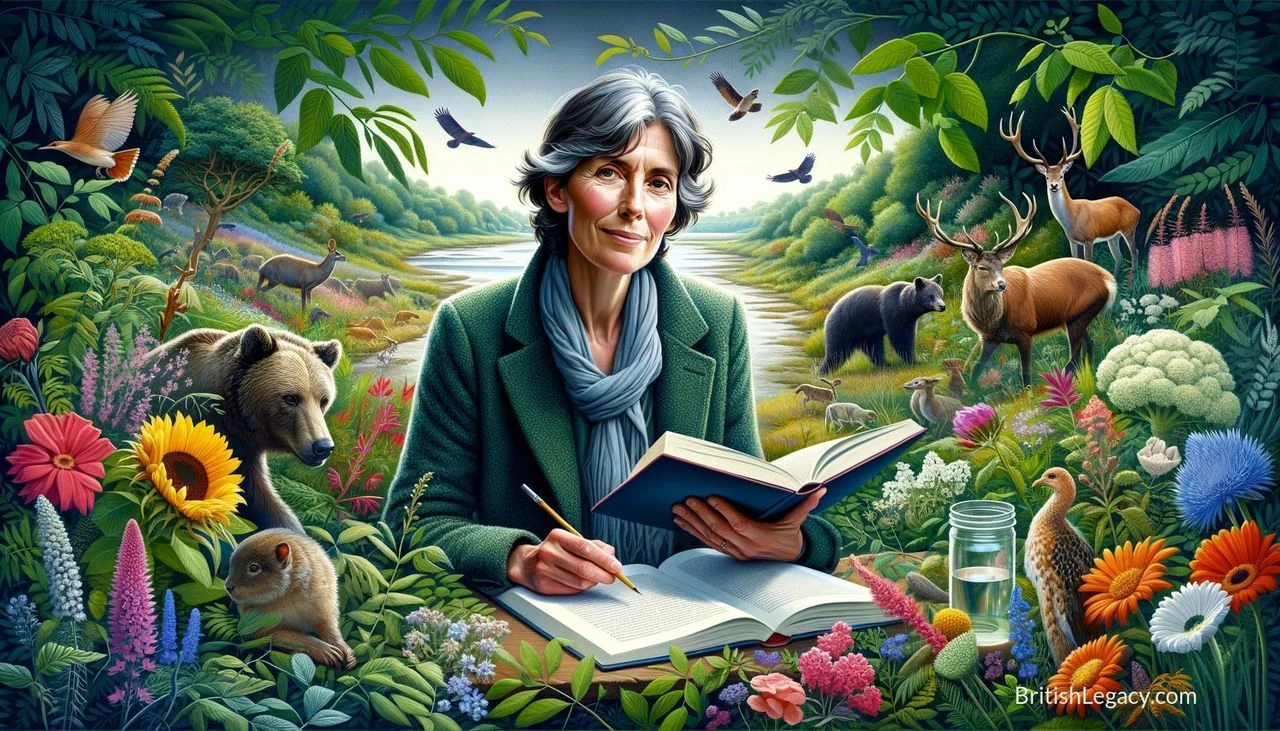
Sara Maitland’s writing moves between fiction, religion and the natural world. Her novels and short stories draw on myth and magic realism; her non-fiction includes a searching account of silence and solitude. The range is visible in a career that began with the award-winning Daughter of Jerusalem and continued through collections of dark tales, theological writing and books about forests and fairy tales.
From London to a writing life
Born Sarah Louise Maitland in London on 27 February 1950, she was the second of six children. She went to school in Wiltshire and attended St Mary’s, a girls’ boarding school in Calne, before entering the University of Oxford in 1968 to study English. After completing her course, she began writing. Her career, which the biographical record dates from 1978, has encompassed fiction, non-fiction and theology.
Religion became a central interest in Maitland’s life from 1972. She was married to an Anglican priest from 1972 until their divorce in 1993, and subsequently became a Roman Catholic. That religious journey informs a body of work concerned with Christianity, saints, women’s lives and the place of belief in contemporary culture. Rather than confining herself to one form, she has written novels, short stories and works of theology, often using imaginative storytelling to approach spiritual questions.
Her first novel, Daughter of Jerusalem, appeared in 1978 and won the Somerset Maugham Award the following year. It established an early connection between her fiction and religious history. Maitland’s later work continued to range across different subjects and styles: the novels include Virgin Territory, Three Times Table and Home Truths, while Hagiographies and Brittle Joys extend her engagement with religious and imaginative themes.
Stories between the everyday and the marvellous
Maitland’s fiction is often described as having a magic realist tendency. Her stories place the extraordinary beside the recognisable, making room for myth, fairy tale and religious imagination without leaving everyday experience behind. The short-story collection Telling Tales appeared in 1983. Later collections include A Book of Spells and Women Fly When Men Aren’t Watching, whose title hints at the transformations and possibilities that recur in her imaginative work.
In 2003, On Becoming a Fairy Godmother offered a fictional celebration of the menopausal woman. The title story of Far North & Other Dark Tales began as “True North” in Telling Tales; it was adapted into a film, True North, in 2007. The 2008 collection brings together dark mythological tales from around the world. In 2009, her short story “Moss Witch” was runner-up for the BBC National Short Story Award.
Alongside fiction, Maitland has written about women and Christianity, religious fiction, women saints and theology. Her non-fiction includes A Map of the New Country: Women and Christianity, A Big-Enough God: Artful Theology and Awesome God: Creation, Commitment and Joy. These books sit in conversation with the imaginative work: both examine how stories, religious traditions and the lives people lead shape their understanding of the world.
Silence, forests and changing surroundings
A Book of Silence, published in 2008, is an autobiographical exploration of silence and solitude. It describes experiences and changes in Maitland’s life as she moved towards a more solitary and prayerful existence. Her pursuit of quiet involved relocating, first to the Isle of Skye and later to a home in Galloway. She has described avoiding some of the comforts of modern life, including mobile phones, radio and television, when they intrude on silence.
The book brings together memoir and reflection, making solitude not simply a subject but a condition through which Maitland considers attention, belief and daily life. It was nominated for the Bristol Festival of Ideas Book Prize in 2009. The interest in place and the non-human world also appears in Gossip from the Forest: the Tangled Roots of our Forests and Fairytales, published in 2012. The book’s title signals a meeting of landscape and storytelling, connecting forests with the tales that have grown around them.
Maitland’s work has also taken her beyond the page. In 1995, she worked with Stanley Kubrick on the film A.I. Artificial Intelligence. She has taught part-time on Lancaster University’s MA in Creative Writing and is a Fellow of St Chad’s College, Durham University. These roles sit alongside a varied publishing career rather than replacing it: her books move between forms, and her subjects include Christianity, saints, mythology, fairy tales and gardening.
A body of work across genres
Maitland’s bibliography includes novels, short-story collections, non-fiction and editorial work. Her books range from the fiction of Daughter of Jerusalem and Hagiographies to the autobiographical inquiry of A Book of Silence. With Wendy Mulford, she wrote Virtuous Magic: Women Saints and Their Meanings; with Martin Goodman, she co-wrote The Write Guide. She also co-edited The Rushdie File with Lisa Appignanesi and edited Very Heaven: Looking Back at the 1960s.
This breadth matters to the shape of her career. Maitland has returned to religious and imaginative material in different ways: as fiction, criticism, theology and memoir. Her writing does not belong to a single genre or subject, and the shifts between them allow questions of belief, identity, solitude and storytelling to recur from more than one angle. That variety is part of what makes her work distinctive within contemporary British writing.
Why Sara Maitland deserves a place in British Legacy
Sara Maitland’s place in British literary life rests on a sustained body of work rather than one book or one genre. Daughter of Jerusalem won the Somerset Maugham Award in 1979, and her subsequent novels and stories continued to explore the meeting of ordinary life with myth, religion and the marvellous. Her fiction ranges from novels to collections of dark tales; her non-fiction and theological writing address Christianity, women’s lives and the practice of solitude. Recognising that breadth gives a fuller account of a writer whose subjects cross the boundaries between literature, belief and memoir.
Her work also offers a specific connection between British writing and landscape. In A Book of Silence, Maitland writes from experience of a more solitary life, including her move to Galloway; in Gossip from the Forest, forests and fairy tales meet as subjects of inquiry. These books do not need inflated claims about changing policy or leading a conservation movement to have significance. They show how a writer can make place, silence and inherited stories part of a literary investigation. Her award-recognised fiction, varied non-fiction and teaching give readers several routes into those questions, and together they form a distinctive contribution to British letters.
Sources
Sara Maitland — revision 1371557722
Adapted in part from Sara Maitland by Wikipedia contributors, under CC BY-SA 4.0. Text has been edited and combined with the existing article; this adapted text is shared under the same licence. Contributor history.