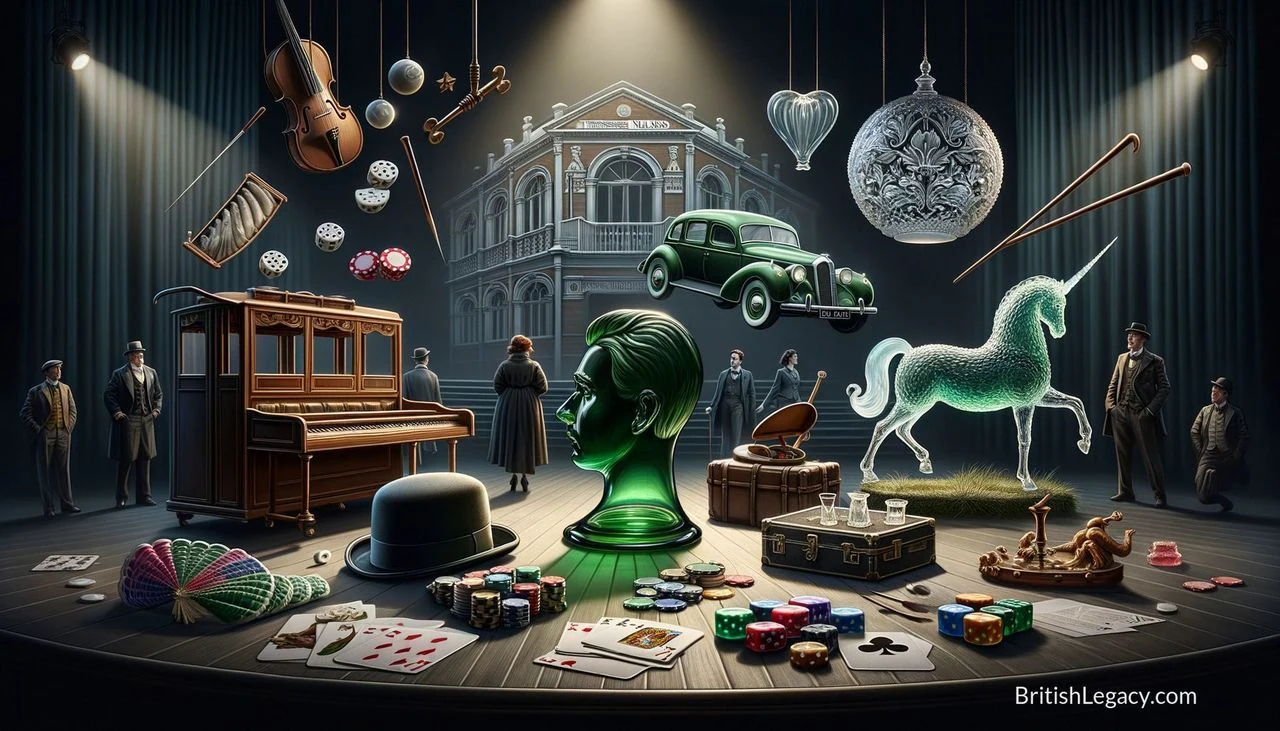
Tennessee Williams’s place in British theatre rests on more than the arrival of celebrated American plays in London. His writing gave British actors and audiences characters shaped by memory, desire and vulnerability; his own travels also brought him to the city. The West End production of A Streetcar Named Desire, starring Vivien Leigh, made one of his most famous creations a striking presence on a British stage. Across the Atlantic, Williams’s plays entered a different theatrical culture without losing the unsettling intimacy that had made them distinctive.
A writer formed in the American South
Thomas Lanier Williams III was born in Columbus, Mississippi, on 26 March 1911. He later adopted the professional name Tennessee Williams, acknowledging his Southern roots and accent. His childhood included periods of illness and frequent moves; after his father’s promotion, the family settled in St Louis. The tensions of family life, and the pressure of a strict upbringing, would become recurring material in his drama. His plays often transform personal experience rather than reproduce it directly: The Glass Menagerie, for example, draws on family memories and gives the past the uncertain, selective quality of recollection.
Williams studied journalism at the University of Missouri before his father withdrew him from university and put him to work in a shoe factory. He later attended Washington University in St Louis and transferred to the University of Iowa, graduating with a degree in English in 1938. He also studied at the Dramatic Workshop of The New School in New York. In the years before recognition, he wrote plays, stories and poems while taking various jobs. A Rockefeller Foundation grant in 1939 helped him continue his work and brought him to the attention of Hollywood, where he received a short-term writing contract.
The plays that established his reputation
The Glass Menagerie brought Williams his first major success. Developed from his short story “Portrait of a Girl in Glass”, the memory play was produced in Chicago in 1944–45, then moved to New York, where it became a hit and won the New York Drama Critics’ Circle Award for best play of the season. Its small family drama, filtered through the recollections of Tom Wingfield, established a form in which theatrical poetry and emotional candour could coexist.
A Streetcar Named Desire, which followed in 1947, secured his standing as a major playwright. Blanche DuBois, a former schoolteacher whose carefully maintained illusions collide with the life around her, is one of his most enduring roles. Williams continued with works including Cat on a Hot Tin Roof, Sweet Bird of Youth and The Night of the Iguana. In 1959, his honours included two Pulitzer Prizes, three New York Drama Critics’ Circle Awards, three Donaldson Awards and a Tony Award. His plays were also adapted for the screen, extending their reach beyond the theatre.
The work of this period is often associated with his close artistic relationship with director Elia Kazan. Williams’s plays drew on private experience, but their force came from dramatic construction: conflicting desires, unstable family ties and characters whose accounts of themselves cannot always be trusted. In The Glass Menagerie, memory openly shapes the action; in Streetcar, Blanche’s self-image is tested against the judgements and pressures of others. That attention to theatrical perspective travelled with the plays when they were staged abroad.
Williams in London and on British stages
A Streetcar Named Desire reached London’s West End in 1949, two years after its New York success. Vivien Leigh played Blanche DuBois in the London production, bringing a leading British performer to one of Williams’s most demanding roles. The production connected a distinctly American setting and voice with British theatre’s actors and audiences. It was not simply a matter of transferring a successful play: Blanche’s vulnerability and self-deception had to be made legible in performance, night after night, to a new audience.
The Glass Menagerie also found a British audience. Its Wingfield family—Amanda, Laura and Tom—are bound together by longing, frustration and the pressure of what has already happened. The play’s memory structure allows the audience to see that the past is not a neutral record: it is being recalled by Tom, who is both participant and narrator. That formal choice, as well as the family’s emotional conflicts, helped make the play a distinctive counterpart to the more openly confrontational world of Streetcar.
Williams spent periods travelling in Europe with his partner Frank Merlo and lived in several cities, including London. The city was one part of a mobile life rather than the centre of his career, which remained rooted in American drama. His later plays, among them Cat on a Hot Tin Roof and Sweet Bird of Youth, also reached British audiences. The range of his work offered performers different kinds of challenge: from the compressed family pressure of Cat to the restless, exposed characters of Sweet Bird.
Personal experience and changing fortunes
Williams’s plays repeatedly returned to family, memory and the costs of concealment. His sister Rose, who was diagnosed with schizophrenia and institutionalised after a lobotomy, remained important to him; when he could afford to do so, he helped provide for her care. Biographers and critics have connected aspects of Rose’s life with characters in his work, though fictional characters should not be treated as direct portraits. Williams’s life with Merlo lasted 14 years. After Merlo’s death from lung cancer in 1963, Williams experienced a period of severe depression and increasing dependence on prescription drugs.
The acclaim of the 1940s and 1950s did not continue unchanged. Williams kept writing, but many later plays failed commercially, and negative reviews affected him. His last play, A House Not Meant to Stand, was produced in Chicago in 1982 and ran for 40 performances despite largely positive reviews. He died in New York on 25 February 1983, aged 71. Although he had requested burial at sea, his brother arranged for him to be buried at Calvary Cemetery in St Louis.
His reputation has continued through performance, publication and study. The archive of his papers is held at the Harry Ransom Center at the University of Texas at Austin; in 2011, an exhibition there marked the centenary of his birth. His plays have also continued to inspire productions and festivals in the United States. Their lasting life depends not only on their first reception but on the repeated work of directors, actors and audiences who find new meanings in them.
Why Tennessee Williams deserves a place in British Legacy
Williams deserves a place in British Legacy because his work became part of British theatrical experience through specific, visible encounters: the West End production of A Streetcar Named Desire in 1949, Vivien Leigh’s performance as Blanche DuBois, and British audiences’ reception of The Glass Menagerie and later plays. These are concrete links, not a claim that Williams was British or that his career belonged chiefly to Britain. His story shows how theatre crosses national borders through productions and performance. A play written in the United States can acquire another life when British actors make its language and conflicts immediate for audiences in London and beyond.
That exchange also matters because Williams’s plays give performers demanding roles and give audiences more than a familiar plot. His work places memory beside action, and exposes the distance between the stories people tell about themselves and the pressures they cannot escape. The British stage’s engagement with those plays is one strand in their international history, while Williams’s periods in London add a personal connection to the city. Remembering him here recognises the influence of American drama on British stages without blurring the distinction between the two traditions. It honours the actors and audiences through whom that influence became a lived part of British theatre.
Sources
Adapted in part from Tennessee Williams by Wikipedia contributors, under CC BY-SA 4.0. Text has been edited and combined with the existing article; this adapted text is shared under the same licence. Contributor history.