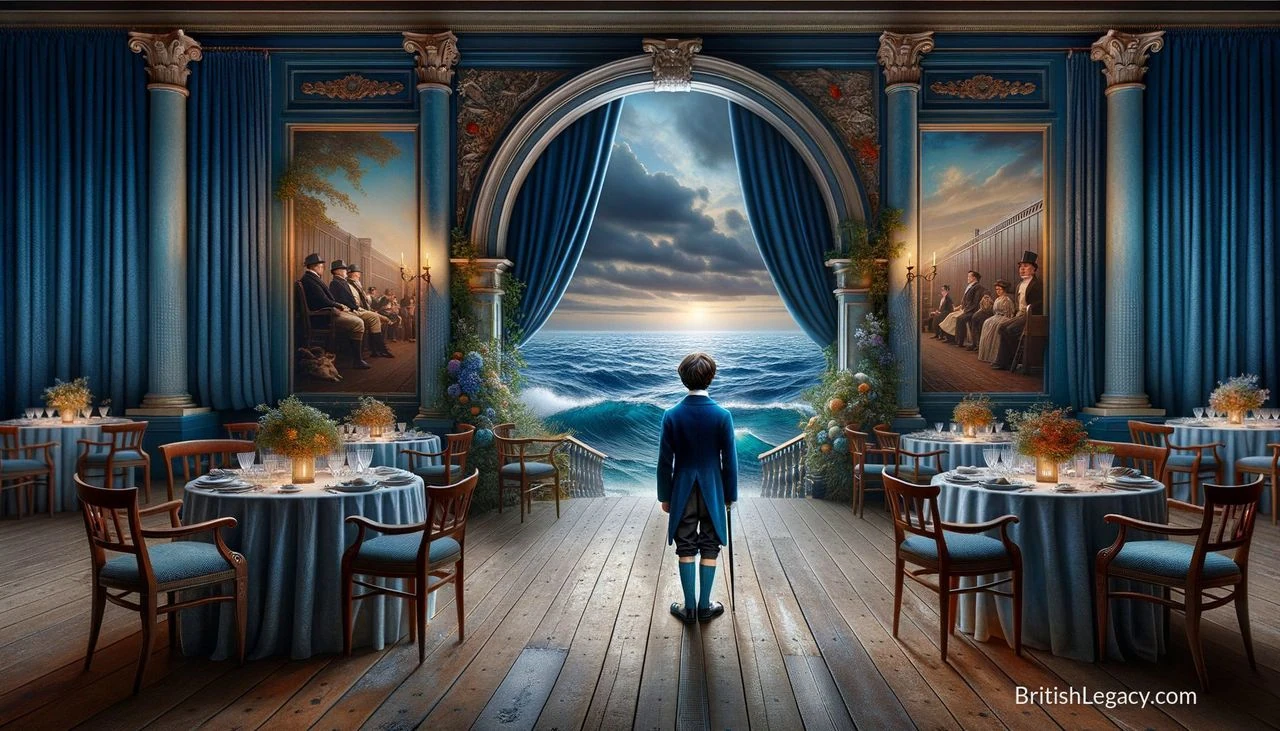
Terence Rattigan made drama from what people could not easily say. His plays place intimate conflicts inside recognisable social worlds: a family challenging an accusation, a marriage under pressure, or hotel residents negotiating loneliness and reputation. The restraint of his writing became unfashionable after the rise of post-war kitchen-sink drama, but works including The Winslow Boy, The Browning Version, The Deep Blue Sea and Separate Tables have repeatedly returned to British stages.
Education and an early success
Terence Mervyn Rattigan was born in South Kensington, London, on 10 June 1911, though his birth certificate and a birth announcement gave 9 June. Most reference books use 10 June, a date he did not publicly dispute. His father, Frank Rattigan, was a diplomat; Terence and his elder brother Brian were of Irish extraction. He attended Sandroyd School and Harrow, where he played cricket for the First XI and scored 29 in the Eton–Harrow match in 1929. He later studied at Trinity College, Oxford.
His first major success came with French Without Tears, a comedy set in a crammer, in 1936. The idea drew on a visit he had made to the Black Forest in 1933, where young Englishmen went to learn German. Rattigan followed it with After the Dance (1939), a social drama about the “bright young things” and their failure to engage politically. The outbreak of war curtailed its prospects of a long run. A pre-war satire about Nazi Germany, Follow My Leader, was refused a licence by the Lord Chamberlain on the grounds that it might offend a foreign country; it was nevertheless performed from January 1940.
War, craft and the post-war plays
During the Second World War Rattigan served in the Royal Air Force as a tail gunner. His service helped inspire Flare Path, and in 1943, as an RAF flight lieutenant, he was posted to the RAF Film Production Unit. There he worked on The Way to the Stars, a substantial reworking for the screen of Flare Path, and on Journey Together.
After the war he alternated between comedy and drama, building a body of work in which formal control carries strong feeling rather than suppressing it. The Winslow Boy (1946) centres on a father’s fight to clear his son’s name after an accusation of theft. Rattigan drew on a real case, setting the family’s struggle in pre-war Britain. Questions of justice and obligation emerge through the measured contest between a household and the institutions it challenges.
The Browning Version (1948) and The Deep Blue Sea (1952) show different sides of his attention to emotional vulnerability. The latter follows Hester Collyer, whose affair and despair lead to a suicide attempt. Its account of private pain is associated with the sexual repression of the period and with Rattigan’s own experience, although reducing the play to autobiography misses the precision of its dramatic construction. Rattigan was gay, and some of his work has been read as containing coded references to sexuality; claims about a supposed original version of The Deep Blue Sea centred on male lovers remain uncertain.
Separate Tables (1954) consists of two one-act plays set in a Bournemouth hotel. Its residents share a setting but live with separate histories of loneliness, deception and a longing for connection. Rattigan’s dramas often take place in upper-middle-class surroundings, yet their conflicts are not confined to class: they turn on the distance between public conduct and private need.
Changing fashions and life beyond Britain
In 1956, the success of John Osborne’s Look Back in Anger helped usher in kitchen-sink drama and the work of writers dubbed the Angry Young Men. Rattigan’s emphasis on understatement and craftsmanship was then labelled old-fashioned or “pre-war”. He responded with bitterness to the critical shift. He described writing for a symbolic playgoer he called “Aunt Edna”, a well-off, conventional middle-class audience; critics used the figure to disparage his tastes. Joe Orton later borrowed the name for his own provocative alter ego.
Rattigan continued writing, though his later plays became less familiar than his earlier hits. They include Ross (1960), based on T. E. Lawrence; Man and Boy (1963); In Praise of Love (1973); and Cause Célèbre (1977). His screen work was substantial too. He wrote or co-wrote original screenplays such as The Sound Barrier (1952), his first Academy Award nomination, The V.I.P.s (1963) and The Yellow Rolls-Royce (1964), as well as adapting or working on films from other writers’ material. Separate Tables reached the screen in 1958; Rattigan and co-writer John Gay received an Academy Award nomination for its screenplay.
Diagnosed with leukaemia in 1962, Rattigan appeared to recover two years later, but fell ill again in 1968. Disliking the “Swinging London” of the decade, he moved to Bermuda, where income from screenplays supported him; for a time he was the world’s highest-paid screenwriter. He also backed younger theatre-makers. In 1964 he congratulated Joe Orton on Entertaining Mr Sloane and invested £3,000 to help transfer it to the West End, while later acknowledging that his own critical unpopularity may have hindered his sponsorship.
Recognition, death and returns to the stage
Rattigan was appointed Commander of the Order of the British Empire in 1958 and knighted in 1971 for services to the theatre. He moved back to Britain and experienced a modest revival in reputation before his death. He died of bone cancer in Hamilton, Bermuda, on 30 November 1977, aged 66; his cremated remains were placed in the family vault at Kensal Green Cemetery.
His reputation has since been renewed through performance and preservation. The British Library acquired 300 volumes of his correspondence and papers in 1990. A 1993 Almeida Theatre revival of The Deep Blue Sea, directed by Karel Reisz and starring Penelope Wilton, was followed by productions including The Winslow Boy at Chichester in 2001 and Separate Tables at Manchester’s Royal Exchange in 2006. The National Theatre staged After the Dance in 2010. Centenary celebrations in 2011 included a revival of Cause Célèbre at the Old Vic, a West End production of Flare Path and a BBC documentary presented by Benedict Cumberbatch. Terence Davies’s screen version of The Deep Blue Sea, starring Rachel Weisz and Tom Hiddleston, was also released that year.
Why Terence Rattigan deserves a place in British Legacy
Rattigan belongs in British Legacy because his plays made the pressures of British social life dramatically visible without relying on spectacle. In The Winslow Boy, a family’s effort to clear a son’s name becomes a sustained test of justice, reputation and duty. In Separate Tables, a Bournemouth hotel brings together people whose loneliness and deceptions remain intensely private. The Deep Blue Sea confronts desire and despair in a period when sexuality was constrained by social taboo. These are specific settings and conflicts, but Rattigan’s method gives them lasting reach: tightly controlled scenes allow unspoken feeling to shape what happens.
His legacy also includes the changing fortunes of his reputation. The critical reaction to Look Back in Anger pushed his restrained style aside, yet later productions and screen adaptations brought audiences back to the plays. Their continued revival, alongside the preservation of his papers at the British Library, keeps both the work and its theatrical craft available for new interpretation. Rattigan was not only a successful dramatist and screenwriter; he also recognised Joe Orton’s talent when the younger playwright’s work was still risky to champion. His career connects British theatre across generations, from the West End successes of the 1930s and post-war years to the revivals that have reconsidered his place in the repertoire.
Sources
Terence Rattigan — Wikipedia revision 1373523719 · Terence Rattigan — Wikipedia
Adapted in part from Terence Rattigan by Wikipedia contributors, under CC BY-SA 4.0. Text has been edited and combined with the existing article; this adapted text is shared under the same licence. Contributor history.