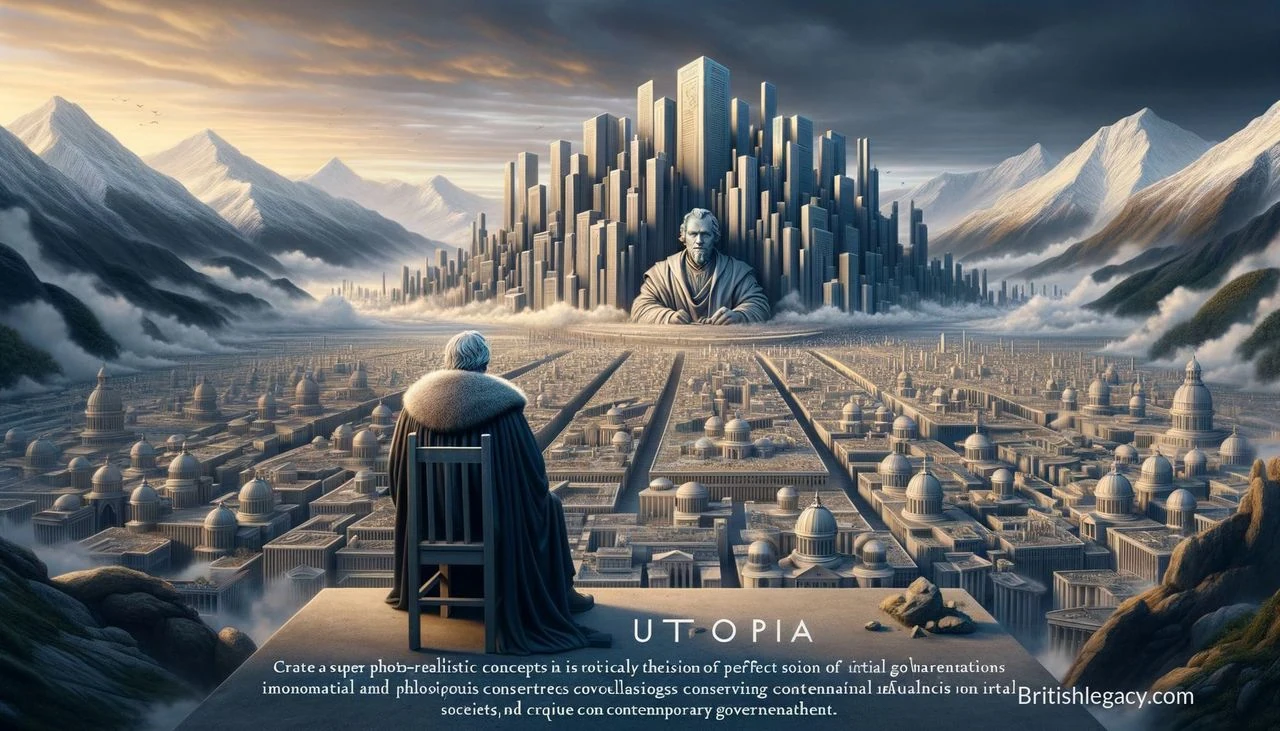
On 6 July 1535, Thomas More was executed at Tower Hill. By then he had served as Speaker of the House of Commons and Lord Chancellor, established a reputation as a lawyer and humanist, and written Utopia, a book whose title entered the language. His refusal to accept Henry VIII’s authority over the Church brought his career to an end. But the story is not simply one of a brave man resisting a king: More had exercised power himself, and had helped suppress religious dissent. Both the writer who asked what a just society might look like and the official who defended religious orthodoxy belong in the account of his life.
A London education in law and humanism
More was born in the City of London on 7 February 1478, the son of John More, a successful lawyer who later became a judge. He attended St Anthony’s School. From 1490 to 1492 he served as a page in the household of John Morton, Archbishop of Canterbury and Lord Chancellor. Morton supported the new humanist learning, and helped secure More’s place at Oxford, where he studied Latin and Greek under Thomas Linacre and William Grocyn. At his father’s insistence, he left after two years to train in law, first at New Inn and then at Lincoln’s Inn. He was called to the bar in 1502.
Law did not displace his literary and scholarly interests. More wrote and translated poetry, became proficient in Latin and Greek, and took part in the European humanist exchange of ideas. His friendship with Desiderius Erasmus connected him to one of the most prominent scholars of the age. Their relationship was intellectual and personal: More’s surviving correspondence includes affectionate letters to Erasmus, while Erasmus praised his friend’s character and learning.
More’s household was also a centre of study. He married Jane Colt in 1505; after her death in 1511 he married Alice Middleton, a widow. He had four children with Jane and also raised children who were not his own. Unusually for the period, he insisted that his daughters receive a classical education comparable to their brother’s. His eldest daughter, Margaret, became known for her learning, including her command of Greek and Latin. More’s letters encouraged his children to write to him when he was away on legal or government business.
Utopia: a thought experiment, not a simple blueprint
Published in Latin in 1516, Utopia takes the form of a conversation. Its first part examines social and political problems in contemporary Europe; its second describes an imaginary island and its institutions. More’s narrator, Raphael Hythlodaeus, criticises enclosure, privileged idleness and the harsh punishment of theft. The argument is not that poverty and crime can be separated from the conditions in which people live. It is that laws and punishments deserve scrutiny when they punish those driven to theft while leaving the causes of deprivation untouched.
The island’s arrangements supply a deliberately unsettling comparison. Property is held in common and goods are stored for distribution; labour is regulated, education is widespread, and public meals and hospitals feature in the account. Men and women are educated, and the laws are presented as sufficiently clear that there is little need for lawyers. The book’s description of religious life includes a measure of toleration, though it has limits. These details do not amount to a ready-made programme for a modern state. The work’s framing, dialogue and irony leave room for doubt about how literally its claims should be read.
The title itself contributes to that uncertainty: it draws on Greek words that can mean both “no place” and “good place”. More’s fiction invites readers to compare an imagined society with familiar institutions, rather than simply accept either as perfect. Its continuing importance lies partly in that method. The book helped establish “utopia” as a term for imagining and testing alternative social arrangements. Readers and writers have since approached it as satire, political argument, social criticism and literary experiment; its influence should not be reduced to a claim that every later political movement descended from it.
The old description of Utopia as a straightforward blueprint for a perfect society obscures its questions and ambiguities. Its imagined arrangements include communal ownership and shared labour, but the dialogue also puts pressure on assumptions about property, punishment, education and the common good. More does not resolve those questions by offering a single, unqualified answer. The contrast between European society and the island makes political arrangements available for criticism: what has been inherited can be examined, and what appears inevitable can be imagined otherwise.
From Parliament to the chancellorship
More’s interest in government was practical as well as literary. He entered Parliament in 1504 and represented London from 1510. He served as one of the City of London’s undersheriffs, became a Privy Counsellor and was knighted in 1521. In 1523 he was elected Speaker of the House of Commons. He became Chancellor of the Duchy of Lancaster in 1525, with responsibilities that included executive and judicial work, and succeeded Thomas Wolsey as Lord Chancellor in 1529.
These offices put him inside the institutions whose workings he questioned in Utopia. He dealt with legal cases and public business, and took an interest in public health and sanitation. As Lord Chancellor, he was associated with the Statute of Sewers, a measure addressing the maintenance of waterways and drainage. He was not merely a writer imagining governance at a distance: he had experience of the courts, Parliament, municipal administration and royal government.
That experience does not make him a modern liberal, nor does it make his record uncomplicated. More was a committed Catholic and an opponent of the Protestant Reformation. He wrote polemics against reformers, including William Tyndale, and, as Chancellor, took an active role in proceedings against suspected heretics. Six people were burned for heresy during his chancellorship. Their trials and sentences involved ecclesiastical and state institutions, and the allocation of responsibility is complex; the fact of More’s opposition to Protestant dissent and his severity towards it should not be obscured.
Accusations that More personally tortured suspects have been contested, and the available account does not establish them as fact. That does not erase his involvement in the suppression of heresy or make his approach tolerant by modern standards. His views belonged to a period in which religious disagreement was widely treated as a threat to both church and society, but historical context is explanation, not exoneration. The tension between his humanist learning and his actions against religious opponents remains central to an honest assessment of his public career.
Conscience, resignation and execution
The break with Henry VIII grew from the king’s efforts to annul his marriage to Catherine of Aragon and to assert royal supremacy over the Church in England. More would not support the annulment or acknowledge the king as head of the Church. He kept his opposition largely private and resigned as Lord Chancellor on 16 May 1532, after the English clergy submitted to royal pressure. Resignation removed him from office, but it did not end the conflict.
In 1534 More was asked to swear an oath connected with the Act of Succession. He accepted Parliament’s authority to settle the succession but would not accept the oath’s repudiation of papal authority. He was imprisoned in the Tower of London. His legal position relied in part on silence: he argued that he had not spoken against the king’s supremacy. At trial in July 1535, Richard Rich testified that More had denied the king’s authority in a conversation. More challenged the credibility of that account, but the jury found him guilty of treason. He was beheaded at Tower Hill on 6 July.
More’s refusal became a lasting example in debates about the claims of conscience and the limits of political authority. It should not be mistaken for a general defence of freedom of belief: the same man had supported the punishment of religious dissent. That contradiction makes the story more difficult, but also more revealing. More’s principles had boundaries, and his certainty could serve both as resistance to royal power and as justification for coercion against people whose beliefs he rejected.
His reputation acquired a religious dimension after his death. Pope Pius XI canonised him in 1935. In 2000 Pope John Paul II declared him patron saint of statesmen and politicians. The Church of England also commemorates him with John Fisher on 6 July. These forms of remembrance reflect different religious traditions, while the historical record remains open to debate about both his courage and his conduct in office.
The writer beyond the martyr
Utopia is not More’s only significant writing. His unfinished History of King Richard III helped shape the English literary image of Richard and influenced Shakespeare’s later portrayal. It is a work of literary power, not a neutral record: More was a young child when Richard died, and the account’s historical reliability has been questioned. Its importance is therefore as much in its influence and style as in its value as evidence about the king.
More also wrote poetry and epigrams, engaged in religious controversy, and left a substantial correspondence. His prison writing includes A Dialogue of Comfort Against Tribulation, a work addressing fear and endurance. Taken together, these works reveal different parts of a writer who moved between public argument, literary invention and religious reflection. Later audiences have encountered him through scholarship and through drama, especially Robert Bolt’s play A Man for All Seasons. Such portrayals have helped keep his trial and conscience in public view, although they cannot stand in for the full and contested record.
His afterlife is not a single consensus. Catholics have honoured a martyr; readers of political literature have debated the island society in Utopia; historians and commentators have argued over his treatment of heretics. These strands intersect without becoming identical. The man who resisted a king’s demand was also a powerful official who defended religious conformity. Recognising both facts allows his ideas and actions to be considered together rather than turning his biography into either a simple celebration or a simple dismissal.
Why Thomas More deserves a place in British Legacy
Thomas More belongs in British Legacy because his career connects the working institutions of English public life with a work of political imagination that travelled far beyond them. As a London lawyer and civic officer, a Member of Parliament, Speaker and Lord Chancellor, he knew the practical business of law and government. As the author of Utopia, he made social arrangements open to comparison and criticism. His book’s enduring contribution is not a settled plan for how a country should be run, but a method: imagine different arrangements, then ask what familiar systems do to people and whether they are just.
His example also makes the national story more demanding. More’s refusal to yield to Henry VIII gives later generations a powerful case of conscience resisting the Crown, but his persecution of religious dissent warns against treating that courage as proof of universal tolerance. The contrast matters to readers considering how law, belief and authority operate. His writing on justice and society, his advocacy of serious education for his daughters, and his experience in public office all offer specific grounds for continued study. So does the discomfort of his contradictions. More’s British legacy is not that he supplied a perfect model, but that his life and work keep questions of power, conscience, education and justice in view—and require us to examine the costs of the answers he himself defended.
Sources
Thomas More — supplied Wikipedia revision · Thomas More — Wikipedia article
Adapted in part from Thomas More by Wikipedia contributors, under CC BY-SA 4.0. Text has been edited and combined with the existing article; this adapted text is shared under the same licence. Contributor history.