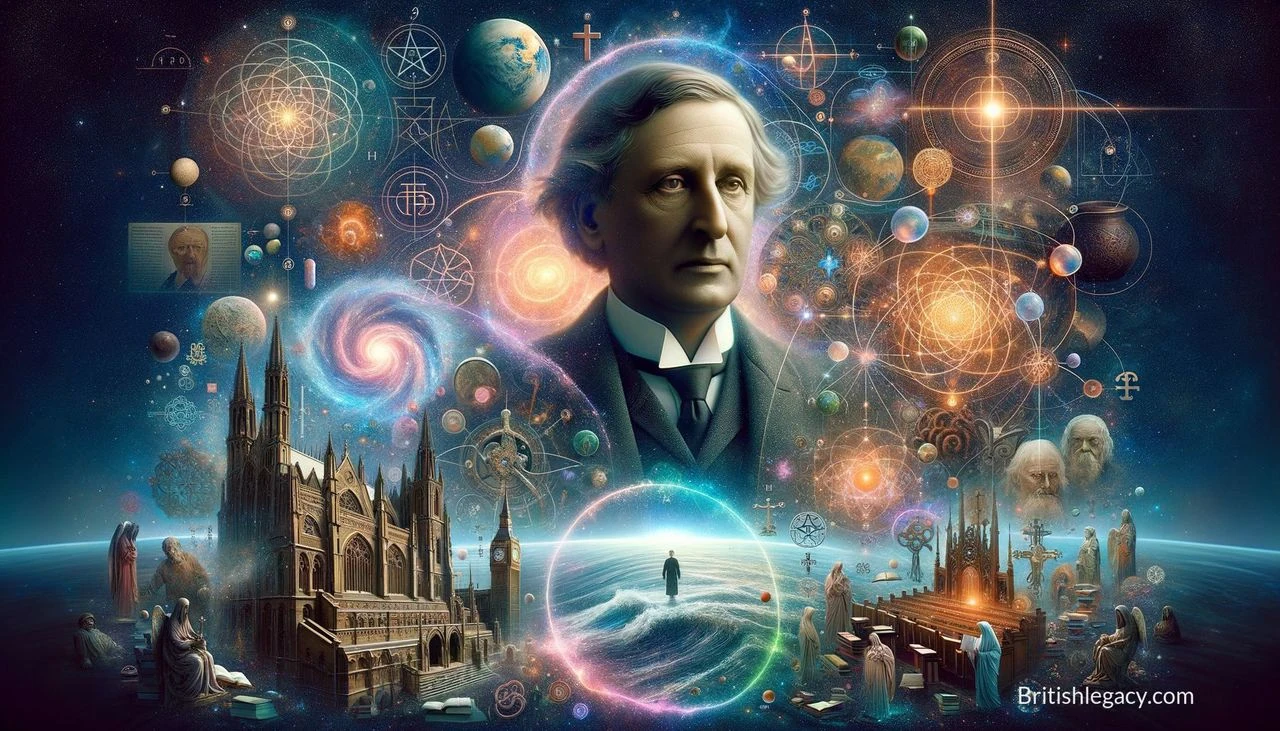
In Principia Mathematica, the three-volume work Alfred North Whitehead wrote with Bertrand Russell, the proof that 1 + 1 = 2 does not appear until page 86 of the second volume. The detail has become a famous measure of the book’s painstaking ambition. It also risks leaving Whitehead in the narrow role of a logician. His career ranged from mathematics and physics through university administration and educational thought to a demanding philosophy of reality as process: a world made not of isolated, unchanging things, but of events shaped by their relations.
Born in Ramsgate, Kent, on 15 February 1861, Whitehead spent much of his working life in British universities before moving to Harvard in 1924. The Atlantic crossing did not sever his intellectual ties with Britain. His later work grew from questions pursued in Cambridge and London, and Process and Reality developed from the Gifford Lectures he gave in Edinburgh. His story is not simply one of a mathematician changing subjects; it is of a thinker repeatedly asking how our different ways of understanding the world fit together.
From Ramsgate to Cambridge
Whitehead was born into a family with a background in education and the Church. His father became an Anglican minister after serving as a schoolmaster, and his grandfather had also been a headmaster. Whitehead attended Sherborne, where he excelled in mathematics and sport and became head prefect. In 1880 he began studying mathematics at Trinity College, Cambridge, under the academic guidance of Edward Routh.
He graduated in 1884 as fourth wrangler, with a dissertation on James Clerk Maxwell’s A Treatise on Electricity and Magnetism. That same year he was elected a fellow of Trinity. He remained associated with the college for decades, teaching and writing on mathematics and physics; his fellowship lasted 57 years. The combination of formal mathematical training and interest in physical theory would remain important even when his work moved into philosophy.
His early writing pursued structures that could bring different mathematical systems into view together. A Treatise on Universal Algebra, published in 1898, examined algebraic systems including Boole’s algebra of logic and Hamilton’s quaternions. Whitehead hoped to develop a general way of interpreting different algebras, though the second volume he planned was never completed. In 1911 he published An Introduction to Mathematics, a work intended for a broader readership than professional mathematicians. It considered the subject’s unity and its relationship to exact thought about natural phenomena.
Whitehead’s Cambridge years also included his growing partnership with Russell, then one of his former pupils. Their collaboration would occupy a decade and produce one of the most ambitious works in mathematical logic. Meanwhile, Whitehead’s own mathematical writing had established an interest in general forms and relations, an approach that would later reappear in a very different register in his account of experience and reality.
A decade spent rebuilding mathematics
Whitehead and Russell originally expected their joint project to take about a year. It took ten. Published in three volumes between 1910 and 1913, Principia Mathematica set out a system of symbolic logic from which mathematical truths might, in principle, be derived. Its more than 2,000 pages record an attempt to examine the foundations of mathematics with exceptional care, rather than simply present established results.
The proof of 1 + 1 = 2, accompanied by the dry observation that the proposition is “occasionally useful”, captures the distance between ordinary arithmetic and the authors’ foundational project. The work set out to show how familiar mathematical results could be built from basic logical principles. It was not a practical arithmetic manual; it was an extended inquiry into what a rigorous system of mathematical reasoning could establish.
Publication itself was costly. The book’s length and specialised readership meant that it appeared at a loss. Cambridge University Press, the Royal Society and the two authors shared the expense. That financial detail gives a sense of the scale of the undertaking, but the project’s significance lies chiefly in its intellectual consequences. It helped make mathematical logic a major field, popularised formal methods and sharpened questions about what proof and foundational systems can achieve.
The programme’s ultimate ambitions were later limited by Kurt Gödel’s incompleteness theorems. These showed that formal systems of the kind sought could not establish every mathematical truth. That development does not reduce Principia Mathematica to a failed experiment. Its methods and questions helped shape subsequent discussion, including the limits of formal proof. Whitehead was not a minor assistant to Russell: the book was a joint intellectual enterprise, and Whitehead was a major architect of it.
In 1910 Whitehead resigned his senior lectureship at Trinity and moved to London without another post already secured. After a year without employment, he became a lecturer in applied mathematics and mechanics at University College London. In 1914 he accepted a professorship in applied mathematics at Imperial College London. His career in the capital soon extended well beyond teaching and research.
Within the University of London system, he became dean of the Faculty of Science in 1918, joined the Senate in 1919 and chaired its Academic Council from 1920. He used those positions to support a new department devoted to the history of science, the establishment of a Bachelor of Science degree and wider access for students with fewer financial resources. His work in higher education was therefore practical as well as intellectual: it concerned the shape of the institution and who could study within it.
The Royal Society elected Whitehead in 1903 and later awarded him the Sylvester Medal. The British Academy elected him a Fellow in 1931. These honours recognised a career that crossed conventional boundaries between the sciences and the humanities, while his London responsibilities placed him directly within the organisation of British higher education.
From scientific concepts to a philosophy of process
Whitehead’s attention gradually moved from mathematics towards the philosophy of science and, ultimately, metaphysics. He wrote about nature, space, time and physical theory in works including An Enquiry Concerning the Principles of Natural Knowledge, The Concept of Nature and The Principle of Relativity. His turn to philosophy was not a retreat from science. He wanted to examine the assumptions beneath scientific description and to understand what scientific concepts reveal, and what they leave out when treated as a complete account of reality.
One target was the picture of the world as a collection of self-contained pieces of matter, related only from the outside and moved by external laws. Whitehead argued that such a description mistakes useful abstractions for the full reality they are meant to describe. He called this error the “fallacy of misplaced concreteness”. Change and relation, in his view, are not superficial additions to things that remain fundamentally fixed; they belong to how the world is constituted.
Whitehead’s philosophy of process reverses a familiar way of thinking. Instead of starting with independent things that later enter into relations, he gives relations a central role in what things are. His basic units are “actual occasions” or events of experience. Each occasion arises from relations with others and contributes something to what follows. Enduring objects and persons can still be described, but as patterns of activity and continuity rather than as perfectly unchanging substances.
Two of his technical terms describe how these occasions take account of one another and come into being. “Prehension” names the way an occasion is influenced by, or takes account of, other occasions. “Concrescence” describes the coming-together through which multiple influences form one concrete occasion. His “philosophy of organism” does not mean that everything in the universe is literally biological. It expresses his view that reality is dynamic and internally related, rather than a collection of inert pieces.
This account has implications for how experience is understood. Whitehead used “experience” broadly, not only for conscious human thought. His aim was to resist a sharp division in which physical events belong to one wholly separate kind of reality and mental life to another. The resulting system is ambitious and difficult; its concepts are not quick substitutes for ordinary scientific descriptions. They are part of an attempt to construct a wider account in which physical explanation, experience, change and value can all be considered.
Harvard, Edinburgh and the mature works
In 1924, aged 63, Whitehead accepted an invitation to join Harvard University as professor of philosophy. He taught there until retiring in 1937 and remained in Cambridge, Massachusetts, until his death on 30 December 1947. The move marked a new stage in his career, but the work he produced there grew from questions he had pursued in Britain: how scientific thought describes nature, and whether its abstractions capture the whole of experience.
At Harvard he published Science and the Modern World in 1925 and Religion in the Making in 1926. His best-known philosophical work, Process and Reality, appeared in 1929. It grew out of the Gifford Lectures he delivered at the University of Edinburgh in 1927–28, before he published them as a book. The lecture series connects his mature metaphysics to a major British academic foundation even as the work itself took shape during his American years.
Process and Reality gives its fullest account of a universe understood through becoming and relation. A person, on this view, is not an unalterable core wrapped in temporary changes, but a connected history of occasions. Nature is not a static stage on which motion happens; interaction and development belong to what the world is. Whitehead’s language can make the book formidable, but the guiding contrast is clear: reality is better understood as a web of events than as a storehouse of independent substances.
Whitehead’s philosophical work did not become the dominant approach in English-speaking philosophy. His prose is difficult, and much analytic philosophy developed along other lines. His influence has instead been substantial in more specific communities. Process theology grew from his work, and ecological thinkers have drawn on its emphasis on mutual dependence. These are developments of his ideas, not evidence that every discipline accepts his system or that his philosophical arguments settle scientific questions.
Education and the value of living knowledge
Whitehead’s concern with education linked his philosophical interests to everyday intellectual life. In The Aims of Education and Other Essays, published in 1929, he warned against “inert ideas”: disconnected pieces of information that students could repeat without understanding how to use them. Knowledge, he argued, should be active, related to judgement and imagination, and brought into contact with the purposes of life.
He did not argue simply for more information or for a larger collection of subjects. He favoured a smaller number of important ideas that could be connected across areas of knowledge and applied in practice. His approach challenged a style of education dominated by external examinations, where teaching could become preparation for a narrow set of tests. Learning, in his account, required room for the development of ideas and their imaginative application.
This educational argument echoes his philosophy. In both, he opposed explanations that win simplicity by cutting away relationships and development. Teaching should not reduce learning to facts detached from use; accounts of nature should not treat change and experience as secondary effects of supposedly self-sufficient matter. The comparison does not make his educational writing a simple restatement of his metaphysics. It shows a recurring concern: how to understand knowledge and things in context, as part of a changing whole.
His public and institutional work gave that concern a setting beyond books. In London, Whitehead held senior roles in the University of London and supported the development of science education, the history of science and wider access to study. His writing on education supplied an argument about how students learn; his administrative work addressed the institutions that made learning possible. Taken together, they show a thinker interested both in abstract foundations and in the conditions under which knowledge is taught.
Why Alfred North Whitehead deserves a place in British Legacy
Whitehead deserves a place in British Legacy because his achievements connect British mathematical education and university life with some of the largest questions of modern philosophy. At Trinity, he built a career in mathematics and physics. With Russell, he co-wrote Principia Mathematica, a landmark attempt to set mathematics on a logical foundation. In London, he held senior academic responsibilities and helped advance the history of science, science degrees and access for students with fewer financial resources. These are concrete contributions to British intellectual and educational institutions, not merely a record of distinction conferred upon an individual.
His later philosophy adds a different kind of value. Whitehead asked readers to take change and relation seriously: not as distractions from reality, but as part of its basic character. His ideas have informed process theology and drawn interest from ecological thinkers and educators. They need not be accepted as a complete system to be useful. They offer a way to question accounts of human life and nature that treat everything as separate, passive or fixed, and invite consideration of how actions and events are connected.
His British legacy is not confined to Principia Mathematica, nor erased by his move to Harvard. The Gifford Lectures in Edinburgh helped shape his best-known philosophical book, while the universities of Cambridge and London formed the earlier stages of his work. Whitehead’s example is of a British-trained mathematician willing to move beyond his first discipline without abandoning rigour. Remembering him brings together logical precision, practical work in higher education and a sustained effort to describe a world in which relations and change matter.
Sources
Alfred North Whitehead — Wikipedia revision 1371954635
Adapted in part from Alfred North Whitehead by Wikipedia contributors, under CC BY-SA 4.0. Text has been edited and combined with the existing article; this adapted text is shared under the same licence. Contributor history.