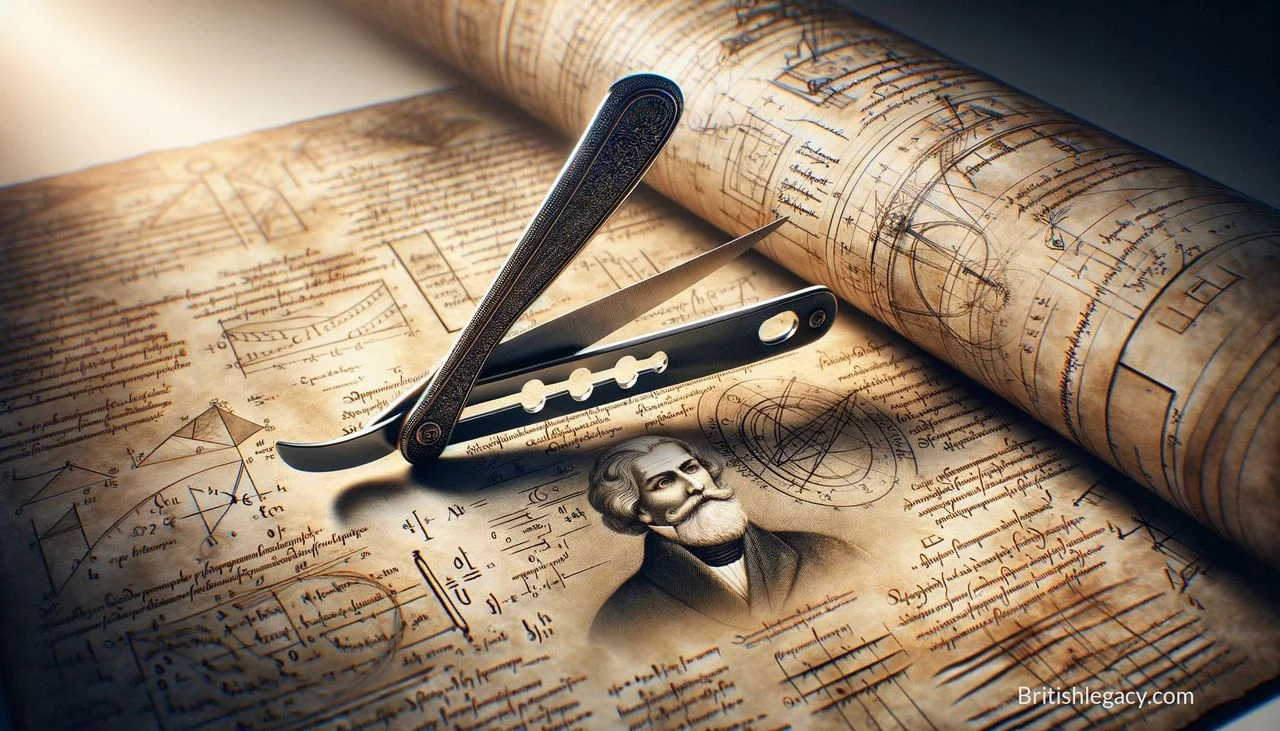
William of Ockham is best known for a razor, but the familiar image of a medieval thinker cutting through complexity can obscure the scale of his work. He wrote on logic, language, knowledge, natural philosophy and theology, and took part in a fierce dispute over the authority of the papacy. Born in Surrey and educated in the Franciscan schools of London and Oxford, he became one of the most influential thinkers of his age by asking what an argument actually needed in order to stand.
Ockham’s razor is not a guarantee that the simplest explanation is always true. It is a demand for restraint: do not posit additional causes or entities unless there is a reason to do so. That distinction matters. Ockham was no advocate of easy answers; his works show a painstaking scholar testing fine points of logic and theology. His intellectual economy was a method for taking claims seriously, not an excuse to avoid their difficulty. [1]
From Surrey to the schools of Oxford
Ockham was probably born in Ockham, Surrey, around 1287. The surviving record of his early life is limited, but the broad outline of his education is known. He joined the Franciscan Order at a young age and received his first theological instruction at its school in London, before studying at Oxford. He was there by the early fourteenth century and probably remained until about 1321.
At Oxford, he lectured on Peter Lombard’s Sentences, a foundational theological work whose commentary formed a central part of a scholar’s training. Ockham completed the requirements for a master’s degree in theology but did not go on to serve as a regent master. The distinction accounts for his later title, Venerabilis Inceptor, or “Venerable Beginner”: he had qualified to begin the next stage of a university career without taking up that role.
His early output ranged beyond theology. It included works on logic and Aristotle, including a commentary on the Physics, as well as the work later known as the Summa logicae, or Sum of Logic. Ockham inherited a formidable scholastic tradition, including ideas developed by Duns Scotus, but did not treat inherited categories as beyond question. He examined whether a distinction or entity was needed to explain the matter at hand, rather than preserving it simply because it had a place in an established system.
This intellectual restraint should not be mistaken for a lack of technical ambition. Ockham worked through detailed arguments about how words signify, how propositions function and what kinds of things can be said to exist. His writing belonged to a university culture in which disputes were a serious method of testing claims. The result was not a rejection of scholastic learning but an exacting contribution to it. [1]
What the razor can—and cannot—do
The maxim most often attached to Ockham is “entities should not be multiplied beyond necessity”. The wording is widely associated with him, but it does not appear in that form in his surviving works. Ockham did express the principle that nothing should be posited without a reason, unless it is self-evident, known through experience or established by the authority of Scripture. The famous sentence is a later formulation of a tendency in his thought, rather than a verbatim quotation.
In practice, the principle called Ockham’s razor asks a thinker not to add hypothetical entities, causes or distinctions without adequate reason. It does not settle a question by choosing whichever explanation has the fewest words, nor does it make every complex theory wrong. Where evidence or argument calls for complexity, the additional explanation may be warranted. The point is that complexity has to earn its place.
That discipline was especially significant in medieval debates about what exists. Philosophers had to consider whether universal terms such as “humanity” or “animal” referred to realities in their own right, or whether they were concepts and words used to speak of individual people and animals. Ockham’s account placed the reality of individual things at the centre. Universals, in broad terms, were concepts and terms through which the mind could think and speak about many individuals. They were not additional objects existing outside the mind alongside those individuals.
His position is often called nominalism, although the label can conceal important details. Ockham’s account included concepts as well as spoken or written words; it was not simply the claim that universals are names and nothing more. Some scholars have preferred descriptions such as terminism or conceptualism. Whatever label is used, his approach turned attention towards the work of language and thought: how terms signify, how propositions refer, and what an argument commits its speaker to.
Ockham’s writing on logic examined those questions closely. The Summa logicae treats terms and propositions as parts of a rigorous analysis of reasoning, rather than as an invitation to accept a claim because it belongs to an inherited scheme. His work on signification and inference is one reason his contribution cannot be reduced to the razor. He was developing a body of logical thought, not merely offering a slogan for tidier explanations.
He also distinguished between intuitive and abstractive cognition. Intuitive cognition concerns whether an object exists or does not exist; abstractive cognition considers an object without making that immediate judgement about its existence. The distinction is scholastic in form, but addresses a lasting philosophical problem: how does direct awareness differ from thought about something that is absent, imagined or otherwise not encountered? Ockham’s account became part of the later medieval discussion of knowledge.
His natural philosophy followed a related concern with what explanations require. In considering Aristotle’s system of categories, he questioned whether every category needed to be treated as a basic kind of reality. This was not modern experimental science in medieval dress, and it would be misleading to present Ockham as having founded scientific method. His contribution was instead to a culture of argument in which an explanation’s assumptions could be challenged and its metaphysical commitments examined. [1]
Avignon, Franciscan poverty and a dispute with the pope
In 1324 Ockham was summoned to the papal court at Avignon to answer concerns about his commentary on the Sentences. His time there brought him into a dispute that would reshape the rest of his career. The Franciscans had committed themselves to poverty, and the question of whether Christ and the apostles had owned property—individually or in common—was tied to the order’s understanding of that commitment.
Pope John XXII rejected important parts of the Franciscan position in a series of pronouncements. Ockham examined the pope’s arguments and concluded that they were erroneous. The disagreement was not a private quarrel over a point of doctrine alone. It concerned the meaning of ownership, the practical conditions of religious life and the extent to which papal authority could settle questions affecting the order.
On 26 May 1328, Ockham left Avignon with Michael of Cesena, the Franciscan minister general, and other dissidents. They eventually found protection in Munich under Louis IV of Bavaria, who was himself in conflict with the pope. Ockham and the other Franciscans were excommunicated for leaving without permission. In the years that followed, Ockham devoted much of his writing to political and ecclesiastical arguments rather than to his earlier academic subjects.
His political works include the Dialogus and the Work of Ninety Days. They consider papal authority, property, political responsibility and the possibility that a pope might be mistaken. Ockham challenged unlimited claims to papal power in temporal affairs and distinguished spiritual functions from earthly rule. He also examined the responsibilities of rulers and the basis on which power could be held. These arguments arose from a specific fourteenth-century conflict, and should not be treated as a complete version of modern constitutional liberalism or a straightforward blueprint for the separation of church and state.
Ockham’s political thought nevertheless extends the habits visible in his philosophy. When an institution claimed authority, he asked what that authority covered and what justified it. The dispute was about more than an abstract division of powers: the Franciscans’ position on poverty concerned how property could be used, who owned it and whether religious practice could be directed by papal decree. His response brought questions of interpretation and reasoning into arguments about public authority.
He remained in Munich after his flight from Avignon. The exact date of his death is uncertain: he probably died on 9 or 10 April 1347, shortly before the Black Death reached the city. The year and place are better established than the precise day. His death ended a life that had moved from English university teaching into the political struggles of the Holy Roman Empire, but his arguments continued to circulate well beyond the circumstances that had first prompted them. [1]
A thinker whose work outlasted its controversies
Ockham’s influence rests on several connected fields rather than a single discovery. His work on logic and language addressed how terms signify and how propositions refer. His discussions of universals challenged the assumption that general concepts must correspond to additional realities outside the mind. His account of cognition contributed to late medieval debates about what it means to know something. His writings on natural philosophy and theology brought the same attention to the assumptions on which an explanation or claim depends.
That range makes him difficult to fit into a simple story of progress towards modern science or political liberalism. Ockham was a Franciscan theologian working within the intellectual and religious institutions of his period. His position on the relationship between faith and reason, like his arguments about papal authority, belonged to that setting. He should not be made into a modern thinker merely because some of his questions remain recognisable.
Nor should his significance be confined to the razor. The maxim survives because it offers an accessible shorthand for an important habit of explanation, but it can also mislead if treated as an instruction always to choose the simplest answer. Ockham’s method demanded reasons, whether an argument was simple or elaborate. His technical works, not the slogan alone, show how that demand was applied to language, knowledge and the kinds of things that a theory asks us to accept.
Ockham’s experience in Avignon added a political dimension to this intellectual legacy. The same scrutiny that he brought to philosophical distinctions became scrutiny of institutional claims. In his political writings he considered the reach of papal authority and the relationship between spiritual office and temporal government. He did not write in the language of modern rights or democracy, but his arguments formed part of a medieval debate about power, ownership and accountability that has attracted later readers.
His continuing place in British religious and intellectual memory has a concrete expression: the Church of England commemorates him on 10 April, the date commonly associated with his death. The commemoration does not turn him into a simple emblem of one tradition or a settled answer to modern questions. It records the presence of a thinker formed in England whose work became part of a wider European argument about what can be known, what words mean and what authority can claim. [2]
Why William of Ockham deserves a place in British Legacy
William of Ockham deserves a place in British Legacy because his achievement began in the intellectual institutions of medieval England and reached into debates that were not confined to England. Probably born in Surrey, educated in the Franciscan school in London and trained at Oxford, he developed a demanding approach to logic, language and explanation. His influence is not best described as a single invention. It lies in the questions he made difficult to avoid: what does a term signify, what kind of reality does a theory require, and what reasons support the claims being made?
The razor gives that approach its most familiar name, but its value depends on using it carefully. Ockham did not establish that the shortest account must be right. His principle asks for reasons before adding assumptions. That is useful in philosophy and scientific reasoning because an explanation should not be burdened with unnecessary machinery; it is equally important not to mistake economy for proof. Ockham’s extensive work in logic and his discussions of universals and cognition show a thinker prepared to pursue complexity when the argument called for it.
His political writing broadens the British connection. After the Franciscan dispute over poverty brought him into conflict with Pope John XXII, he wrote about property, papal authority and the boundary between spiritual and temporal power. These are medieval arguments, not modern political programmes, but they examine how institutions justify their authority and where its limits might lie. The fact that the Church of England still marks his memory on 10 April offers a further link between his English formation and the country’s continuing intellectual and religious history.
Remembering Ockham therefore means preserving both the reach and the limits of his legacy. He was not the inventor of modern science, nor can the razor stand in for everything he wrote. He was an English Franciscan whose analysis of reasoning, concepts and authority entered a much larger European conversation. His example offers readers a durable intellectual benefit: take claims seriously enough to test them, and do not accept an extra assumption merely because it has become familiar.
Sources
William of Ockham — Wikipedia revision 1374746336 · William of Ockham — Wikipedia
Adapted in part from William of Ockham by Wikipedia contributors, under CC BY-SA 4.0. Text has been edited and combined with the existing article; this adapted text is shared under the same licence. Contributor history.