
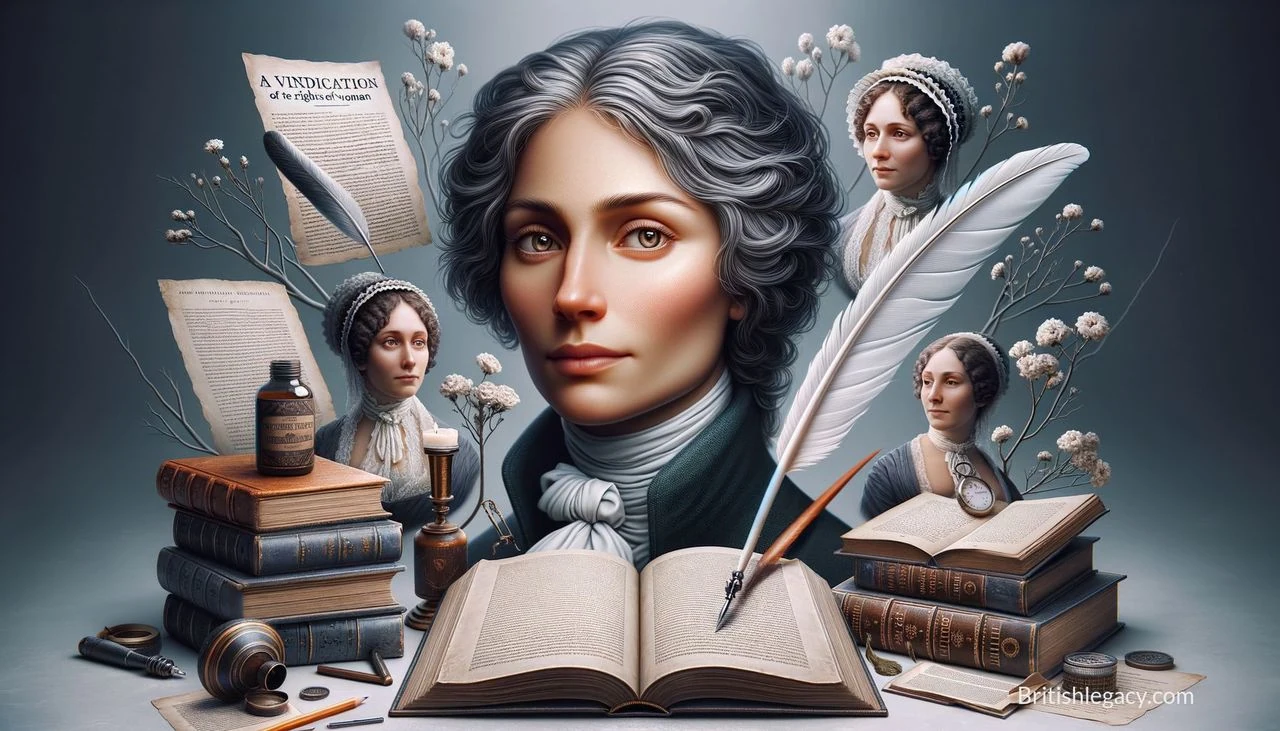
Mary Wollstonecraft’s most famous book began with a challenge to the assumptions behind women’s apparent weakness. In A Vindication of the Rights of Woman (1792), she argued that women were not naturally incapable of reason: they had been denied the education that would allow them to develop it. The argument reached well beyond the classroom. It questioned a society that praised virtue while training women for dependence, and asked what kind of nation could be built when half its population was discouraged from thinking independently.
Wollstonecraft was an English writer and philosopher who earned her living through writing at a time when few women could support themselves in that way. Her work ranged from educational books and political pamphlets to fiction, history and travel writing. Her life carried her from a financially unsettled childhood in London to the radical publishing circles around Joseph Johnson, revolutionary Paris and Scandinavia. After her death, her reputation was obscured for generations by the disclosures in her husband’s memoir. The writing, however, remained available to readers who would recover its force and carry its arguments into later campaigns for women’s rights.
A life shaped by constraint and self-education
Mary Wollstonecraft was born in Spitalfields, London, on 27 April 1759, the second of seven children. Her family’s finances deteriorated as her father squandered money, and the household moved repeatedly. The family was eventually so short of money that her father required her to give up money she would otherwise have inherited. The supplied Wikipedia account describes him as violent towards his wife; Wollstonecraft, still a teenager, sometimes lay outside her mother’s bedroom to protect her. She also took on a protective, maternal role towards her sisters, Everina and Eliza. These experiences placed dependence and women’s restricted choices in front of her as lived problems, not simply topics for argument.
She had little formal education, but developed her mind through reading, discussion and friendship. As a young woman in Beverley she read books and attended lectures with Jane Arden, whose father encouraged an intellectual atmosphere at home. Another important friendship was with Fanny Blood, whom Wollstonecraft credited with opening her mind. Their friendship became part of a wider effort to find security and purpose outside the conventional expectations placed on women.
Wollstonecraft worked as a lady’s companion in Bath, returned home when her mother was dying, and later helped to establish a school for girls at Newington Green with her sisters and Blood. The school did not survive. Blood’s marriage and worsening health took her away, and Wollstonecraft left to nurse her in Lisbon, where Blood died. The loss helped inspire Wollstonecraft’s first novel, Mary: A Fiction, published in 1788. The school’s brief existence still matters to the development of her ideas: girls’ education was a practical question about the lives and prospects women could build, not an abstract debate.
After working as a governess to the daughters of the Anglo-Irish Kingsborough family in Ireland, Wollstonecraft decided to become an author. The choice was a difficult one: respectable career options for poor women were narrow, and earning a living by writing was unusual. She moved to London and, with the support of the publisher Joseph Johnson, built a working life through translation, reviewing and original writing. She contributed reviews, mainly of novels, to the Analytical Review, and translated works from French and German. Johnson’s circle brought her into contact with writers and political thinkers, including Thomas Paine and William Godwin. She was not simply observing the intellectual life around her; she wrote and argued within it.
Education, character and independence
Education was a continuing concern in Wollstonecraft’s writing. In Thoughts on the Education of Daughters (1787) and the children’s book Original Stories from Real Life (1788), she considered how education could form character and judgement. These books challenged an ideal of feminine accomplishment that placed appearance, pleasing others and dependence above the development of reason. She wanted education to encourage self-command and the ability to think, rather than to prepare girls merely to attract approval.
That argument was also political. Wollstonecraft believed that women mattered to the life of the nation as well as to private households. If women were to educate children and take part in family life, it was illogical to deny them the intellectual formation that could make them capable companions and responsible parents. Nor did she regard the home as separate from public questions: the habits of dependence taught in private life affected the character of society as a whole.
In A Vindication of the Rights of Woman, she argued that women appeared inferior because they were not given the opportunities to develop their minds. Her case connected education with work, marriage, virtue and self-respect. Women needed the ability to support themselves where necessary and to participate in relationships as companions, rather than as decorative dependants. She also proposed a national system of education, including schooling in which boys and girls would in important respects be educated on the same model. Her point was not that women should copy men, or that domestic life had no value. It was that reason and virtue could not be expected to flourish when one sex was trained to be intellectually dependent.
Wollstonecraft’s argument challenged more than overt exclusion. Compliments about women’s delicacy or charm could coexist with their exclusion from education and independence; praise was no substitute for opportunity. She rejected the idea that women’s dignity could be secured by treating them as naturally purer or more deserving of protection. Instead, she argued for their capacity to exercise judgement and to develop virtue through education. The book’s attention to ordinary institutions—schooling, work and marriage—gave its account of liberty an immediate social dimension.
Political writing and revolutionary experience
Wollstonecraft’s first major political intervention was A Vindication of the Rights of Men (1790), written in response to Edmund Burke’s Reflections on the Revolution in France. Burke defended established hierarchy and used the language of chivalry to describe the French royal family. Wollstonecraft attacked hereditary privilege and the sentiment that, in her view, softened or concealed its injustice. Her response made her a prominent participant in Britain’s dispute over the French Revolution. It also exposed the limits of political arguments about liberty that left women’s position unexamined.
The two Vindications are linked: the first challenged inherited political authority; the second asked why the principle of equal rational dignity should stop at the boundary of sex. In Rights of Woman, Wollstonecraft argued that women should be treated as rational beings and that their education should match their place in society. She connected their development to the quality of family life and the nation. This was not a demand for respect in name alone. It was a demand to change the circumstances that restricted women’s choices and kept them from exercising their abilities.
In December 1792 Wollstonecraft travelled to Paris, where she witnessed the revolution she had followed and supported from Britain. The political situation grew more dangerous. She was a British subject in France, associated with the moderate Girondins, and unable to leave after foreigners were forbidden to do so in 1793. Her experience placed her close to the changing fortunes of the revolution and the violence of the Reign of Terror. It also complicated any simple celebration of political upheaval. Wollstonecraft had to confront the distance between a revolution’s promises and the actions of those exercising power.
In France she formed a relationship with the American Gilbert Imlay. Their daughter, Fanny, was born in 1794. Imlay later left Wollstonecraft, and she returned to London in 1795. Her account of the revolution, An Historical and Moral View of the French Revolution, was published in 1794. It considered the conditions that had brought about revolution while also confronting the violence and abuses of the new regime. Rather than treating political ideals as immune to events, Wollstonecraft tried to understand both the social causes of upheaval and the consequences of power unchecked.
Wollstonecraft’s later travel writing offers another view of her range. After Imlay’s departure, she travelled through Sweden, Norway and Denmark on business, with her young daughter and a maid. She developed the experience into Letters Written in Sweden, Norway, and Denmark (1796), a book that combines travel observation, reflections on society and personal feeling. It was her most popular work during her lifetime. Its attention to landscape, commerce and inner life shows an author working beyond the political pamphlet, and one able to turn an unsettled personal period into searching prose.
Marriage, death and the afterlife of her reputation
Wollstonecraft and Godwin’s relationship developed after her return to England. They married on 29 March 1797, after Wollstonecraft became pregnant, and moved to Somers Town. Their marriage was brief. On 30 August she gave birth to their daughter, Mary, later known as Mary Shelley. Wollstonecraft died on 10 September 1797, aged 38, from an infection following childbirth. The child survived and became the author of Frankenstein. Wollstonecraft had written across education, political controversy, fiction, history and travel; her life ended before she could complete several further projects.
Godwin’s Memoirs of the Author of A Vindication of the Rights of Woman, published in 1798, described her life with an openness that shocked many readers. It disclosed her relationships, her daughter with Imlay and her suicide attempts. Rather than ensuring that the public understood the full complexity of her work, the memoir helped damage her reputation for much of the nineteenth century. Critics and writers often treated her personal life as a warning, while the wider range of her writing received less attention.
Her work was not entirely forgotten. Writers and reformers continued to engage with it, and the later nineteenth-century campaign for women’s suffrage helped restore her standing. Millicent Garrett Fawcett wrote an introduction to a centenary edition of Rights of Woman in 1892, presenting Wollstonecraft as a forerunner of the struggle for the vote. In the twentieth century, the growth of feminist scholarship and activism brought renewed attention to both her writing and her life. That recovery shifted the emphasis away from scandal and towards the arguments that had made her a political thinker.
Wollstonecraft’s books reward attention beyond the single title by which she is best known. Her educational writing, political polemic, novels and travel letters each approach questions of judgement, power and the conditions of a woman’s life in different ways. Her early fiction examined women’s restricted choices, while Letters Written in Sweden, Norway, and Denmark made room for observation of place, society and feeling. Together, the works show a writer who did not confine herself to one genre or one aspect of public debate.
Why Mary Wollstonecraft deserves a place in British Legacy
Mary Wollstonecraft deserves a place in British Legacy because she made the meaning of liberty harder to evade. In the British political argument sparked by the French Revolution, she challenged hereditary privilege and the sentimental language used to defend it. Then, in A Vindication of the Rights of Woman, she pressed the question further: how could a society claim to value reason and virtue while denying women the education needed to develop either? Her answer connected schooling with work, marriage, family life and public responsibility. Women’s independence was not a decorative addition to a debate about freedom; it changed what freedom had to mean in practice.
Her contribution is also evident in the range and circumstances of her work. Wollstonecraft made a living as an English author through translation, reviewing and original writing, and she used that career to take part in the intellectual life of her time. She wrote educational books that treated girls as minds capable of formation, political works that questioned the authority of inherited rank, and travel writing that joined social observation to personal reflection. These achievements helped give later readers a more forceful language for women’s education and independence. Her career also offers a clear British connection: she developed her political voice in London’s publishing and reforming circles and intervened in arguments about the society around her. Her legacy rests not on a claim that she solved every question of equality, but on the lasting value of the questions she made central: who is educated, who is trusted to reason, and who is allowed to live independently.
Sources
Mary Wollstonecraft — Wikipedia, revision 1375562955 · Mary Wollstonecraft — Wikipedia
Adapted in part from Mary Wollstonecraft by Wikipedia contributors, under CC BY-SA 4.0. Text has been edited and combined with the existing article; this adapted text is shared under the same licence. Contributor history.
.jpg)