
Alastair McIntosh’s work asks who should have power over land, and what that power means for the people who live with its consequences. A Scottish writer, academic and activist, he has brought questions of community control into debate about environmental responsibility, while connecting climate change and land reform with ethics and spirituality. His writing and campaigning have ranged from the Isle of Eigg to opposition to a proposed superquarry on Harris.
From Lewis to environmental thought
Born in 1955, McIntosh was brought up in Leurbost on the Isle of Lewis. His later education brought together geography, moral philosophy, psychology and business: he graduated from the University of Aberdeen in 1977 with a BSc in geography, submajoring in moral philosophy and psychology, and gained an MBA from the University of Edinburgh in 1981.
McIntosh’s academic interests did not remain within one discipline. His work joins environmental questions to the social and ethical frameworks through which people understand them. In 2008, the Academy of Irish Cultural Heritages at the University of Ulster approved a PhD by published work based on Soil and Soul and twelve supporting publications, accompanied by a linking thesis on liberation theology and community empowerment in Scottish land reform. A version of that work appeared as Rekindling Community: Connecting People, Environment and Spirituality, published with colleagues and in association with WWF International and the Centre for Human Ecology.
Land reform and community control
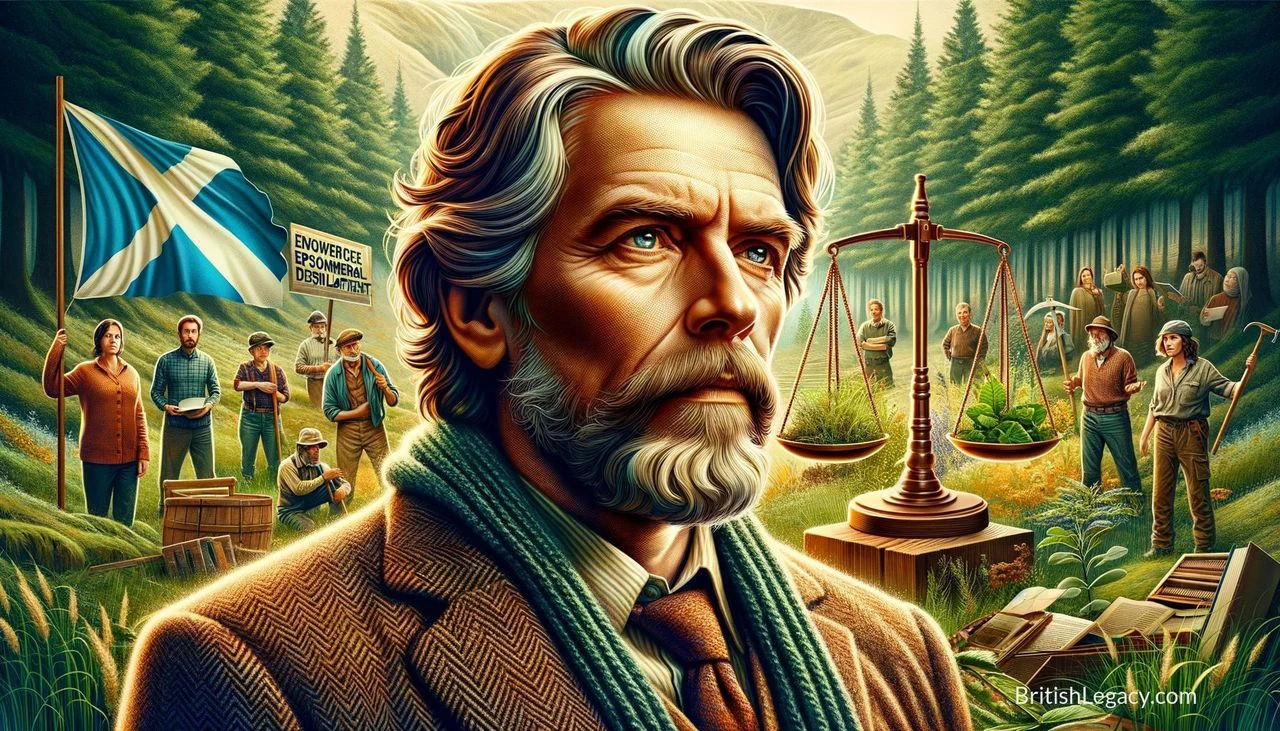
McIntosh has been involved in Scottish land reform, particularly on Eigg. His work in this area is closely associated with the community buyout of the island in the late 1990s. Residents organised through the Isle of Eigg Heritage Trust and secured collective ownership, replacing the control of an absentee landlord with community stewardship. The change made a practical question of a wider political argument: whether people living on and depending on land should have a meaningful say in its future.
McIntosh’s contribution sits within a larger community effort, rather than making the buyout a story of one individual. His writing helped bring land, identity and power into the same discussion. In Soil and Soul: People Versus Corporate Power, published in 2001, he examined the relationships between communities, corporate power and the places people inhabit. The book became his best-known work and carried those debates to readers beyond the islands.
His campaigning also extended to Harris, where he campaigned successfully against the proposed superquarry at Lingerbay. The Eigg and Harris campaigns involved distinct local questions, but both show the importance of community participation in decisions about land and development. They also locate McIntosh’s environmental work in particular Scottish places, rather than in abstract calls for sustainability alone.
Writing on climate, hope and spirituality
McIntosh’s books have developed these concerns across different forms. Healing Nationhood: Essays on Spirituality, Place and Community appeared in 2000. His 2006 collection, Love and Revolution, brought together his poetry. In Hell and High Water: Climate Change, Hope and the Human Condition, published in 2008, he considered the psychological and spiritual dimensions of climate change alongside its wider human implications.
That emphasis does not make climate change simply a matter of personal belief: it reflects McIntosh’s interest in how people understand and respond to collective problems. His work brings environmental concerns into contact with questions of meaning, responsibility and social justice. The approach also informs Spiritual Activism: Leadership as Service, written with Matt Carmichael and published in 2014.
His later writing continued to address the climate crisis. Riders on the Storm: the Climate Crisis and the Survival of Being appeared in 2020. The book’s title points to the scale of the subject, while McIntosh’s wider body of work repeatedly returns to how people and communities can face environmental change without separating it from human wellbeing.
Academic work and community institutions
Alongside his books and campaigns, McIntosh has held academic and community roles. He is a fellow of the Centre for Human Ecology and an honorary fellow of the Schumacher Society. In 2006, he became a visiting professor of human ecology at the University of Strathclyde, the first appointment of that kind at a Scottish university.
He also helped set up the GalGael Trust, based in Govan, and serves as its treasurer and a non-executive director. The organisation’s community setting reflects an enduring strand in McIntosh’s work: environmental and social questions are not confined to universities or policy debates, but are also addressed through local institutions and relationships. His public work has included writing, teaching and engagement with community groups.
Why Alastair McIntosh deserves a place in British Legacy
McIntosh’s place in British Legacy rests on the way his writing and activism have connected Scottish land reform with larger debates about democratic participation and environmental responsibility. His involvement in the Eigg campaign is part of a collective achievement: island residents organised through the Isle of Eigg Heritage Trust to secure community ownership. McIntosh’s contribution to the wider debate has helped make clear that land reform is not only about who holds title. It is also about whether communities can influence decisions affecting their homes, livelihoods and future. His successful campaign against the proposed Lingerbay superquarry on Harris adds another specific example of local environmental advocacy.
His books extend that public contribution beyond any single campaign. From Soil and Soul to his writing on climate change, McIntosh has brought together ecology, community, spirituality and social justice, giving readers a framework for considering environmental issues as human and ethical questions as well as technical ones. His academic work, teaching and involvement in institutions such as the Centre for Human Ecology and GalGael connect those ideas to education and community life. This is a distinctly Scottish contribution to British public debate: grounded in particular landscapes and local efforts, yet concerned with questions of power and stewardship that reach far beyond them.
Sources
Adapted in part from Alastair McIntosh by Wikipedia contributors, under CC BY-SA 4.0. Text has been edited and combined with the existing article; this adapted text is shared under the same licence. Contributor history.
.jpg)