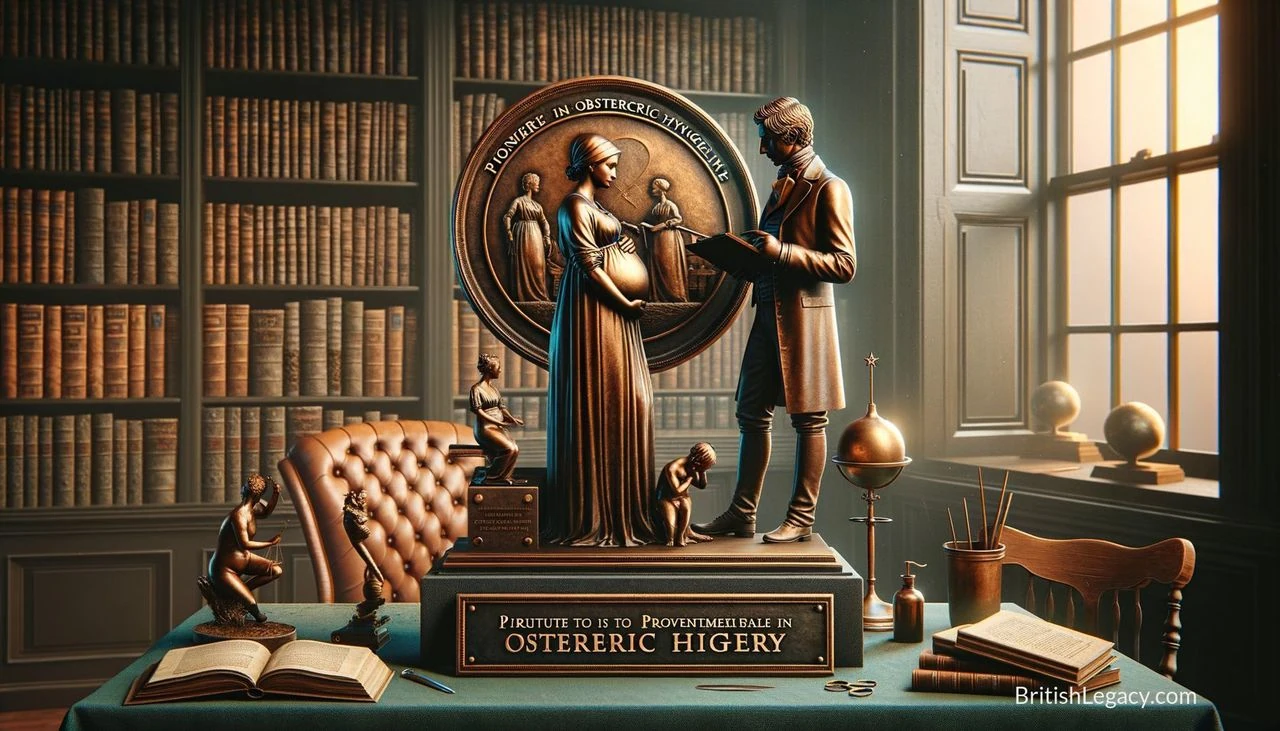
Alexander Gordon’s study of puerperal fever began with a practical question: why were women who had recently given birth falling ill in clusters? By recording who had attended each patient, the Aberdeen physician concluded that midwives and doctors could carry the infection from one woman to another. In 1795, he published his findings and urged attendants to wash themselves and have their clothing fumigated. His account was unusually direct: he acknowledged that he, too, had helped spread the disease.
Education across Scotland and Europe
Gordon was born on 20 May 1752 at Milton of Drum, a farmstead in Aberdeenshire. His father, also named Alexander, was a tenant farmer there. Between 1771 and 1775 Gordon studied for an arts degree at Marischal College, Aberdeen, and graduated with a Master of Arts. He then pursued medicine, walking the wards at Aberdeen Infirmary for clinical experience. As the university did not then offer regular undergraduate medical classes or award medical degrees, he went to Leiden in the Netherlands, a leading medical school and a familiar destination for Scottish students.
In 1779–80, Gordon attended anatomy lectures in Edinburgh given by Alexander Monro secundus. He did not graduate in medicine at either Leiden or Edinburgh. Instead, he passed the examination of the Company of Surgeons, later the Royal College of Surgeons, and earned its Certificate of Proficiency. This combination of study and practical training shaped a career that crossed naval, hospital and community medicine.
From naval surgeon to Aberdeen physician
Gordon joined the Royal Navy as a surgeon’s mate in 1780 and was promoted to surgeon the following year. In 1785 he left the navy on half pay. He spent time in London as a resident pupil at the Store Street Lying-in Hospital, attended lectures on childbirth by Thomas Denman and William Osborne, and gained experience assisting at deliveries. He also attended the Middlesex Lying-in Hospital and pursued surgical experience at Westminster Hospital.
There was no practising obstetrician in Aberdeen, so Gordon returned in 1785. From February 1786 he worked as physician to the Aberdeen Dispensary, seeing patients both there and in their homes. He received an MD from the University of Aberdeen in 1788. During this period he wrote a medical textbook, The Practice of Physick, which described contemporary practice and favoured decisions grounded in observation and experience over reliance on old aphorisms. Yet his own treatment of puerperal fever still included bleeding and purging, standard remedies of the period.
Following the fever through Aberdeen
Between 1789 and 1792, epidemics of erysipelas, a skin infection, and puerperal fever began and ended over the same period. Gordon was familiar with childbed fever from his experience in London, but it had not previously been recognised in Aberdeen. He kept detailed notes of his visits, recording the names of midwives and doctors and the dates they had attended affected women. The patterns led him to conclude that a small number of attendants were carrying the illness between patients. He also recognised that he himself had been a carrier, admitting in his account: “I myself was the means of carrying the disease to a great number of women.”
Gordon argued that the fever came from a specific contagion or infection, not from a generally unhealthy atmosphere, as miasma theory proposed. He linked the course of the puerperal-fever epidemic with that of erysipelas and considered both to involve infectious matter. His explanation was not modern germ theory, and he described transmission in the medical language of his time. But his careful comparison of cases, attendants and dates gave him grounds to challenge the prevailing account of disease.
His 1795 publication, Treatise on the Epidemic Puerperal Fever of Aberdeen, set out his findings and advice. Gordon said patients’ clothing and bedclothes should be burnt or thoroughly purified, and that nurses and physicians should wash themselves and have their clothing fumigated before wearing it again. The current article’s additional claim that he recommended disinfecting instruments is not included here: the referenced account specifies clothing, bed linen and the cleanliness of attendants. Gordon’s suggestions were informed in part by sanitary improvements associated with naval surgeon James Lind and military surgeon Sir John Pringle.
Opposition, influence and later life
Gordon’s candid case records named patients and midwives. He understood that revealing those names carried risks, and the resulting hostility was substantial. He wrote that midwives had “raised an odium against my practice”; by the end of his time in Aberdeen, his patients, midwives, fellow doctors and members of the public had turned against him. The account of his work therefore includes not only an early argument for infection control, but also the personal and professional cost of publishing sensitive evidence.
Gordon’s paper appeared 48 years before Oliver Wendell Holmes published The Contagiousness of Puerperal Fever in 1843; Holmes quoted Gordon and credited him. Semmelweis published his major work on the prevention of childbed fever 66 years after Gordon’s treatise, without mentioning it. These distinctions matter: the evidence supports Gordon as an earlier investigator of contagion and prevention, but not the claim that his work was later vindicated by both Semmelweis and Joseph Lister. Gordon’s account also records that he continued to use treatments such as bleeding and purging, so his insight into transmission should not be mistaken for a complete break with the medicine of his day.
Gordon married Elizabeth Harvie in 1784. They had two daughters, one of whom died young; their daughter Mary married Robert Harvey, one of Gordon’s pupils. In 1795 Gordon was recalled to the navy. He served on HMS Adamant and then HMS Overyssel. After contracting pulmonary tuberculosis, he returned to his brother James’s farm at Logie, Aberdeenshire, where he died on 19 October 1799, aged 47.
Why Alexander Gordon deserves a place in British Legacy
Gordon deserves a place in British Legacy for the method and candour of his investigation as well as its conclusions. Rather than treating each death as an isolated event, he recorded the attendants and timing of cases and used those patterns to argue that puerperal fever could pass from one patient to another. He then made the uncomfortable admission that he had helped transmit it himself. That combination of systematic observation and personal accountability gave his case unusual force, even though his understanding of infection remained shaped by the medicine of the eighteenth century.
His practical recommendations connected that evidence to prevention: clean attendants, washed bodies, fumigated clothing and purified or burnt bed linen. They anticipated later recognition of the importance of infection control in childbirth, while the chronology places Gordon’s publication decades before Holmes and Semmelweis. His record also shows the human consequences of medical inquiry: naming patients and midwives brought hostility, and his practice became unpopular. Remembering Gordon in a British context means recognising a Scottish physician working in Aberdeen and within wider British medical and naval institutions, not claiming that one man single-handedly created modern maternity care. His documented contribution is more specific and more valuable: an early, evidence-led account of contagion in childbirth, accompanied by concrete advice intended to protect women.
Sources
Alexander Gordon (physician), revision 1354942271
Adapted in part from Alexander Gordon (physician) by Wikipedia contributors, under CC BY-SA 4.0. Text has been edited and combined with the existing article; this adapted text is shared under the same licence. Contributor history.