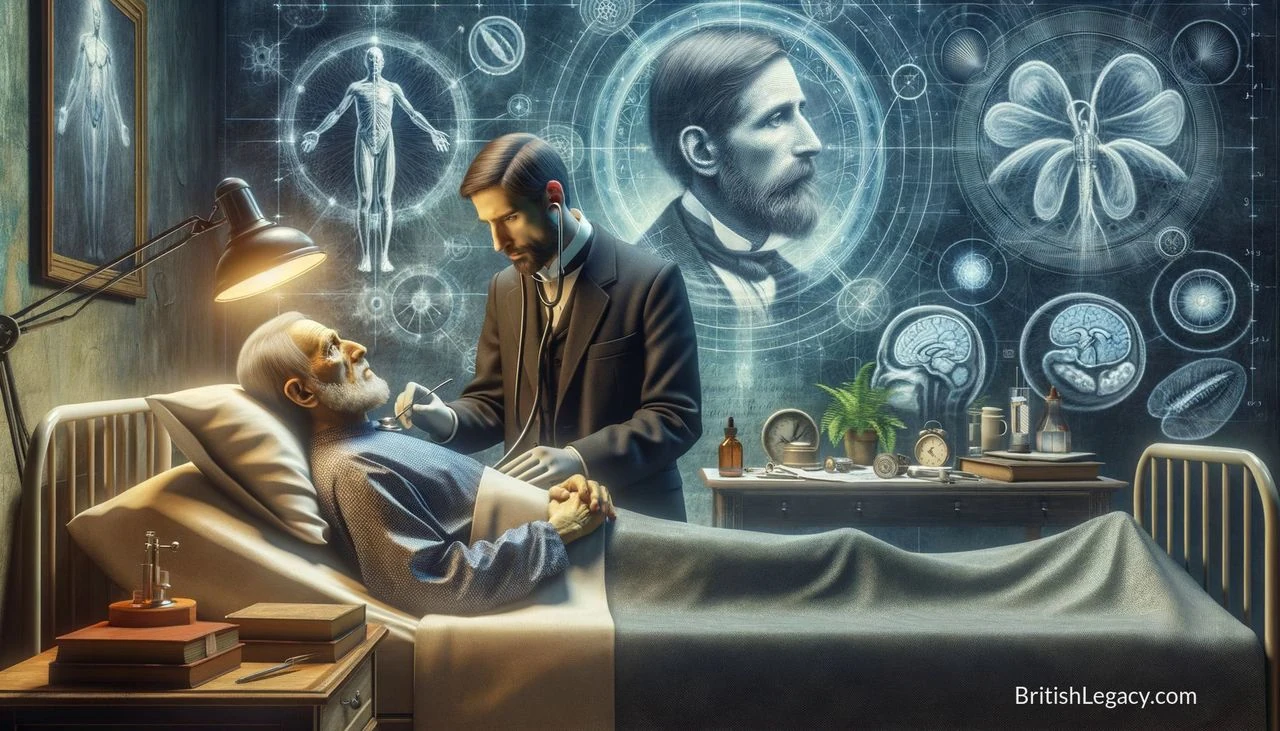
William Osler’s most enduring teaching idea was also a practical one: medical students should learn from patients, not only from books and lectures. As a physician and educator in Canada, the United States and Britain, he helped establish bedside teaching and medical residency as central parts of clinical training. His career reached its British chapter in 1905, when he became Regius Professor of Medicine at Oxford.
From Canada to the medical faculty
Osler was born on 12 July 1849 in Bond Head, Canada West, and was raised in Dundas, Ontario. He initially entered Trinity College at the University of Toronto intending to follow his father into the ministry. His interests changed towards medicine, and after studying at the Toronto School of Medicine he entered McGill University’s medical programme in Montreal. He received his medical degree in 1872.
After postgraduate study in Europe, including work under the pathologist Rudolf Virchow in Germany, Osler returned to McGill in 1874 as a professor. His teaching and research there ranged across clinical medicine and pathology. He also established what the biographical account describes as the first formal journal club, bringing doctors together to discuss medical papers.
In 1884, Osler took the chair of clinical medicine at the University of Pennsylvania in Philadelphia. He became one of the founding members of the Association of American Physicians in 1885. Four years later, he moved to Baltimore as the first physician-in-chief of Johns Hopkins Hospital. When the Johns Hopkins School of Medicine was established in 1893, he became one of its first professors of medicine.
Teaching in the wards
At Johns Hopkins, Osler made direct contact with patients a defining part of medical education. He took small groups of students on hospital rounds and encouraged them to observe, question and examine patients. His approach was not simply a call for a warmer bedside manner: it made the ward a place of structured learning and clinical work.
Osler’s idea of clinical clerkship gave students in their third and fourth years experience working with patients on the wards. They took histories, conducted physical examinations and undertook laboratory tests. He reduced the emphasis on lectures alone, believing that a doctor’s judgement had to be developed through seeing and talking to people who were ill. His often-quoted advice, “Listen to your patient—he is telling you the diagnosis”, captures that attention to the patient’s account.
He also helped establish the medical residency at Johns Hopkins. In the system he developed, physicians in training took on hospital responsibilities over an extended period, with residents living at the hospital. The structure was demanding, but it gave trainees sustained clinical experience. The residency model and bedside teaching spread beyond Johns Hopkins and influenced medical education across the English-speaking world.
Books, calm and professional life
Osler was a prolific writer as well as a teacher. His The Principles and Practice of Medicine, first published in 1892, brought together contemporary clinical knowledge and became an influential textbook for students and practitioners. It went through many editions and was translated into several languages. Osler was also a collector of books on medical history, a subject he treated as an important part of understanding the profession.
His 1885 farewell address at the University of Pennsylvania, titled “Aequanimitas”, discussed the composure and balance he considered necessary in a physician. The address became closely associated with his approach to professional life: technical knowledge mattered, but doctors also needed self-command in difficult circumstances. His writing and public speaking were noted for their clarity, and his essays addressed both clinical practice and the responsibilities of doctors.
Osler’s British career began in 1905, when he was appointed Regius Professor of Medicine at Oxford. He remained in the post until his death. In Britain he helped initiate the Association of Physicians in 1907 and served as founding senior editor of its journal, the Quarterly Journal of Medicine. He also took part in building postgraduate medical organisations, becoming the first president of the Postgraduate Medical Association in 1911. That year he was created a baronet for his contributions to medicine.
Oxford and the final years
Osler became a fellow of Christ Church while at Oxford. His work there connected university medicine with the wider professional institutions he helped to establish. He served as president of the Bibliographical Society from 1913 to 1919 and supported medical libraries in Britain as well as in North America. His interest in books and the history of medicine was more than private collecting: he helped create institutions through which such material could be studied.
Osler died in Oxford on 29 December 1919, aged 70, during the Spanish flu epidemic. The biographical account identifies complications from undiagnosed bronchiectasis as the most likely cause. His wife, Grace, and their son Edward had been part of his family life; Edward, a British officer, was killed in the First World War in 1917. Osler’s own library was left to McGill University, where it became the foundation of the Osler Library of the History of Medicine.
Why William Osler deserves a place in British Legacy
Osler’s claim on British Legacy rests on a specific chapter of a career that was international from the outset. He was born and trained in Canada, held major posts in Philadelphia and Baltimore, and then spent the last fourteen years of his working life as Regius Professor of Medicine at Oxford. In Britain he helped establish the Association of Physicians and its journal, and contributed to postgraduate medical organisations. These were practical commitments to the professional life of medicine, not simply the prestige of an Oxford title.
His wider importance lies in the teaching methods he developed and championed. Osler made the patient’s bedside a place where students could practise careful observation, history-taking and examination, and helped establish residency as sustained clinical training. Those approaches shaped medical education beyond the institutions where he worked. His textbook and his writing on composure and professional responsibility also joined clinical knowledge to reflection on how doctors should practise. Remembering Osler in a British context therefore does not require making him exclusively British: it recognises how his years in Oxford and his work with British medical institutions formed part of a career whose educational influence crossed national boundaries.
Sources
William Osler — Wikipedia revision 1377841368
Adapted in part from William Osler by Wikipedia contributors, under CC BY-SA 4.0. Text has been edited and combined with the existing article; this adapted text is shared under the same licence. Contributor history.