Angela Georgina Burdett-Coutts inherited a fortune large enough to make her one of the wealthiest women in England. She used much of it to support schools, housing, public health, the relief of poverty and projects overseas. Her philanthropy ranged from a home for young women established with Charles Dickens to a market in east London, church endowments and an early effort to improve Jerusalem’s water supply. In 1871, Queen Victoria made her a peer in recognition of her work.
An inheritance turned towards public work
Born on 21 April 1814, Burdett-Coutts was the daughter of Sir Francis Burdett, 5th Baronet, and Sophia Coutts, the daughter of banker Thomas Coutts. In 1837, after the death of her step-grandmother Harriot Beauclerk, Duchess of St Albans, she inherited her grandfather’s fortune, reported at around £1.8 million. She joined her father’s and grandfather’s surnames by royal licence, becoming Burdett-Coutts.
She was widely known as one of England’s richest heiresses. Her wealth gave her unusual means to fund projects, but the breadth of her giving was not confined to a single institution or cause. She supported education and relief for people in poverty, while also backing public and community projects. She avoided taking sides in partisan politics and gave to causes without making a particular religious creed a condition of her charity.
Her private life also drew public attention. She held receptions at Holly Lodge, her country house in Highgate, and collected paintings, including works by Old Masters. Her companion Hannah Brown, formerly her governess, was a central figure in her life; when Brown died in 1878, Burdett-Coutts described herself as crushed by the loss after 52 years together. At 67, she married her American-born secretary, William Lehman Ashmead Bartlett, who took the surname Burdett-Coutts. A clause in the duchess’s will restricting marriage to a foreign national was invoked, and she forfeited three-fifths of her income to her sister.
Schools, training and a home with Dickens
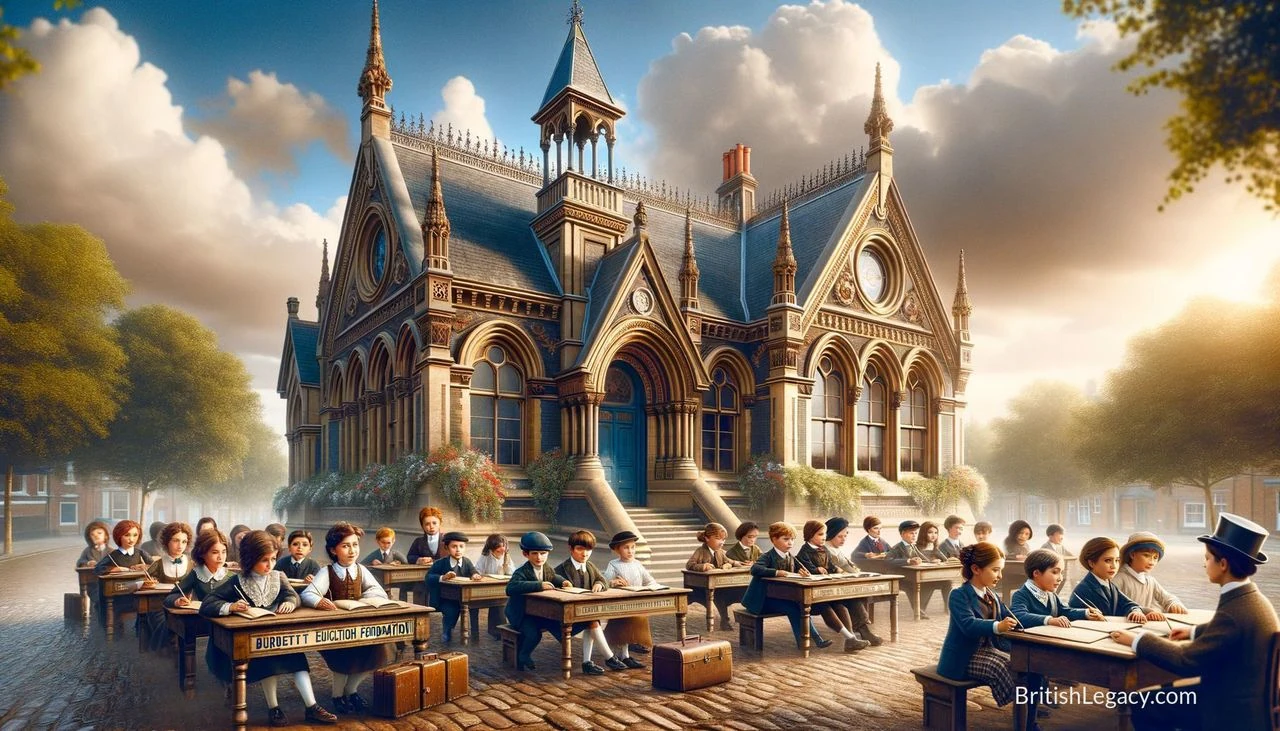
Education was a substantial part of Burdett-Coutts’s philanthropy. She built and endowed church schools, including St Stephen’s Church in Rochester Row, Westminster, and contributed to the education of children in working communities. Acting as executor of the poet Chauncy Hare Townshend’s will, she and the Reverend Thomas Helmore used money from his estate to establish a primary school in Westminster. It became known as Burdett-Coutts & Townshend Foundation Church of England Primary School.
Her work also addressed the needs of people for whom conventional schooling was not the central issue. With Charles Dickens, she co-founded Urania Cottage, a home for young women who had been drawn into theft or prostitution. The project offered a refuge and a route towards a different life, reflecting a practical interest in support as well as education. In 1893 she founded Westminster Technical Institute, extending her educational work into technical training.
Her concern for young people included destitute boys: she helped place hundreds in training ships for service in the navy and merchant marine. She supported a sewing school for women in Spitalfields when the silk trade declined, and promoted fishing schools and the provision of boats in Ireland. In 1880 she advanced £250,000 for seed potatoes for impoverished tenants there. These efforts joined instruction and training to attempts to address particular economic hardships.
Markets, housing and public health
In 1869 Burdett-Coutts founded Columbia Market in Bethnal Green, in London’s East End, where much of her work was concentrated. Its produce market was intended to serve local needs; the associated development in Columbia Square placed her among the supporters of social housing. She also created Holly Village in Highgate, a small housing development on the edge of her estate.
Clean water and sanitation shaped another strand of her work. In 1864 she financed an Ordnance Survey of Jerusalem, whose principal purpose was to find a better drinking-water supply for the city. The survey did not locate a new source, but produced a detailed map that later research could use. Burdett-Coutts subsequently helped fund other explorations in the Holy Land, including a proposed further search for water led by Charles Warren. In Britain, she provided drinking fountains, including one in Victoria Park, as well as fountains for dogs.
Her giving reached beyond London and Britain. She endowed bishoprics in Cape Town and Adelaide in 1847, and the founding bishopric of British Columbia in 1857. She supported missionary and nursing efforts, and backed organisations concerned with Indigenous peoples in Australia and the Dayak people of Borneo. She also supported relief for Turkish peasants and refugees during the 1877 Russo-Turkish War; the Ottoman Order of the Medjidie was among the honours she received. Her projects included support for cotton production in Nigeria and the Cotton Supply Association.
Public service and recognition
Burdett-Coutts took an active role in organisations as well as providing funds. She was involved in the Royal Society for the Prevention of Cruelty to Animals and became the first president of its ladies’ committee, formed in 1869. In 1884 she co-founded the London Society for the Prevention of Cruelty to Children, which became the National Society for the Prevention of Cruelty to Children in 1889. She also served as president of the British Beekeepers Association from 1878 until 1906.
Queen Victoria conferred on her a peerage in 1871, making her Baroness Burdett-Coutts of Highgate and Brookfield in the County of Middlesex. The recognition reflected a public career that spanned education, welfare and civic improvement. In 1872 she received the Freedom of the City of London; in 1874 she became the first woman to receive the Freedom of Edinburgh. She was also a benefactor of the Church of England and supported the installation of church bells at St Paul’s Cathedral.
Death and the scale of her giving
Burdett-Coutts died of acute bronchitis at her home in Piccadilly on 30 December 1906. By then, she had given more than £3 million to good causes. Nearly 30,000 people filed past her coffin before her burial at Westminster Abbey on 5 January 1907. She left no children, and her barony became extinct on her death.
Her charitable work included individual grants, endowed institutions and projects intended to change the conditions in which people lived. Not every undertaking had the outcome its supporters hoped for: the Jerusalem survey, for instance, did not find a new water source. Yet its mapping work had lasting research value. The mix of practical relief, institutional support and civic construction gives a clearer measure of her work than a single description of her as a benefactor.
Why Angela Burdett-Coutts deserves a place in British Legacy
Burdett-Coutts’s place in British history rests on more than the size of her inheritance or the number of causes she supported. She used private wealth to help build and sustain institutions with specific public purposes: schools in Westminster, technical training, a society to prevent cruelty to children, and facilities such as Columbia Market in Bethnal Green. Her work connected education with material circumstances, from vocational support for young women at Urania Cottage to sewing instruction in Spitalfields and fishing schools in Ireland. Those initiatives show philanthropy operating through buildings, training and organised services, rather than solely through charitable gifts.
Her projects also linked local needs to wider interests. In London, she supported housing and drinking fountains; in Jerusalem, she financed a survey intended to improve access to water; overseas, she endowed bishoprics and supported relief, nursing and missionary work. Some outcomes were limited, but the range of aims is itself significant: she treated public welfare as a matter for sustained investment across communities and institutions. Her leadership in the RSPCA’s ladies’ committee and her role in founding the organisation that became the NSPCC added an organisational dimension to her giving. For British Legacy, her story records how a woman with exceptional resources shaped civic and charitable life at home and beyond it.
Sources
Angela Burdett-Coutts, 1st Baroness Burdett-Coutts
Adapted in part from Angela Burdett-Coutts, 1st Baroness Burdett-Coutts by Wikipedia contributors, under CC BY-SA 4.0. Text has been edited and combined with the existing article; this adapted text is shared under the same licence. Contributor history.