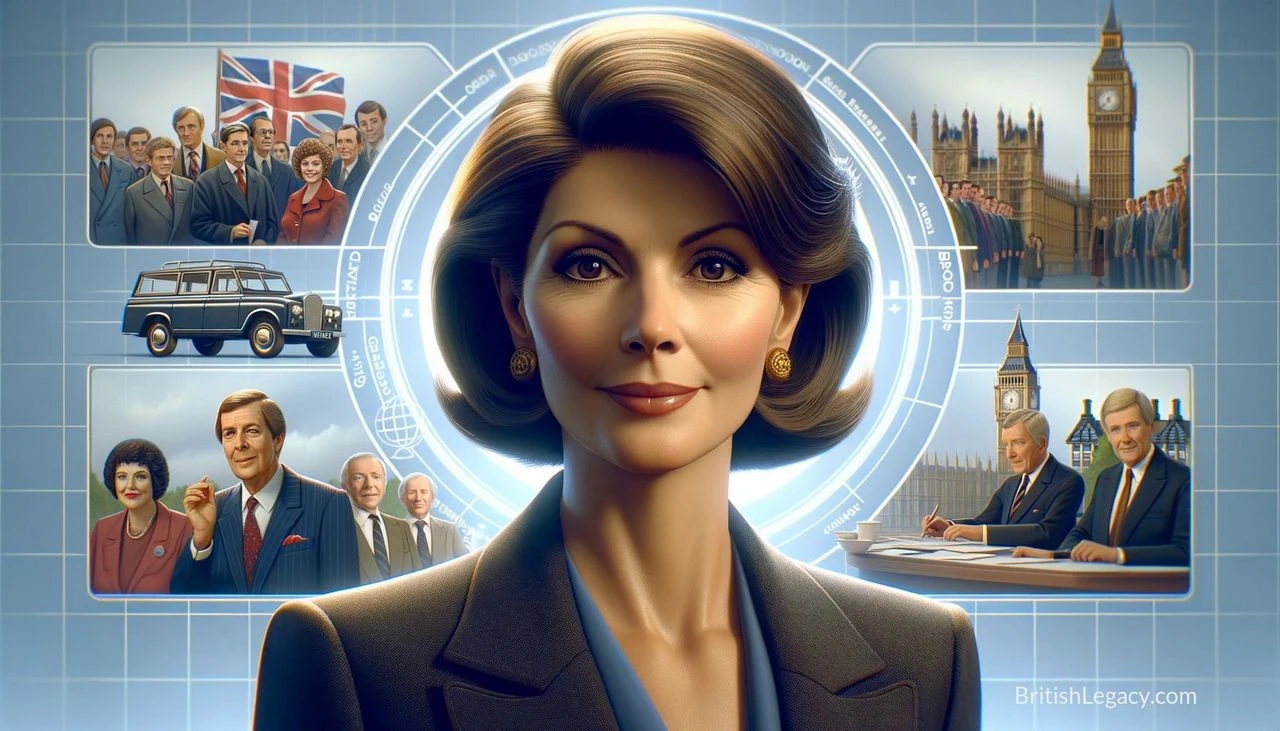
Angela Rippon’s career has moved between the television news studio, the ballroom and programmes made for a broad daytime audience. Her place in British broadcasting history rests on a specific milestone: she was the first female journalist to read the news regularly on national television. But her work was never confined to the news desk. From a striking appearance on a Morecambe and Wise Christmas special to consumer television and radio, Rippon built a long career across different formats.
From Plymouth to the national news
Angela May Rippon was born in Plymouth on 12 October 1944. Her father, John, was a Royal Marine; her mother, Edna, worked for a fine china company and as a seamstress. Rippon attended the Public Secondary School for Girls in Plymouth. At 17, she left school and joined the photographic office of the Western Morning News. She also worked for the Sunday Independent, before moving into broadcasting as an editor at BBC local radio and Westward Television.
In 1966, aged 21, Rippon began her television career at BBC South West in Plymouth. She went on to report for BBC television news, and in 1974 presented a national news programme on BBC Two. The following year, after briefly standing in for Richard Baker on BBC One’s Nine O’Clock News, she was offered a permanent newsreading role.
The distinction matters. Rippon was not the first woman to read television news in Britain: Barbara Mandell had appeared on ITV in 1955, and Nan Winton had presented national news for BBC Television in 1960. Rippon was the first female journalist to read the news regularly on national television. Her appointment brought a woman journalist into a continuing role on one of the BBC’s principal news programmes, rather than making her a one-off or temporary presenter.
A newsreader beyond the news desk
While reading the Nine O’Clock News, Rippon also took on programmes that used different parts of her experience. She briefly presented Antiques Roadshow in 1979, and was the first presenter of the BBC television version of Top Gear, which she presented from 1977 to 1979. She hosted the Eurovision Song Contest in 1977 at the Wembley Conference Centre, and later presented coverage of the 1979 general election results and the 1981 wedding of the Prince of Wales and Lady Diana Spencer.
Her appearance on the 1976 Morecambe and Wise Christmas Show supplied one of the most memorable contrasts with her serious newsreader image. First seen behind a BBC news desk, she emerged to perform a high-kicking dance routine to “Let’s Face the Music and Dance”. The performance became a defining piece of television entertainment, and she returned for a cameo in the following year’s show.
Rippon’s presenting work continued across genres. In the mid-1980s she hosted the BBC One quiz Masterteam, and from 1988 to 1990 presented ITV’s revival of What’s My Line?. She also hosted the tennis-based game show Matchpoint in 1990. Her connection with ballroom television included presenting Come Dancing, the long-running BBC competition, and presenting the BBC’s coverage of the United Kingdom Ballroom Championships in 1991.
Broadcasting through a changing career
Rippon’s career included setbacks as well as prominent assignments. She appeared briefly on TV-am after its launch in 1983. The two women presenters were dismissed, and Rippon later said she feared for a year that her television career had ended. She subsequently worked for WHDH-TV in Boston as an arts and entertainment correspondent, making a documentary that won an Emmy, before returning to work in Britain.
In 1990, Rippon moved into daily radio news, presenting Angela Rippon’s Morning Report on LBC Newstalk until 1994, followed by Angela Rippon’s Drivetime. She was also a regular presenter on BBC Radio 2, including seasonal Friday-night programmes and cover for Jimmy Young. On television, she stood in as a newsreader on Channel 4’s The Big Breakfast until 2002. These roles kept her work in journalism while extending it into the looser rhythms of radio and breakfast television.
Later programmes brought her to new audiences. Rippon co-presented Rip Off Britain with Gloria Hunniford and Julia Somerville from 2009 until her departure in 2024. The BBC consumer programme examined problems affecting members of the public. She also co-presented Holiday Hit Squad in 2013 and 2014, and Amazing Greys in 2014. In 2016, she co-presented the two-part series How to Stay Young. Her other television work included Cash in the Attic, the BBC One factual series Health: Truth or Scare and voiceover work on the game show The Wall.
Rippon returned to the dance-floor spotlight as a contestant on the sixth series of Dancing on Ice in 2011. In 2023, more than three decades after presenting Come Dancing, she took part in the twenty-first series of Strictly Come Dancing. A career that began with reporting and newsreading had, by then, encompassed competition, documentary, consumer and entertainment television, as well as radio.
Writing, public roles and honours
Alongside broadcasting, Rippon has written books. In the early 1980s, her name appeared on a series of children’s books about the tree fairy Victoria Plum. She also wrote Mark Phillips, the Man and His Horses in 1982, and later published keep-fit guides for older people, including Stay Active, Stay Supple, Stay Healthy. In 2000, she became chair of English National Ballet, leaving the role in late 2003 after complaints about her leadership style.
Rippon was appointed Officer of the Order of the British Empire in the 2004 Birthday Honours. In 2012, Plymouth University awarded her an honorary doctorate of Arts. She was appointed Commander of the Order of the British Empire in the 2017 New Year Honours for services to dementia care, in connection with her role as development lead with Dementia Friendly Communities.
Why Angela Rippon deserves a place in British Legacy
Angela Rippon’s place in British broadcasting history is grounded in a clearly defined change: she became the first female journalist to read the news regularly on national television. The qualification is important, because women had appeared as television newsreaders before her. Rippon’s permanent role on the BBC’s Nine O’Clock News marked a further step: a woman journalist was entrusted with regular delivery of national news. Her career gives that milestone a human scale, showing how a breakthrough can be significant without needing to erase those who came earlier.
Her legacy also lies in the range of public broadcasting she helped make familiar. Rippon moved from reporting and newsreading to programmes including Top Gear, Come Dancing, radio news and Rip Off Britain. That breadth connected the authority of the newsroom with entertainment, consumer information and everyday television. Her later work on a programme addressing consumer problems continued a public-facing strand of broadcasting, while her role in dementia-friendly communities is recognised in her 2017 CBE. Together, these achievements make her story relevant to British Legacy: it records both a barrier broken in national journalism and a career sustained across the changing forms of British television and radio.
Sources
Adapted in part from Angela Rippon by Wikipedia contributors, under CC BY-SA 4.0. Text has been edited and combined with the existing article; this adapted text is shared under the same licence. Contributor history.