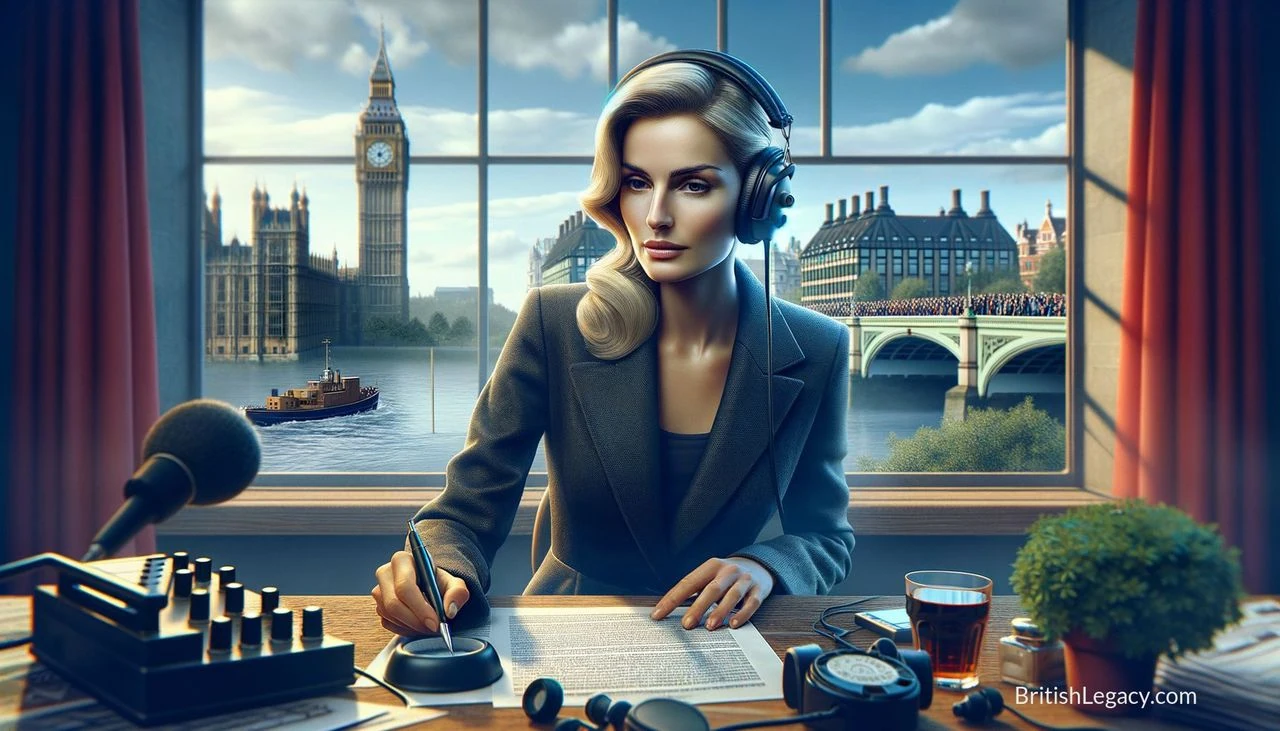
Kirsty Young’s broadcasting career has moved between the immediacy of television news, the public appeal of Crimewatch and the intimate conversations of Desert Island Discs. Born in East Kilbride, she began in Scottish broadcasting before becoming a leading news presenter on Channel 5 and one of the best-known hosts of BBC Radio 4’s long-running interview programme. Her work connects Scottish broadcasting with national television and radio, while her career has continued into live events and newer interview formats.
Starting out in Scotland
Young was born on 23 November 1968 in East Kilbride, Lanarkshire. She attended Cambusbarron Primary School and Stirling High School. After leaving school, she did not get the exam result she needed to go to university. Instead, she took a succession of jobs, including work as a runner and then a researcher for her sister’s boyfriend’s television company. That route brought her into broadcasting without the conventional university path.
In 1989, Young became a continuity announcer for BBC Radio Scotland. Three years later she moved to Scottish Television, where she presented the news programme Scotland Today. The work led to her own chat show, Kirsty. She left Scotland Today in 1996, taking relief-presenter work on The Time, The Place and appearing on the BBC’s Holiday programme. She also co-hosted The Street, a consumer show on BBC Two. These early roles gave her experience across news, interviews and factual television before she became a national news anchor.
Channel 5 and national television
In March 1997, Young joined the news team of the newly launched terrestrial channel Channel 5, presenting its flagship programme, Channel 5 News. She remained its lead presenter for a decade, apart from a short period away. Her position placed her at the centre of the channel’s news operation from its launch, and she became a familiar face to viewers.
Her television work was not confined to the news. In 1999, she took part in the first Celebrity Stars in Their Eyes, winning with an impersonation of singer Peggy Lee performing “Fever”. The following year she left Channel 5 for ITV, where she briefly hosted the quiz show The People Versus. In 2001, she became a co-presenter of the ITV Evening News. After the birth of her first child, she returned to Channel 5 News, presenting again from 14 January 2002.
Young later broadened her factual television work. From January 2010, she presented the four-part BBC series The British Family; in 2011, she presented The British at Work. These programmes sat alongside her news and interview work, extending her television career beyond the daily bulletin.
Two defining programmes
In June 2006, the BBC announced Young as the new presenter of Desert Island Discs, succeeding Sue Lawley. Young began hosting the BBC Radio 4 programme on 1 October that year. She returned briefly to Channel 5 News in September 2006, but announced the following year that she would leave the programme in the autumn. Her last edition was broadcast on 29 August 2007, after ten years as its lead anchor.
In September 2007, the BBC announced that Young would take over from Fiona Bruce as the presenter of Crimewatch. She hosted the BBC One programme from January 2008 until December 2015. Her work on the two programmes involved different kinds of broadcasting: Crimewatch brought crime appeals and information to a television audience, while Desert Island Discs centred on guests choosing the music that mattered to them and discussing their lives through those selections.
Young remained at the helm of Desert Island Discs until health problems interrupted her work in 2018. The BBC announced in August that she would step away for a number of months to receive treatment for fibromyalgia, with Lauren Laverne deputising. In July 2019, Young said she would not return as host. She explained that her enforced absence had changed her perspective and that she wanted to pursue new challenges. Her tenure had lasted from 2006 to 2018; Laverne continued in the role.
Work beyond the studio
Young’s later broadcasting has included major public events. In June 2022, she presented BBC One’s live coverage of the lighting of more than 1,500 beacons for the Platinum Jubilee. In September that year, she fronted the later part of the BBC’s television coverage of Queen Elizabeth II’s state funeral at St George’s Chapel, Windsor Castle. She also presented Young Again on BBC Radio 4, interviewing notable guests about what they would tell their younger selves; the programme ran until 2025.
In May 2026, Young hosted David Attenborough’s 100 Years on Planet Earth, a concert at the Royal Albert Hall celebrating Attenborough’s life and natural-history career. The event marked a further shift in format, from daily news and studio interviews to live coverage of a large-scale public occasion.
Why Kirsty Young deserves a place in British Legacy
Young’s place in British broadcasting rests on the range of programmes through which audiences have encountered her work. She began at BBC Radio Scotland and Scottish Television, then became a leading presenter on Channel 5 News from the new channel’s launch. She went on to host Crimewatch on BBC One and Desert Island Discs on Radio 4. These roles placed her in distinct traditions of British broadcasting: television news, public-facing crime appeals and the long-form radio interview. Her career shows how a presenter can move between formats while remaining closely associated with programmes that have a strong place in the country’s media life.
Her contribution is also evident in the span of her work. The ten years she spent as Channel 5 News’s lead anchor were followed by eight years presenting Desert Island Discs, and by later coverage of the Platinum Jubilee and the state funeral of Queen Elizabeth II. Those events called for live broadcasting on a national scale; Young Again returned her to the patient exchange of an interview. Together, these roles offer a specific reason to remember her: Young has helped carry news, conversation and public occasions to audiences across the UK. Her route from Scottish radio to national television and radio also makes her a notable figure in the story of broadcasting across Britain.
Sources
Adapted in part from Kirsty Young by Wikipedia contributors, under CC BY-SA 4.0. Text has been edited and combined with the existing article; this adapted text is shared under the same licence. Contributor history.