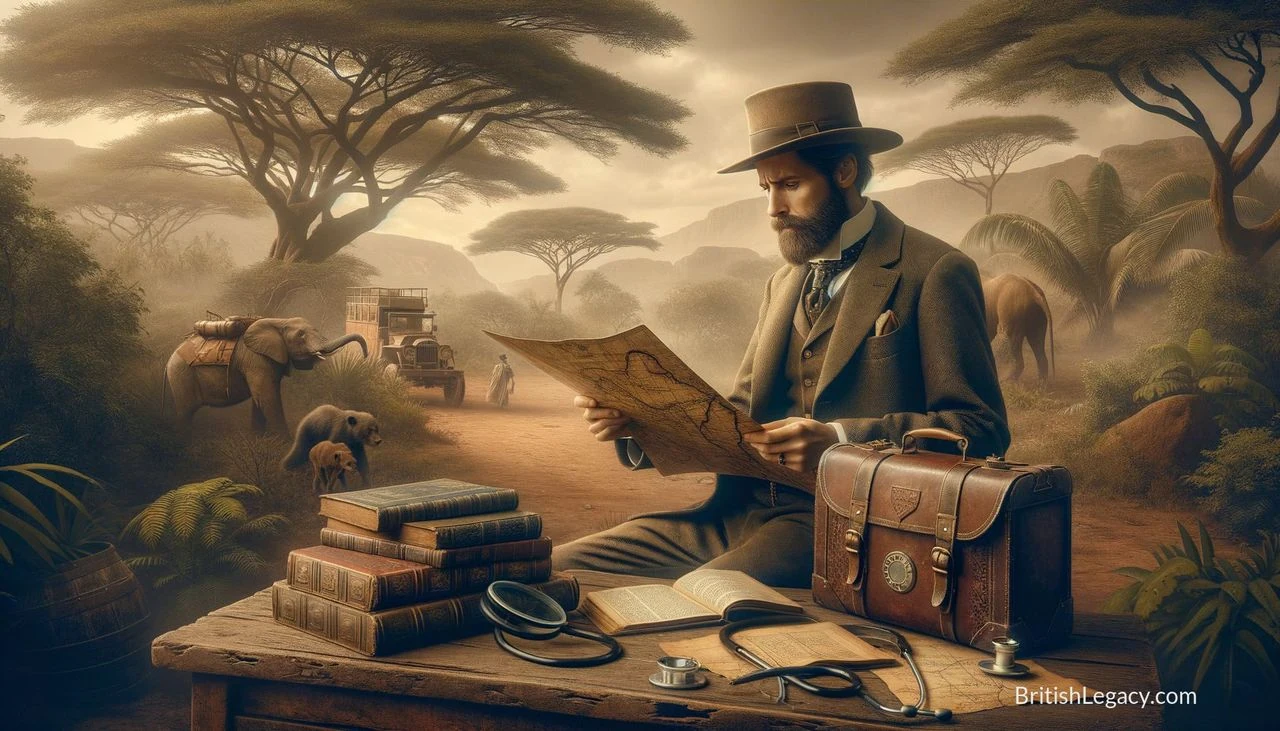
David Livingstone became one of Victorian Britain’s best-known explorers, but his African journeys were never only about geography. A Scottish doctor and Congregationalist missionary, he hoped Christian missions and what he called “legitimate commerce” could help displace the slave trade. His reputation as a national hero grew from achievements that mattered to European geography and public debate, but his record was not uncomplicated: expeditions failed, colleagues questioned his leadership, and his ambitions were bound up with European commercial and colonial expansion.
A working life before Africa
Livingstone was born on 19 March 1813 in Blantyre, Scotland, in a tenement for cotton-factory workers. The second of seven children, he began work in the mill at ten, tying broken threads and later working as a spinner. His shifts could last 14 hours, yet he attended the village school and continued reading. His father, Neil, was a Sunday-school teacher and teetotaller whose interest in theology and missionary work helped shape the family’s religious life.
Livingstone also developed a strong interest in science and the natural world. He sought to reconcile scientific study with Christian faith, and medical training offered a route into missionary work. He studied medicine and chemistry at Anderson’s University in Glasgow, alongside theology, then undertook clinical training at Charing Cross Hospital in London. He qualified in 1840 and was ordained as a Congregationalist minister that November.
In 1838 the London Missionary Society (LMS) had accepted him as a probationary candidate. He initially hoped to serve in China, but the LMS’s plans changed. The missionary Robert Moffat’s account of communities north of established mission stations helped direct Livingstone towards southern Africa. He left Britain in November 1840 and reached the Cape of Good Hope the following March.
Mission stations and the road north
Livingstone’s early years in southern Africa combined missionary work with travel and practical challenges. After reaching the Kuruman mission, he travelled with other missionaries and African companions to investigate places where a new station might be established. He worked at Mabotsa, where a lion attack in 1844 badly injured his left arm. In January 1845 he married Mary Moffat, Robert Moffat’s daughter.
His mission work did not follow a straightforward course. He left Mabotsa after disagreements with fellow missionary Roger Edwards, and moved on from Chonuane after drought and other difficulties. At Kolobeng he converted Chief Sechele, but Livingstone’s expectations of Christian practice brought him into conflict with Sechele’s existing family and social commitments. Sechele later continued to profess Christianity and helped spread it among the Kwena, while retaining customs Livingstone had challenged.
Livingstone’s missionary project was therefore not simply a story of education and healthcare being brought to the people he encountered. It involved religious aims and cultural tensions, as well as the knowledge and labour of African guides, interpreters and companions who made his travels possible. His own ambition to move beyond established stations repeatedly shaped the course of his work.
Routes, rivers and Victoria Falls
Livingstone travelled north from Kolobeng with William Cotton Oswell. In 1849 they reached Lake Ngami; in 1851 Livingstone reached the Zambezi, which he considered a possible route into the interior. In 1852 he sent his family back to Britain and set out from the river with Kololo guides and interpreters. Their journey west brought them to Luanda on the Atlantic coast in 1854. Livingstone judged that route too difficult for future traders, returned to Linyanti, then travelled east with another group of Kololo men.
On this eastern journey he became the first European recorded to see Mosi-oa-Tunya, which he named Victoria Falls in honour of Queen Victoria. He reached the Indian Ocean at Quelimane after travelling along much of the Zambezi’s course. In Britain, his crossing was celebrated as an opening of central Africa. But regional trade routes already existed: Portuguese traders had travelled inland from both coasts, and African and Arab traders had crossed the continent before him. Livingstone’s achievement added to European geographical knowledge; it was not the discovery of an empty or unknown land.
He returned to Britain in 1856. His account, Missionary Travels, appeared in 1857 and became a bestseller. It described his journeys and field observations, and argued that river access, Christian missions and legitimate trade could offer an alternative to slave trading. The LMS did not support his plans for further exploration as they turned increasingly towards commerce. He resigned from the society in 1857 and became a British consul with a roving commission in parts of eastern and central Africa.
Ambition, setbacks and the slave trade
Livingstone’s government-backed Zambezi expedition, which ran from 1858 to 1864, was intended to investigate the river’s potential as a commercial route. The plan encountered serious practical problems: boats could not pass the Cahora Bassa rapids, and the expedition struggled to make progress. Disagreements developed among its members, and Livingstone dismissed the artist Thomas Baines. The expedition was recalled and criticised in the British press. Its scientists nevertheless collected botanical, ecological, geological and ethnographic material for institutions in Britain.
The expedition brought personal loss as well. Mary Livingstone died of malaria in 1862. A later LMS mission to the Kololo, for which Livingstone had promoted the region, suffered several deaths from malaria. His own experience of the disease had not prevented him from understating the dangers and overstating the quality of the land, according to biographer Tim Jeal’s assessment reported in the article’s account of the episode.
In 1866 Livingstone returned to Africa to investigate the sources of the Nile. He did not find them. His travels took him to lakes including Mweru and Bangweulu and to the Lualaba River, which he eventually understood did not flow into the Nile. His observations helped map areas that had been left blank on European maps, but his theory about the Nile’s source was mistaken.
Opposition to the slave trade became central to his public purpose. Livingstone recorded the violence and suffering he witnessed, and used letters, books and reports to draw attention to the trade. Yet the realities of his later travels made him dependent at times on assistance from traders involved in slavery. His account of the 1871 massacre at Nyangwe also has a complicated publication history: the journal edited after his death left out context present in his field notes. His campaigning brought the trade to public attention, but he was not separate from the networks on which his expeditions depended.
Stanley, death and a public reputation
Livingstone lost contact with the outside world for years. In November 1871 the American journalist and explorer Henry Morton Stanley found him at Ujiji. The familiar greeting “Dr. Livingstone, I presume?” became part of the episode’s legend, but its wording is uncertain: Stanley’s diary pages for the meeting did not survive, and Livingstone’s own account does not record it.
Livingstone refused Stanley’s urgings to leave Africa and continued travelling despite poor health. He died on 1 May 1873 at Chief Chitambo’s village, in what is now Zambia, from malaria and internal bleeding due to dysentery. His African attendants Chuma and Susi arranged for his heart to be buried near the place of death, then led the long journey carrying his remains, papers and belongings to the coast. His body was returned to Britain and buried in Westminster Abbey.
His reputation had suffered during his lifetime after the Zambezi expedition failed. The news of his death, Stanley’s account and the remarkable journey made by his attendants helped restore his standing. The Royal Geographical Society awarded him its Patron’s Medal in 1855 for his explorations. His legacy also includes the observations he recorded, the public attention his writing brought to the slave trade, and the consequences of a vision joining religious mission to British commercial and colonial ambitions.
Why David Livingstone deserves a place in British Legacy
Livingstone’s place in British history rests on more than the familiar image of an explorer beside Victoria Falls. His geographical observations helped Europeans map parts of central Africa, while his books and reports brought accounts of the slave trade to a British readership. He argued that missions and legitimate commerce could replace trade in enslaved people. That programme was bound up with expanding British influence, however, and his own journeys depended at times on assistance from slave traders. His expeditions also exposed the costs of ambitious plans: the Zambezi venture failed, colleagues faced danger and disease, and Mary Livingstone died during the expedition’s years. Acknowledging these tensions makes his influence clearer, not smaller.
His story connects Scottish origins and British institutions with events across Africa. The LMS shaped his early career; government support enabled later exploration; the Royal Geographical Society recognised his work; and Westminster Abbey became his place of burial. African guides, interpreters and companions supplied essential local knowledge and labour. After his death, Chuma and Susi led the journey that carried his remains and papers to the coast, ensuring that his work could be returned to Britain. Remembering Livingstone in British Legacy means holding together his contribution to geography and anti-slavery debate with the limits and costs of his project. His life offers a specific view of how Victorian faith, commerce and empire travelled together, and of the people whose work made that history possible.
Sources
David Livingstone (revision 1379268759)
Adapted in part from David Livingstone by Wikipedia contributors, under CC BY-SA 4.0. Text has been edited and combined with the existing article; this adapted text is shared under the same licence. Contributor history.