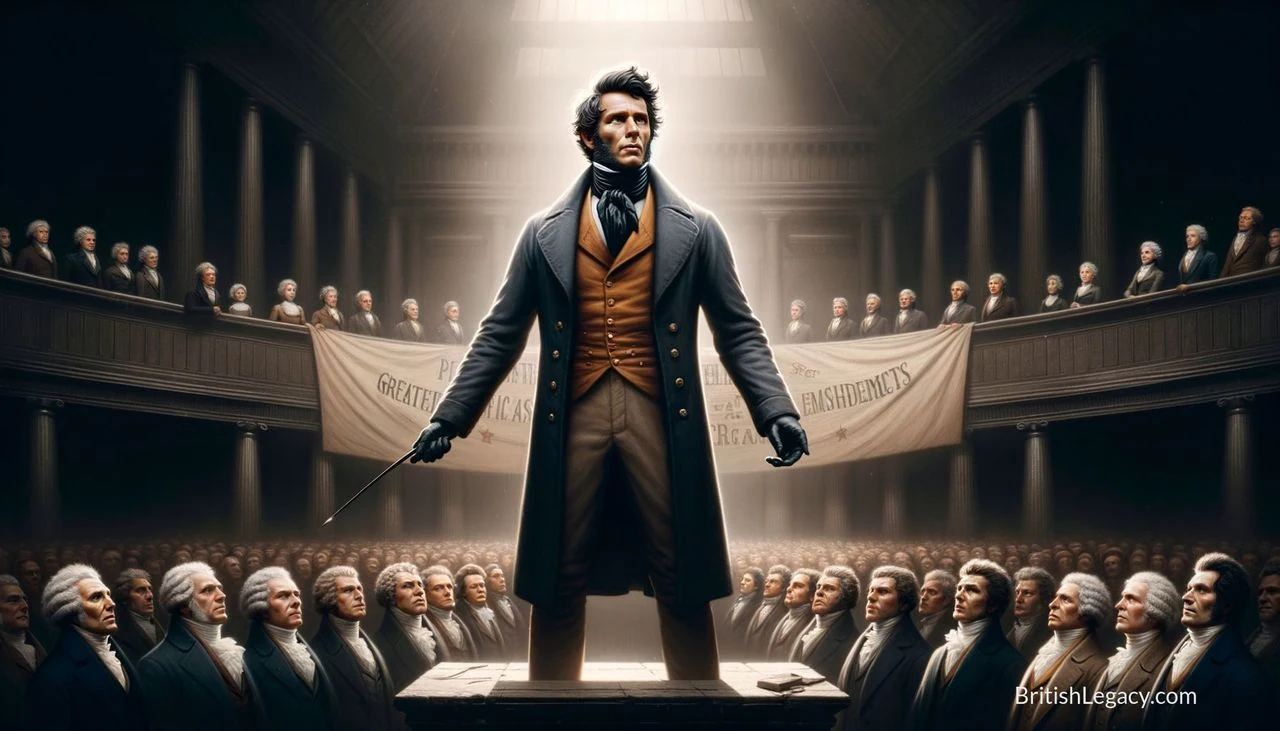
Thomas Clarkson did not confine the case against the slave trade to Parliament. He rode thousands of miles across Britain, interviewed sailors, collected evidence from ports and carried objects into public meetings to make the trade’s workings harder to ignore. His research and campaigning helped build the movement that secured the British Slave Trade Act of 1807. He continued to work for abolition after that law, including campaigning for emancipation in British colonies and for the wider abolition of slavery.
A Cambridge essay becomes a life’s work
Clarkson was born in Wisbech, Cambridgeshire, on 28 March 1760. His father, the Reverend John Clarkson, was a Church of England priest and headmaster of Wisbech Grammar School. Thomas attended the school before going to St Paul’s School in London. In 1779 he entered St John’s College, Cambridge, where he took a Bachelor of Arts degree in 1783. He was ordained a deacon that year, but did not proceed to priest’s orders.
The turning point came in 1785, when Clarkson entered a university Latin essay competition on whether it was lawful to enslave people against their will. He read widely, including abolitionist writing and first-hand accounts, and interviewed people with experience of the slave trade. He won the competition. On his journey home, the subject continued to occupy him; he later recalled stopping near Wadesmill in Hertfordshire and resolving that someone should work to end the suffering he had been studying.
Clarkson translated his essay into English and published it as a pamphlet in 1786. Its circulation brought him into contact with people already campaigning against the trade, including Granville Sharp and Quakers. The movement had predecessors: in 1783, 300 Quakers had petitioned Parliament. In May 1787, Clarkson joined a group that formed the Committee for the Abolition of the Slave Trade, with Sharp as chairman. The committee brought together Quaker members and Anglicans, including Clarkson, Sharp and Philip Sansom. Clarkson also approached William Wilberforce, the Anglican MP who became a central parliamentary advocate for abolition.
Evidence gathered on the road
The committee gave Clarkson the task of collecting evidence. For the next two years he travelled through England, visiting ports including Bristol, Liverpool and London, and promoting the campaign. The account of his work records that he interviewed 20,000 sailors and rode about 35,000 miles. His travels brought him into contact with people who had sailed on slave ships, including the surgeons Alexander Falconbridge and James Arnold, whose experiences could be used in published accounts.
This was dangerous work. Slave trading was legal and profitable, and its supporters had influence in port cities. In Liverpool in 1787, Clarkson was attacked by a gang of sailors reportedly paid to kill him; he escaped. In Manchester, by contrast, his speech at the collegiate church on 28 October that year helped galvanise local opposition. He wrote as well as travelled, publishing a summary of the slave trade and the likely consequences of abolition in 1787, and further arguments in the following years.
Clarkson’s evidence was not limited to testimony. He obtained equipment used aboard slave ships, including handcuffs, leg-shackles, thumbscrews and branding irons. He also collected examples of African goods. On visiting the trading ship The Lively, he encountered carved ivory, woven textiles, beeswax, palm oil and peppers. The workmanship impressed him; he used such goods to argue that commerce could be based on African produce rather than the enslavement and sale of people.
He carried a wooden chest, now associated with the name Clarkson’s box, containing objects from his collection. At public meetings, the artefacts gave audiences something concrete to examine alongside his words and printed arguments. He also used an image based on a plan of the slave ship Brooks, showing people packed aboard. He supplied this image and other material to Wilberforce for use in Parliament. Clarkson’s methods joined investigation, publication and public display: evidence gathered on the road could be used in a pamphlet, at a meeting and in parliamentary debate.
Campaigning through setbacks and into law
Clarkson’s work contributed to the material for Wilberforce’s first abolitionist speech in the Commons in May 1789. The first bill, introduced in 1791, was defeated. The campaign faced repeated parliamentary resistance, and the outbreak of war with France curtailed debate. Clarkson’s health failed in 1794 after years of exhausting travel, and he withdrew from the campaign for a time, settling in the Lake District.
In 1796 he married Catherine Buck. Their son, Thomas, was born that year. The family later lived in Bury St Edmunds, and Clarkson eventually made his home at Playford Hall in Suffolk. When the campaign revived in 1804, he returned to travelling and canvassing support. Parliament passed the Slave Trade Act in 1807, ending British participation in the trade and providing for naval support to enforce the law. The Act ended the British slave trade; it did not itself abolish slavery in the colonies.
Clarkson continued to press for enforcement and for an international end to the trade. He travelled to Paris in 1814 and to Aix-la-Chapelle in 1818 in pursuit of agreement, and published an account of progress towards abolition in 1808. In 1816 he became a pacifist and helped found the Society for the Promotion of Permanent and Universal Peace with his brother John and others.
From the end of the trade to emancipation
A new campaign began in 1823, when the Society for the Mitigation and Gradual Abolition of Slavery was formed. Clarkson travelled widely to build support, reviving the network of local anti-slave-trade societies. The campaign delivered 777 petitions to Parliament demanding emancipation. When the society adopted a policy of immediate emancipation, Clarkson and Wilberforce appeared together in support. Parliament passed the Slavery Abolition Act in 1833; emancipation in the British colonies was completed on 1 August 1838.
Clarkson’s later campaigning extended beyond Britain’s colonies. In 1840 he was the principal speaker at the opening of the first World Anti-Slavery Convention in London, which brought together delegates from several countries and sought support for ending slavery internationally. In 1846 he hosted the American abolitionist Frederick Douglass during Douglass’s first visit to England. Clarkson died at Playford on 26 September that year, aged 86, and was buried at St Mary’s Church in the village.
Objects, places and public memory
Clarkson’s campaign left a material record as well as a political one. The Clarkson chest and collection are displayed at Wisbech & Fenland Museum. The town also has a memorial to him, unveiled in 1881, and a blue plaque. In 1879 a monument was erected at Wadesmill, where Clarkson had resolved to devote himself to abolition. In 1996 a tablet in his memory was placed in Westminster Abbey, near the tomb of Wilberforce. These memorials connect the public story of the campaign to the places where Clarkson was born, worked and made his decision.
His name has also been attached to places and institutions beyond Wisbech. A town in Jamaica was named Clarksonville after emancipation, and a mission station in South Africa was named Clarkson in 1839. In 2007 he appeared on a UK commemorative stamp marking the abolition of the slave trade. Such remembrance does not make his work a solitary achievement: the campaign depended on many people, including formerly enslaved witnesses, sailors, local organisers, writers and parliamentary allies. Clarkson’s distinctive contribution was to gather evidence, carry it between communities and sustain the case through years of political reversals.
Why Thomas Clarkson deserves a place in British Legacy
Thomas Clarkson deserves a place in British Legacy because he helped make a distant and profitable system visible to people who might otherwise have encountered it only as a parliamentary question. He travelled through British ports and towns, interviewed sailors, gathered objects from ships and compiled testimony for campaigners and legislators. His wooden chest and his use of images made the evidence tangible at public meetings. The method mattered: research gathered in the field could be turned into pamphlets, lectures and material for parliamentary debate. Clarkson helped connect those forms of advocacy, while working with a wider movement whose members included Quakers, Granville Sharp, William Wilberforce and many local campaigners.
The consequences of that work must be stated precisely. The 1807 Act ended Britain’s slave trade, not slavery itself. Clarkson then continued to campaign for enforcement and international abolition, and later backed the movement for emancipation in the British colonies, achieved through the 1833 Act and completed in 1838. His public role at the 1840 World Anti-Slavery Convention and his welcome to Frederick Douglass in 1846 show that his concern reached beyond the first legislative victory. The museum collection, memorials and commemorations attached to his name preserve parts of that history in public view. His British legacy lies in a sustained contribution to organised campaigning: gathering evidence, persuading audiences and pressing political institutions to act against the slave trade and, later, slavery.
Sources
Thomas Clarkson — Wikipedia, revision 1372277222
Adapted in part from Thomas Clarkson by Wikipedia contributors, under CC BY-SA 4.0. Text has been edited and combined with the existing article; this adapted text is shared under the same licence. Contributor history.