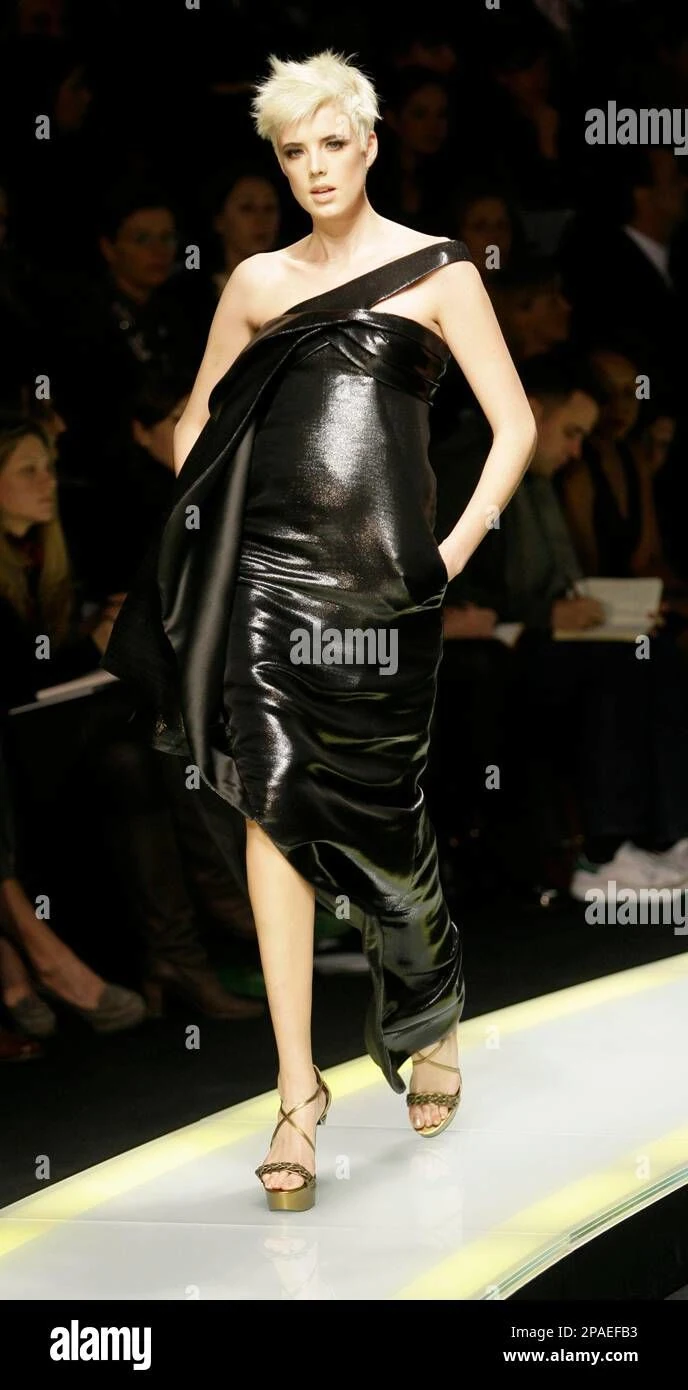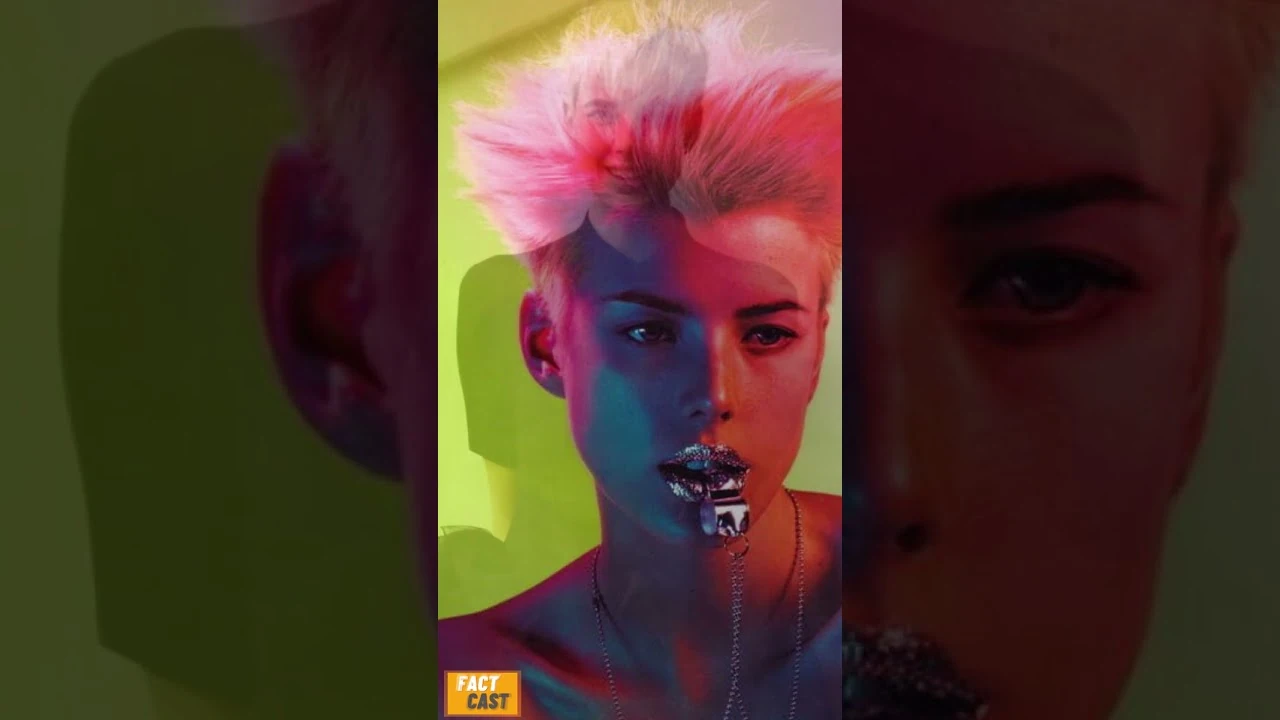
In the 2000s, Agyness Deyn’s short hair and androgynous style made her a conspicuous presence on international runways and magazine covers. Born Laura Michelle Hollins in Littleborough, Greater Manchester, she built a modelling career that took in major fashion houses, advertising campaigns and editorial work. She later stepped away from modelling to pursue acting and design, carrying a public profile first made on the catwalk into other creative work.
From Rossendale to London
Deyn was born on 16 February 1983 in Littleborough and spent her early childhood in Failsworth. She grew up in Cloughfold, beside Rawtenstall in the Rossendale Valley, Lancashire. She attended All Saints Roman Catholic High School and completed her A levels at Bacup and Rawtenstall Grammar School.
Her working life began early: at 13, she was a part-time server at a fish-and-chip shop in Stubbins, Rossendale. She had her first modelling experience for Sunday Best, a Rawtenstall boutique. Aged 16, she won the Rossendale Free Press competition “Face of ’99”. She later recalled having short hair from the age of 13 and shaving her head at 17, a look that would become closely associated with her public image.
Her route to London ran through friendship as well as fashion. When her close friend Henry Holland moved there to study fashion, Deyn stayed with him in his university accommodation. She worked in a fast-food restaurant during the day and a bar at night. Her biography says she was spotted while shopping with Holland in Kentish Town. She signed with Select Model Management, rather than the agency named in some earlier accounts.
A recognisable face on the international circuit
Deyn’s modelling career gathered pace in the middle of the decade. In May 2007, she appeared on the cover of American Vogue as one of “The World’s Next Top Models”, alongside nine other models. Her magazine covers also included British Vogue, Vogue Italia, Pop, Grazia and Time. Vogue Paris later included her among its top 30 models of the 2000s.
She worked on runways for houses and designers including Chanel, Dolce & Gabbana, Burberry, Dior, Lanvin, Versace, Stella McCartney and Yves Saint Laurent. Her advertising work ranged across fashion, beauty and footwear: campaigns included Dior, Burberry, Calvin Klein, Vivienne Westwood, Mulberry, Paul Smith, Adidas and Reebok. She also became the face of Burberry’s The Beat fragrance and Jean Paul Gaultier’s Ma Dame.
These jobs help explain why Deyn’s appearance became so familiar, but her influence is harder to reduce to a single look. Her cropped hair and androgynous presentation set her apart within fashion imagery of the period. The original account describes her style as combining high fashion with streetwear; that is best understood as a description of her visual identity, not proof that she alone changed the industry’s standards of beauty or gender. Her prominence nonetheless made that alternative image visible across runways, campaigns and magazines.
In May 2008, she guest-edited i-D. The issue included writing by and about her, as well as interviews she conducted with designers, including Vivienne Westwood. She also appeared on one of the covers of V magazine’s autumn issue that year. The editorial work offered a role beyond modelling: she helped shape a publication and put questions to figures working in the fashion industry.
Leaving the catwalk for other work
By 2009, Deyn was speaking of a change in direction. In an interview the following year, she said she had stopped modelling officially and described the decision as gradual: her feelings about the industry had changed, and she wanted to do something different. Her public work included a 2015 appearance on the Yves Saint Laurent runway and later returns to Burberry, walking for the brand at London Fashion Week in 2019 and 2024. These appearances sit alongside her stated move away from modelling rather than erase it.
Acting became one of those new directions. Deyn played Aphrodite in the 2010 film Clash of the Titans, then appeared opposite Richard Coyle in the 2012 film Pusher. That year she made her West End debut as Paula in François Archambault’s comedy The Leisure Society. She went on to play Chris Guthrie in the film adaptation of Lewis Grassic Gibbon’s Scottish novel Sunset Song (2015). Other screen work included the lead role in Electricity (2013), the thriller Patient Zero (2015), BBC drama Hard Sun, and the films The Titan and Her Smell (both 2018).
Music and design provided further outlets. Deyn supplied vocals for Five O’Clock Heroes’ single “Who” and appeared in its video; the track reached number 109 in the UK chart. She collaborated with her younger sister Emily on a T-shirt and vest-top range for Uniqlo in 2010. In 2012, she began a design partnership with Dr Martens covering accessories, shoes and clothing, with a third collaboration planned for spring 2014.
Fashion work with a British base
Deyn’s story has a clear connection to British fashion without depending on claims that she single-handedly transformed it. Her career began with a local competition and a boutique modelling experience in Lancashire, then developed through London and the British fashion world. She worked with British names including Burberry, Vivienne Westwood, Stella McCartney, Paul Smith and Giles Deacon, and appeared in British publications such as Vogue and i-D. Her later return to Burberry’s London Fashion Week runway brought that connection into a new phase.
She also crossed between roles that are often treated separately: model, magazine guest editor, performer, vocalist and designer. The evidence of that range is concrete—her interviews for i-D, stage debut, film roles and clothing collaborations—rather than a general claim that she inspired every later model or artist. Her career shows how a British model could work across international fashion while returning to British institutions and collaborators.
Why Agyness Deyn deserves a place in British Legacy
Agyness Deyn merits a place in British Legacy for a career that connects local beginnings with international reach. Her first modelling experience came in Rawtenstall, and her early path included a Lancashire newspaper competition before work took her to London and then to the runways and campaigns of major fashion houses. She appeared on the cover of American Vogue, worked with British designers and brands, and was recognised by Vogue Paris among the leading models of the 2000s. Those milestones make her a significant British presence in the decade’s fashion culture.
Her contribution also lies in the breadth of the work that followed. Deyn did not confine her public career to modelling: she guest-edited i-D, interviewed designers, appeared on the West End stage and in films, recorded vocals, and developed clothing collaborations with Uniqlo and Dr Martens. These projects show how experience and visibility in fashion can lead into editorial, performance and design. Her androgynous look was distinctive, and helped make a less conventional model image prominent in mainstream fashion media. The case for remembering her is therefore specific: a Lancashire-born model made an international career, worked with British fashion institutions and used that platform to explore other creative roles.
Sources
Adapted in part from Agyness Deyn by Wikipedia contributors, under CC BY-SA 4.0. Text has been edited and combined with the existing article; this adapted text is shared under the same licence. Contributor history.