Tilda Swinton’s career has moved between experimental film, theatre and major international productions without settling into a single type of role. Her screen work includes Derek Jarman’s early films, Sally Potter’s adaptation of Orlando and the corporate lawyer she played in Michael Clayton, a performance that won her an Academy Award. Alongside acting, she has helped create live art and independent film events, bringing an interest in how films are made and seen into her work beyond the screen.
From London to the stage
Katherine Matilda Swinton was born in London on 5 November 1960 and grew up in Scotland. She attended West Heath Girls’ School, where she was a classmate and friend of Lady Diana Spencer, later the Princess of Wales. In 1983, she graduated from New Hall, University of Cambridge, with a degree in social and political sciences. She began performing on stage while at university.
Swinton joined the Royal Shakespeare Company in 1984, appearing in Measure for Measure. She also worked at Edinburgh’s Traverse Theatre, including in Philippe Gaulier’s No Son of Mine in 1985 and Manfred Karge’s Mann ist Mann in 1987. Her first film was Derek Jarman’s Caravaggio (1986). She went on to appear in several of his films, including The Last of England (1987), War Requiem (1989) and Edward II (1991). For the last of these, she won the Volpi Cup for Best Actress at the Venice Film Festival.
In Orlando (1992), Sally Potter’s adaptation of Virginia Woolf’s novel, Swinton played the title character across a story spanning centuries and exploring changes in gender presentation. The role brought together qualities that would recur in her work: an ability to move between different kinds of screen presence and an interest in characters who unsettle familiar categories.
Range on screen
Swinton’s work has crossed between independent cinema and larger studio productions. In the early 2000s, she appeared in films including The Beach, Vanilla Sky and Adaptation. In The Deep End (2001), she played a mother who suspects that her son has killed his boyfriend; the performance brought her a Golden Globe nomination. For her role in the British film Young Adam (2003), she received the British Academy Scotland Award for Best Actress.
In 2005, she played the White Witch in The Chronicles of Narnia: The Lion, the Witch and the Wardrobe, returning for the series’ subsequent films. Two years later, she played corporate attorney Karen Crowder in Michael Clayton. The performance earned her several major award nominations and won the Academy Award for Best Supporting Actress and the BAFTA for Best Actress in a Supporting Role.
Her later screen credits include We Need to Talk About Kevin (2011), Snowpiercer (2014) and Luca Guadagnino’s Suspiria (2018), in which she played three roles. She also became a recurring presence in Wes Anderson’s films, appearing in Moonrise Kingdom, The Grand Budapest Hotel, The French Dispatch and Asteroid City. These projects sit alongside work in films such as Memoria (2021) and The Eternal Daughter (2022), sustaining a career that moves between distinct directors and styles.
Performance beyond the screen
Swinton’s interest in performance has also taken a live and collaborative form. In 1995, she developed The Maybe with producer Joanna Scanlan: an installation at London’s Serpentine Gallery in which she appeared asleep, or apparently asleep, in a glass case for a week. It was later presented in Rome and, in 2013, at New York’s Museum of Modern Art. In 2008, she founded the Ballerina Ballroom Cinema of Dreams, a film festival held in a ballroom in Nairn, Scotland.
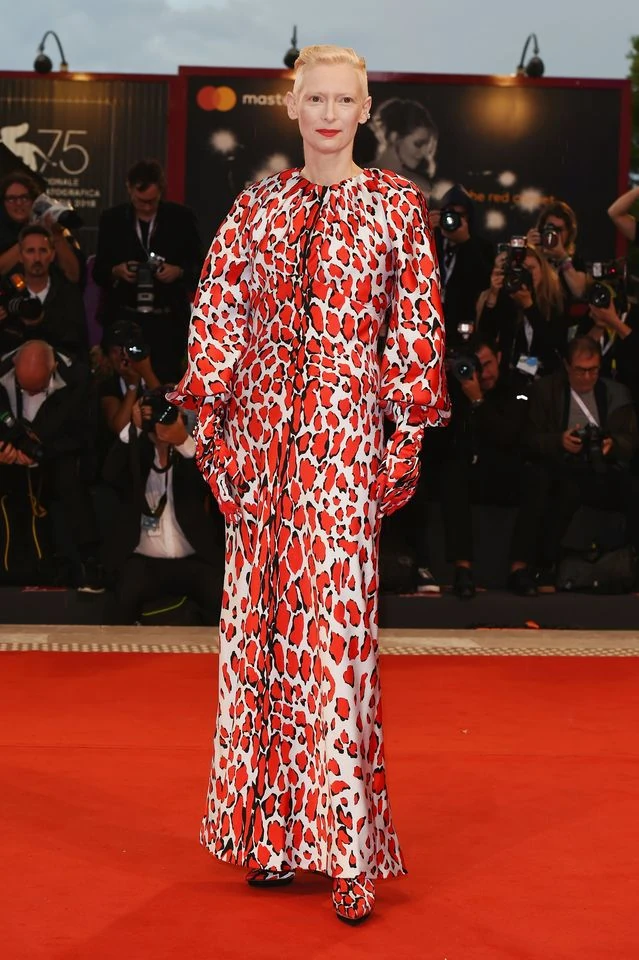
She has also worked with artists and fashion designers. In 2003, designers Viktor & Rolf made her the focus of One Woman Show, an event featuring models styled to resemble Swinton and a poem she had written. Her interest in androgyny also connects with Orlando, where gender presentation is part of the story. Her public style has been described as avant-garde and androgynous; that description is best understood alongside her creative choices, rather than as a substitute for the work itself.
In 2009, Swinton and filmmaker Mark Cousins took a portable cinema through the Scottish Highlands on a large truck, hauling it manually and using it to create a travelling independent film festival. The project was documented in Cinema Is Everywhere and the festival was repeated in 2011. These initiatives extended her involvement from performing in films to supporting the experience of watching and sharing them.
Recognition and Scottish ties
Swinton was born in England but describes her nationality as Scottish, connecting that identity to her childhood and family background. She moved to Scotland in 1997. Her career has consequently linked Scottish settings and film culture with work recognised well beyond the country. The Nairn festival, the Highlands cinema project and her work with Screen Academy Scotland, whose new production centre she opened in Edinburgh in 2006, are concrete examples of that connection.
Her honours include the British Film Institute Fellowship, awarded in 2020, and the British Independent Film Awards’ Richard Harris Award, recognising her contribution to British film. In 2022, she received the FIAF Award for work on the preservation and promotion of archive film, film history and women’s role in it. These distinctions reflect more than a list of acting prizes: they recognise contributions to film culture and its preservation as well as her performances.
Why Tilda Swinton deserves a place in British Legacy
Swinton’s place in British Legacy rests on a body of work that connects British and Scottish performance traditions with a wide-ranging international film career. She began on stage with the Royal Shakespeare Company and Edinburgh’s Traverse Theatre, then became closely associated with Derek Jarman’s experimental cinema. Her Volpi Cup for Edward II and Academy Award and BAFTA for Michael Clayton mark recognition at very different points in that career. Between them lie roles in films as varied as Orlando, Young Adam, We Need to Talk About Kevin and The Grand Budapest Hotel.
Her contribution also reaches beyond acting. The Ballerina Ballroom Cinema of Dreams and the portable cinema project with Mark Cousins brought film screenings to audiences in Scotland, while The Maybe explored performance in a gallery setting. Her fellowship from the British Film Institute and FIAF award further connect her work to film culture, history and preservation. These achievements offer a specific British legacy: a Scottish-identifying actor who has carried an unconventional approach from British stages and independent projects into world cinema, while also helping create ways for audiences to encounter film.
Sources
Tilda Swinton — revision 1379796409 · Tilda Swinton
Adapted in part from Tilda Swinton by Wikipedia contributors, under CC BY-SA 4.0. Text has been edited and combined with the existing article; this adapted text is shared under the same licence. Contributor history.