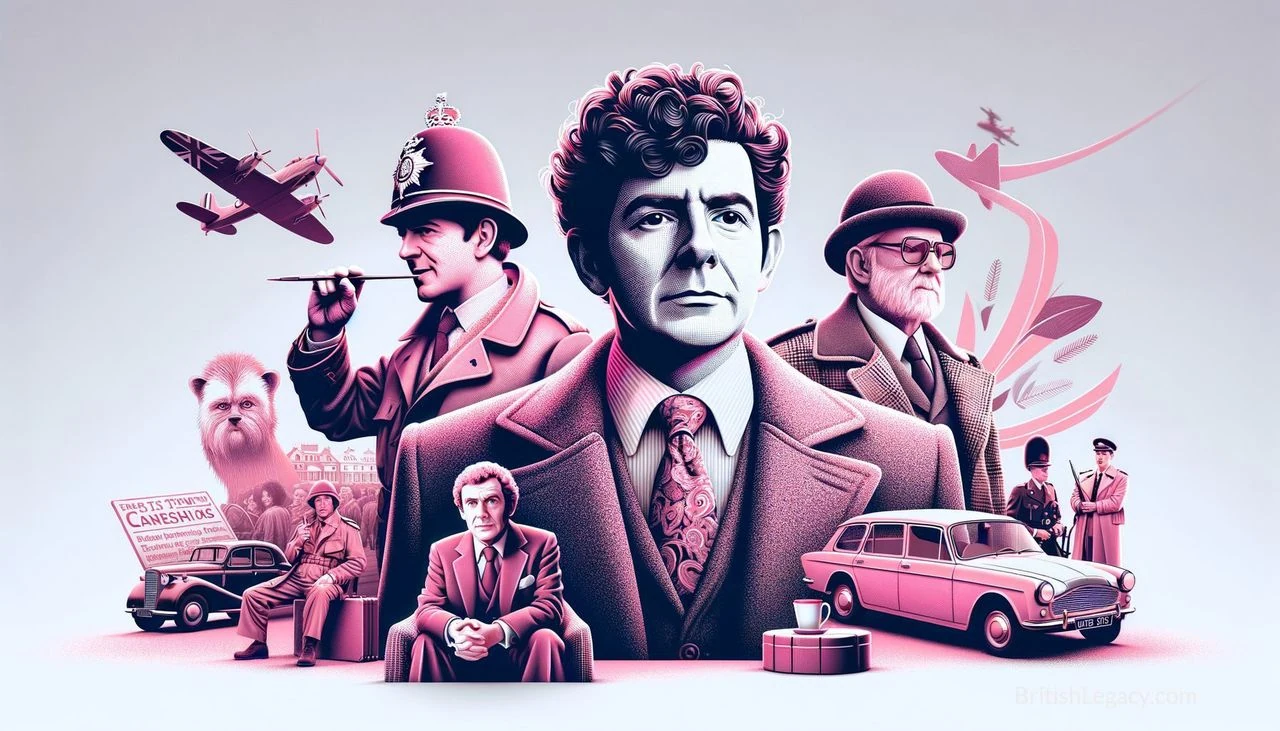
Peter Sellers could make a character ridiculous without making him aware of it. As Inspector Jacques Clouseau, he played a detective whose confidence survived every mishap; in Dr. Strangelove, he moved between three sharply differentiated roles. The versatility was not simply a matter of disguises or accents. It grew from a performer’s close attention to voice, appearance and movement, first developed on the British variety circuit and heard by millions on BBC radio’s The Goon Show.
A childhood on the variety circuit
Sellers was born Richard Henry Sellers in Southsea, Portsmouth, on 8 September 1925. His parents, William “Bill” Sellers and Agnes Doreen “Peg” Marks, were variety entertainers; his mother performed with the Ray Sisters troupe. They called their son Peter after his stillborn elder brother. When he was two weeks old, he was carried on stage at the Kings Theatre in Southsea. The family toured frequently, and the unsettled life of a young performer gave him an early view of entertainment from backstage as well as in front of an audience.
In 1935 the family settled in Muswell Hill, north London, and Sellers attended St Aloysius’ College in Highgate. His formal schooling ended at fourteen after the outbreak of the Second World War. The family moved to Ilfracombe, where his maternal uncle managed the Victoria Palace Theatre. Sellers began working there at fifteen, first as a caretaker and later in jobs including box-office clerk, usher, assistant stage manager and lighting operator. He watched performers at close quarters and began to develop his own stage act with Derek Altman.
He also learnt drums, playing with touring bands and performing for the Entertainments National Service Association, which provided entertainment for British forces and factory workers. In 1943 he joined the Royal Air Force. Poor eyesight ruled out pilot training, but he toured with Squadron Leader Ralph Reader’s RAF Gang Show troupe. The work brought together music, impersonation and performance for service audiences, skills that would become central to his later career.
The Goons and the making of a radio performer
After the war, Sellers returned to entertainment and gradually found regular work in radio. His first television appearance came in 1948, and he became a radio performer that year. In 1951, he joined Spike Milligan, Harry Secombe and Michael Bentine in The Goon Show. The programme ran until 1960 and gave Sellers an unusually broad space for character acting: he performed four principal characters and seventeen minor ones, shifting rapidly among their voices and comic temperaments.
The show’s audience grew from 370,000 to as many as seven million listeners in Britain, according to the Wikipedia article. Its mixture of absurd situations, wordplay and distinctive voices established Sellers as a prominent radio comedian and helped create a foundation for his screen career. He also made comic recordings: his 1958 album, The Best of Sellers, included “Balham – Gateway to the South” and reached number three in the UK Albums Chart. His second album, Songs for Swingin’ Sellers, did the same the following year.
Film work followed, first in smaller parts and then in roles that made use of his transformations. In Alexander Mackendrick’s 1955 Ealing comedy The Ladykillers, Sellers played Harry Robinson opposite Alec Guinness. In The Mouse That Roared (1959), he took three leading roles, including an elderly Grand Duchess, a prime minister and an inexperienced farm boy. His performance as Fred Kite in I’m All Right Jack (1959), a satire on industrial relations, won him a BAFTA for Best British Actor.
From Clouseau to Dr Strangelove
Blake Edwards cast Sellers as Inspector Jacques Clouseau in The Pink Panther. The film was released in the UK in January 1964, and Sellers’s creation of the character helped turn a supporting part into one of his best-known roles. He devised Clouseau’s costume, moustache, make-up and accent, building a comic detective who remained convinced of his own competence. His repeated attempts to preserve dignity as events went wrong gave the slapstick its particular tension.
Stanley Kubrick’s Dr. Strangelove or: How I Learned to Stop Worrying and Love the Bomb, released in 1964, put another side of Sellers’s technique on display. He played Group Captain Lionel Mandrake, US President Merkin Muffley and Dr Strangelove, each with a distinct voice and bearing. He was nominated for the Academy Award for Best Actor for the performances. The film’s political satire and the contrast among his characters showed how impersonation could serve more than a succession of comic tricks.
His range was not confined to those two films. He appeared in Stanley Kubrick’s Lolita (1962), as Clare Quilty, and in Blake Edwards’s The Party (1968), as the accident-prone actor Hrundi V. Bakshi. In 1979, he played Chance, a sheltered gardener mistaken for a sage, in Hal Ashby’s Being There. The performance brought him a Golden Globe for Best Actor in a Musical or Comedy and a nomination for the Academy Award for Best Actor. Across these roles, Sellers repeatedly used vocal and physical detail to make characters recognisable and to shape the audience’s response to them.
Technique, recognition and personal difficulty
Sellers described beginning with a character’s voice, then working on appearance and walk. He would draw a character and discuss how to translate the design into make-up; he also recorded voices to study. That process helps explain the specificity of his performances, from Clouseau’s self-possession to the contrasting voices in Dr. Strangelove. His characters could be foolish or inept while retaining a sense of their own dignity, a quality that made their failures comic rather than merely cruel.
His work received recognition across several parts of his career. Alongside the BAFTA for I’m All Right Jack, he earned an Academy Award nomination for The Running Jumping & Standing Still Film, the 1959 short he made with Spike Milligan and others. He won the Golden Globe for Being There in 1980. The Wikipedia article also records that he was appointed a Commander of the Order of the British Empire, or CBE.
Sellers’s public achievement coexisted with personal difficulties. The Wikipedia account describes struggles with depression and insecurity, and notes that he often clashed with colleagues. He was married four times and had three children. These facts give context to the pressures and instability of his life, but do not need to be turned into a simple explanation for his work. Sellers died in London on 24 July 1980, aged 54, after a heart attack.
Why Peter Sellers deserves a place in British Legacy
Sellers’s British legacy begins with a distinctly British route into entertainment: a childhood among touring variety performers, theatre work in Ilfracombe, wartime service as a performer for British forces and factory workers, and a defining career on BBC radio. The Goon Show was not just an early credit. Its ensemble of recurring voices gave Sellers room to refine the rapid changes of character that later became a hallmark of his films. The show reached millions of listeners in Britain, while his records and early British comedies carried that comic inventiveness into other forms.
His later international recognition did not erase those roots. Clouseau brought a British performer’s carefully constructed comic character to a worldwide film audience, while Dr. Strangelove showed how his command of voice and persona could work within political satire. From the three roles in Kubrick’s film to the quiet precision of Chance in Being There, Sellers demonstrated that transformation could be a disciplined acting method rather than a surface-level trick. His performances and the radio work that helped shape them influenced later comedians, including John Cleese, Peter Cook, Rowan Atkinson and Eddie Izzard, as described in the Wikipedia article. Remembering Sellers in British Legacy recognises both the national institutions that formed his career and the imaginative range with which he carried that tradition to audiences beyond Britain.
Sources
Adapted in part from Peter Sellers by Wikipedia contributors, under CC BY-SA 4.0. Text has been edited and combined with the existing article; this adapted text is shared under the same licence. Contributor history.