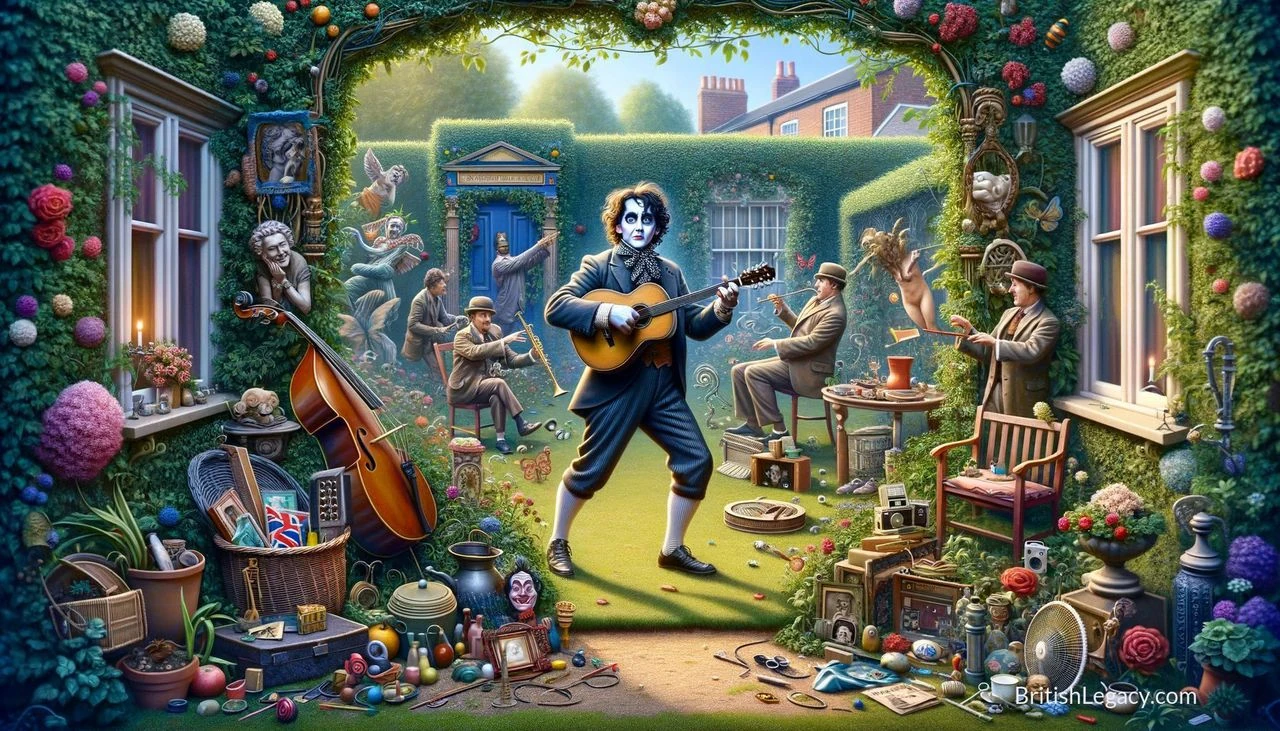
Bill Bailey’s comedy often begins with a musical instrument, but rarely ends where an audience expects. A keyboard, guitar, theremin or kazoo can become part of a routine that moves between musical parody, surreal digression and close observation. That blend has carried him from the stand-up circuit to television, from the bookshop of Black Books to the dance floor of Strictly Come Dancing.
Learning music, finding a comic voice
Mark Robert Bailey was born in Keynsham, Somerset, on 13 January 1965, and grew up in the town between Bath and Bristol. His father, Christopher, was an NHS general practitioner; his mother, Madryn, was a hospital ward nurse. Bailey attended King Edward’s School in Bath, where he studied music to A-level and played in the school band Behind Closed Doors. His music teacher gave him the nickname Bill after hearing him play “Won’t You Come Home Bill Bailey” on guitar.
He began an English degree at Westfield College but left after a year, then gained an Associate Diploma from the London College of Music. Music was not simply an accomplishment to display: it became a means of building comic structures. Bailey could set a familiar tune against an unexpected style, interrupt a joke with a musical turn, or take a traditional gag apart to expose its workings.
His first steps in comedy included touring with performers such as Mark Lamarr. In 1984, he formed the double act the Rubber Bishops with Toby Longworth. The act gave him room to develop a mix of musical parodies and variations on conventional jokes. After Longworth left in 1989, Martin Stubbs joined. In 1994, Bailey and Sean Lock performed Rock at the Edinburgh Festival Fringe. Its small audiences and Bailey’s doubts about continuing in comedy make a useful counterpoint to the later success: his path was not an uninterrupted rise.
Bailey went solo the following year with Bill Bailey’s Cosmic Jam, combining music with a wandering, post-modern comic style. A performance at London’s Bloomsbury Theatre became a Channel 4 special in 1997. He won a Time Out award after supporting Donna McPhail in 1995, and his Edinburgh show the next year was nominated for the Perrier Comedy Award. In 1999, he won the British Comedy Award for Best Live Stand-Up.
Television: from Manny to the music quiz
Bailey’s television work has never been limited to one format. In 1998, he wrote and presented Is It Bill Bailey?; in 2000, he joined the cast of Channel 4 sitcom Black Books as Manny Bianco, the gentle assistant to Dylan Moran’s bookshop owner, Bernard, with Tamsin Greig as Fran. Three series of six episodes were made. The role put Bailey’s offbeat timing into a scripted comedy, while his stand-up continued to depend on the freedom of live performance.
In 2002, he succeeded Sean Hughes as a team captain on Never Mind the Buzzcocks, appearing until 2008. The programme’s irreverent music quiz gave his musical knowledge and quick comic responses a natural setting. He became a frequent guest on QI, appeared on Have I Got News for You as both guest and presenter, and took roles in programmes including Spaced, Skins and Doctor Who. The breadth of those appearances reflects a career in which television has been a series of different stages, not a substitute for stand-up.
In 2020, Bailey won the eighteenth series of Strictly Come Dancing with professional partner Oti Mabuse. Aged 55, he became the programme’s oldest winner at the time. The result brought his physical performance into the foreground, but the same combination of musicality and comic character that shaped his stage work remained visible in his dancing.
Music, touring and the wider world
Bailey plays a wide range of instruments, including keyboards, guitar, theremin and kazoo, and uses music from genres such as classical, jazz, rock and drum and bass. His live shows have included Bewilderness, Part Troll, Tinselworm, Qualmpeddler and Limboland. Part Troll, first performed at the Edinburgh Festival Fringe in 2003, transferred to the West End and toured in the UK, Australia, New Zealand and the United States. Later tours also took his work to audiences across Europe and Australasia.
His musical interests have extended beyond solo comedy. In 2007, he performed with the BBC Concert Orchestra and conductor Anne Dudley in Cosmic Shindig, which included orchestral versions of earlier songs and new pieces. The following year, he performed Bill Bailey’s Remarkable Guide to the Orchestra with the same orchestra at the Royal Albert Hall. These projects made the musical element of his comedy explicit: the instruments are not props, but part of the form and substance of the work.
Bailey has also presented natural-history programmes, including Wild Thing I Love You, which focused on the protection of British wild animals, and Bill Bailey’s Jungle Hero, a two-part documentary about naturalist Alfred Russel Wallace, filmed in Indonesia and Borneo. He is a patron of International Animal Rescue and has supported campaigns including the rescue of dancing bears and the Sumatran Orangutan Society. His conservation work has also been recognised with an honorary doctorate in conservation and sustainability from the University of the Sunshine Coast in Australia in 2014.
His public work includes cancer fundraising: he walked 100 miles in memory of his mother, who died in 2005, and has raised awareness of prostate cancer. In 2018, the University of Bath awarded him an honorary doctorate. He has written books on British birds and happiness, as well as My Animals, and Other Animals, a memoir published in 2024.
Why Bill Bailey deserves a place in British Legacy
Bill Bailey’s place in British Legacy rests first on a distinctive achievement in performance: he has made musical ability integral to his comedy. Rather than use music as a brief interlude, he builds jokes and entire passages around it, drawing on instruments and styles that can move a routine in unexpected directions. That approach has travelled across stand-up, television and orchestral performance, from the intimate comedy of Cosmic Jam to appearances with the BBC Concert Orchestra. His work on Black Books and Never Mind the Buzzcocks also shows how that comic sensibility can adapt to very different television forms.
His contribution reaches beyond entertainment. Bailey has used television to bring attention to wildlife protection, including work on British animals and a documentary series about Alfred Russel Wallace. His support for animal-rescue and conservation campaigns gives that interest practical expression, while his cancer fundraising connects his public profile with charitable action. These are specific strands of a varied career, not a claim that any one performer represents the whole of British culture. Together, they make Bailey’s record notable: a comic who crosses boundaries between music and humour, live and broadcast performance, and entertainment and public advocacy, while continuing to bring curiosity and an individual musical voice to each.
Sources
Adapted in part from Bill Bailey by Wikipedia contributors, under CC BY-SA 4.0. Text has been edited and combined with the existing article; this adapted text is shared under the same licence. Contributor history.