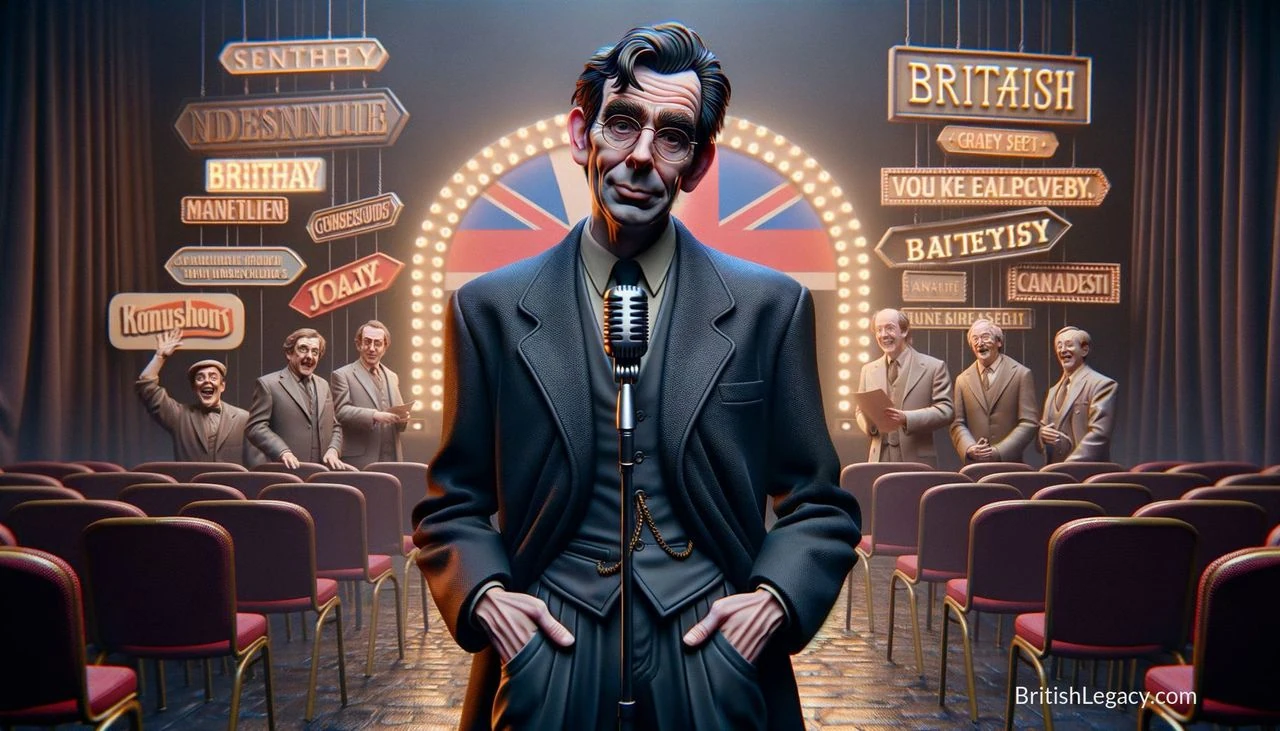
Paul Merton’s comedy depends on a distinctive contrast: a dry, measured delivery carrying ideas that may be surreal, sharply topical or both. He first reached a broad television audience through improvisation on Whose Line Is It Anyway? and became one of the enduring team captains of Have I Got News for You. His career also runs through live comedy, radio, sketch shows and documentaries, making him a familiar presence across several generations of British broadcasting.
Finding a comic voice
Born Paul James Martin in Parsons Green, west London, on 9 July 1957, Merton grew up in Hammersmith and Fulham. He attended St Thomas’s School in Fulham, St Teresa’s in Morden and Wimbledon College, where he passed A-levels in English and history. After leaving school, he worked as a clerical officer at Tooting employment office, leaving the job in February 1980. He had considered acting and auditioned for the Royal Academy of Dramatic Art at 19.
Comedy became a professional pursuit in 1982. Merton has described his debut with writing partner John Irwin in Swansea, followed by performances on the London alternative-comedy circuit, including at the Comedy Store and Jongleurs. In 1985 he took part in the Edinburgh Fringe show Have You Been on Telly and joined the Comedy Store Players, an improvisation group with which he continued to perform. Those club and stage settings gave him room to develop the economical, deadpan manner that would distinguish his work on television.
He began his professional career using his birth name. When he joined Equity, he found that Paul Martin was already being used by a Leeds juggler, so he adopted the surname Merton, after the London district where he grew up. The change was practical, but the name soon became recognised well beyond the comedy clubs.
Improvisation reaches television
Merton’s television breakthrough came in 1988 with Channel 4’s Whose Line Is It Anyway?, an improvisational comedy show that had moved to television from BBC Radio 4. He had already appeared on Channel 4’s Saturday Live and presented the series Comedy Wavelength. On Whose Line, he could put his stage experience to work in a format that made spontaneous invention the point of the performance. He remained with the programme until 1993.
In 1990, the year Have I Got News for You began, Merton became one of its team captains. The panel show’s subject is the news, but its comedy depends on more than topical knowledge: timing, disagreement and the ability to find an unexpected angle matter too. Merton’s dry responses and improvisational instincts suited that combination. He has remained a regular presence on the programme, apart from a break during its eleventh series in 1996. He later said that he had been tired of the show and felt it had become stuck in a rut; he also thought his absence gave it a useful fresh impetus.
His television work in the 1990s was not confined to panel shows. He made two series of Paul Merton: The Series, and presented a documentary about the London Palladium’s history. In 1996 he performed revised versions of scripts by Ray Galton and Alan Simpson in Paul Merton in Galton & Simpson’s.... The reception was poor, a reminder that taking on celebrated material does not guarantee success. In 1999, he took over as host of Room 101, interviewing guests about the irritations they would consign to the programme’s imagined chamber. He presented the show until 2007.
Radio, stage and the craft of comedy
Radio has provided Merton with another long-running setting for improvisation. He appeared on BBC Radio 4’s The Big Fun Show in the late 1980s and first joined Just a Minute in 1989, after contacting the programme’s producer at Nicholas Parsons’s suggestion. He continued to appear regularly. His radio work also included I’m Sorry I Haven’t a Clue, The Masterson Inheritance and a programme in which he interviewed British and Irish comedians who, like him, had been brought up in the Roman Catholic Church.
Live performance remained central to his work. Alongside the Comedy Store Players, Merton performed in Paul Merton’s Impro Chums at the Edinburgh Comedy Festival from 2008. In 2006, he made Paul Merton’s Silent Clowns, a BBC Four series about the work of Buster Keaton, Charlie Chaplin, Laurel and Hardy, and Harold Lloyd. The programme combined discussion of the performers’ careers with clips and material from a live presentation. Merton took a stage version to the Edinburgh Fringe and later toured it in the UK; a book, Silent Comedy, followed in 2007.
That project reflected an interest in comedy history as well as performance. Merton’s television work has included documentaries on the early history of Hollywood and on Alfred Hitchcock’s British films, as well as travel programmes in China, India and Europe. His autobiography, Only When I Laugh, appeared in 2014. These projects broadened his work beyond the panel-show format while keeping comedy—its performers, traditions and techniques—close to the centre.
Recognition and a continuing career
Merton’s work has been recognised through television and broadcasting awards. After several BAFTA nominations for Best Entertainment Performance, he won the award in 2003. He also received British Comedy Awards for his television work, including Top TV Comedy Personality in 1992 and Best Comedy Entertainment Personality in 1999, and the Broadcasting Press Guild Award for Best Non-Acting Performer in 2004. Such honours mark the scale of his presence on television, but his career is also defined by sustained work across formats rather than one role alone.
His later programmes have continued to take him beyond the studio. In 2015, he presented Paul Merton’s Secret Stations, about little-used request-stop railway stations in Britain. In 2021, Motorhoming with Merton & Webster followed him and his wife, fellow improviser Suki Webster, travelling around Britain in a camper van. Merton has also continued to appear in programmes alongside other performers, including a 2024 walk on the Isle of Purbeck with Bill Bailey.
Why Paul Merton deserves a place in British Legacy
Paul Merton’s place in British Legacy rests on a particular and well-evidenced contribution: he has made improvisation a visible part of mainstream British entertainment. His work on Whose Line Is It Anyway? brought the skills of live, unscripted comedy to a television audience, while his membership of the Comedy Store Players kept him connected to performance in front of a live crowd. Rather than being confined to one format, that instinct for invention carried into radio, stage work and television.
His long association with Have I Got News for You gives that talent a different purpose. In a programme built around current affairs, comic timing can make a point memorable, expose an absurdity or shift the audience’s view of a news story. Merton’s career shows how a recognisable comic voice can travel between club performance, improvisation, satire and documentary without losing its grounding in live performance. His work on silent comedy also connects contemporary audiences with earlier comic traditions. Together, these achievements make his legacy more than a list of popular appearances: they show a British performer sustaining and adapting a form of comedy across broadcasting, stage and generations of viewers.
Sources
Adapted in part from Paul Merton by Wikipedia contributors, under CC BY-SA 4.0. Text has been edited and combined with the existing article; this adapted text is shared under the same licence. Contributor history.