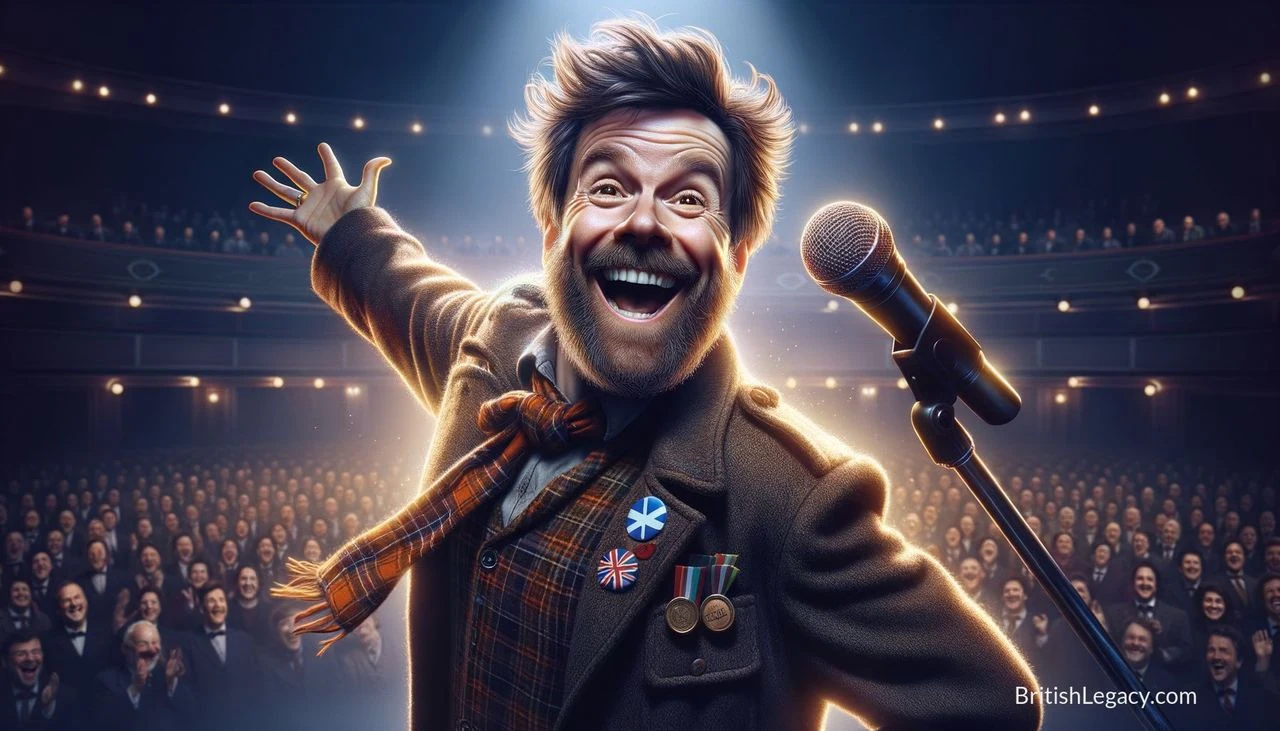
Billy Connolly’s route to comedy ran through Glasgow’s shipyards and folk clubs. Before he became known as the Big Yin, he trained and worked as a boilermaker, learned the banjo and performed with the folk group the Humblebums. His long, digressive stories and direct delivery soon took centre stage. A breakthrough television appearance in the 1970s helped carry a particular Glasgow voice and comic sensibility to audiences across Britain and, later, around the world.
Glasgow, school and the shipyards
William Connolly was born in Anderston, Glasgow, on 24 November 1942. His childhood was spent in the city’s tenements and, from his teens, on the Drumchapel housing estate. His mother left the family when he was four, while his father was serving with the Royal Air Force in Burma. His father’s two sisters cared for him and his older sister, Florence. Connolly later spoke about difficult experiences at home and at school; these are part of his biography, but they do not need to be turned into a simple explanation for his comedy.
At school, Connolly decided he wanted to make people laugh. Music also drew him in: by his teens he was listening to American performers including Jerry Lee Lewis and Chuck Berry. He left school at 15 with engineering qualifications and, after work delivering books and driving a bakery van, entered Glasgow’s shipbuilding trade. At Alexander Stephen and Sons in Linthouse he trained as a boilermaker, learning to weld and spending several years in a working environment he later described as formative.
In 1965, after completing his apprenticeship, Connolly took a ten-week job building an oil platform in Biafra, Nigeria. Back in Britain, he briefly worked at John Brown & Company, then left to pursue music. The shipyard years remained a source of material and perspective: Connolly recalled the trades, the men at work and the force of Glasgow humour. His comedy would draw on an ear for how people speak, without being confined to stories about his own background.
The Humblebums and a comic voice
Connolly’s first substantial step into performance was as a folk musician. He formed the Humblebums with Tam Harvey; Gerry Rafferty joined in 1969, and the group recorded for Transatlantic Records. Connolly sang and played banjo, guitar and autoharp. His introductions to songs grew into extended comic turns, though music remained part of his act and recording career for years.
The Humblebums split in 1971. Connolly returned to performing as a folk singer, but the jokes between songs were becoming the main event. Transatlantic’s Nat Joseph encouraged him to concentrate on comedy. In 1972, Connolly appeared in the revue Connolly’s Glasgow Flourish at the Cottage Theatre in Cumbernauld and performed at the Edinburgh Festival Fringe. That year he also released his first solo album, Billy Connolly Live!, mixing comedy with songs.
His 1973 recording Solo Concert, released in 1974, brought a wider audience. It included “The Crucifixion”, a deliberately irreverent routine that recast the Last Supper as a drunken night out in Glasgow. Some radio stations banned the recording. The material showed Connolly’s willingness to take comic risks, while its local references and particular voice travelled far beyond the city.
A 1975 appearance on the BBC’s Parkinson proved a turning point. Connolly delivered a bawdy joke despite advice from his manager not to do so. The appearance made a strong impression on viewers and helped establish him as a national television performer. He returned to the programme many times, eventually making 15 appearances. His success also reached the charts: his comic version of “D-I-V-O-R-C-E” reached number one in the UK singles chart in 1975.
Stand-up across borders, and work on screen
Connolly’s stage style depended on more than punchlines. His stories could wander, doubling back through the oddities of daily life, while his movement, facial expressions and Glaswegian accent gave them a physical presence. His comedy was often improvised and could be explicit or blasphemous. “The Crucifixion” remains a well-known example of how he brought irreverence to material that many performers would have avoided.
He became a familiar figure on British television and toured beyond the UK. In 1976, Elton John invited him to open on a United States tour. The pairing did not produce the American breakthrough hoped for: audiences were unfamiliar with Connolly, and some struggled with his accent. His international career developed over time through tours, television work and film roles. The story is not one of instant universal success, but of a performer who carried his own idiom into unfamiliar settings.
Connolly’s screen work ranged from the Disney film Pocahontas to Muppet Treasure Island and The Last Samurai. His performance as John Brown, Queen Victoria’s Scottish servant, in Mrs Brown (1997) earned him a BAFTA nomination for best actor in a leading role. Later parts included King Fergus in the animated film Brave and Dáin II Ironfoot in The Hobbit: The Battle of the Five Armies. These roles brought his voice and presence to audiences who might not have encountered his stand-up.
He also made television travel programmes, including tours of Scotland, Australia, England, Ireland and Wales, and New Zealand. In those series, performance and place met: the comedian travelled through landscapes and communities, making the journey itself part of the programme. Music remained another strand of his career, from his Humblebums recordings to comic songs and later musical projects.
Later work, honours and retirement
Connolly received a Commander of the Order of the British Empire (CBE) in 2003 for services to entertainment. In 2017, he was knighted for services to entertainment and charity. His other recognition included the BAFTA Fellowship, awarded in 2022 for lifetime achievement. These honours mark the scale and longevity of his work, but the range of his career is also visible in the different forms it took: live comedy, recordings, acting and television.
In 2013, Connolly disclosed that he had undergone treatment for early-stage prostate cancer and was experiencing initial symptoms of Parkinson’s disease. He later spoke publicly about the condition and its effect on performing. He retired from stand-up in 2018. In that year he also held his first art exhibition, beginning a further creative chapter. He has since published collections of his art and spoken about the value of making it.
Connolly’s comic career grew from a distinctive combination: a working-class Glasgow upbringing, a musician’s route into performance, a gift for extended stories and a stage presence that could fill a room. His achievements did not stop at stand-up, but the live performer remains central to understanding how he became such a recognisable figure.
Why Billy Connolly deserves a place in British Legacy
Billy Connolly belongs in British Legacy because his career made a particular Scottish voice central to British popular entertainment. He began in Glasgow’s shipyards, moved through folk clubs and developed a form of stand-up that drew on everyday observation, long-form storytelling and an unmistakable delivery. His 1975 Parkinson appearance helped bring that style to a national television audience. The route from the Humblebums to solo albums, chart success and sold-out performances shows how music and comedy fed one another rather than occupying separate chapters of his life.
His contribution also reaches beyond the stage. Connolly’s work in films such as Mrs Brown, Brave and The Hobbit: The Battle of the Five Armies carried his performance to audiences who knew him in different roles. Travel programmes placed a Glasgow-born comedian in conversation with places and people across Britain and overseas. His honours, including a knighthood for services to entertainment and charity and the 2022 BAFTA Fellowship, recognise a career sustained across decades and media. Connolly’s British legacy is not a general claim about national character: it is the specific achievement of bringing the speech, humour and experience of Glasgow into mainstream comedy, while retaining the freedom to move between music, television, film and visual art.
Sources
Adapted in part from Billy Connolly by Wikipedia contributors, under CC BY-SA 4.0. Text has been edited and combined with the existing article; this adapted text is shared under the same licence. Contributor history.