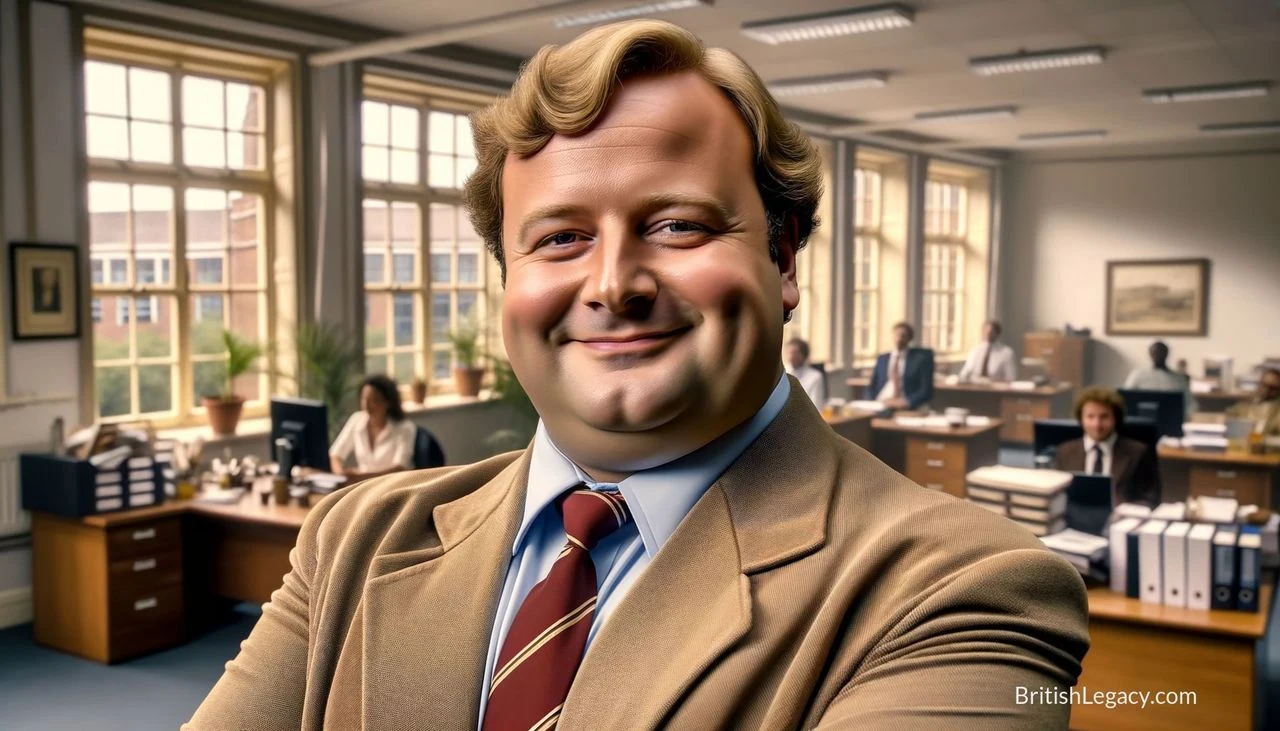
Ricky Gervais made his name by finding comedy in the distance between self-image and reality. In The Office, David Brent believes himself to be a gifted manager and entertainer; the people around him see a boss who cannot read the room. Gervais developed the character with Stephen Merchant, then extended his interest in vanity, embarrassment and ambition through Extras, stand-up, radio and later television. His route to prominence ran through music and broadcasting before the BBC mockumentary brought him a much wider audience.
Reading, university and an early music career
Born in Reading, Berkshire, on 25 June 1961, Gervais was the youngest of four children. He attended schools in Whitley and, after a gap year working as a gardener at the University of Reading, began studying at University College London in 1980. He initially intended to study biology, changed to philosophy and graduated in 1983. At UCL he met Jane Fallon, with whom he has been in a relationship since 1982.
Music came before his television career. In 1983, Gervais and his friend Bill Macrae formed Seona Dancing, a new-wave duo signed to London Records. The label released two singles, “More to Lose” and “Bitter Heart”. Neither made an impact on the UK singles chart, although “More to Lose” later became a hit in the Philippines. Gervais also managed Suede before the band became successful in the 1990s.
He moved into comedy through broadcasting and television. Gervais worked as an assistant events manager at the University of London Union before becoming head of speech at the alternative radio station Xfm. When the station needed an assistant, he interviewed Stephen Merchant; the two would become long-term creative collaborators. In 1998, Gervais’s job was made redundant after Capital Radio took over Xfm. Around the same time, he appeared in Channel 4’s Comedy Lab and made Golden Years, a one-off comedy about a David Bowie obsessive. His cutting, outspoken television persona became more widely known through The 11 O’Clock Show, followed in 2000 by the short-lived Meet Ricky Gervais.
David Brent and the making of The Office
The Office began with a short film Merchant made during a BBC production course. His seven-minute parody, The Seedy Boss, introduced the character who would become David Brent. The idea passed through BBC comedy executives, and Gervais and Merchant were commissioned to develop a full pilot script. Their series placed its comic attention on the social rituals and discomforts of ordinary working life, with Gervais playing the self-important manager of a fictional paper company in Slough.
The first six episodes aired in July and August 2001 without much initial attention. Repeats, word of mouth and home-video releases helped the series find an audience; a second six-episode series followed. Rather than relying on a conventional stream of punchlines, the mock-documentary format let pauses, glances and awkward silences carry much of the comedy. Brent’s hunger for approval made him both the source of the embarrassment and, at moments, a recognisably insecure person beneath the performance.
The series went on to reach audiences beyond Britain. It was remade in countries including France, Germany, Brazil, India and the United States. Gervais and Merchant served as producers on the American version and co-wrote an episode. The American adaptation, starring Steve Carell, became particularly prominent, but its international success grew from a format first developed around a British workplace and a boss whose delusions were made visible in everyday encounters.
Recognition followed the programme’s growing audience. In 2004, The Office won the Golden Globe for best television series, musical or comedy, and Gervais won the award for best actor in that category. He later described the award as a gateway to America. The series established a working pattern for his career: Gervais acted in projects he also created or co-wrote, often alongside Merchant, and used comic characters to examine status, ambition and social awkwardness.
Extras, broadcasting and a widening body of work
Gervais and Merchant followed The Office with Extras, which began on the BBC in 2005. Gervais played Andy Millman, a background performer who wants to become a star. The series took its comedy from the difference between Millman’s ambitions and the marginal roles available to him, while guest performers appeared as comic versions of themselves. The guest list included Kate Winslet, Samuel L. Jackson, Ben Stiller, Daniel Radcliffe and David Bowie. Gervais won a Primetime Emmy for his performance in the second series in 2007.
His work with Merchant also extended into radio and podcasting. After returning to Xfm in 2001, the pair worked with producer Karl Pilkington, whose observations became central to their conversations. The Ricky Gervais Show developed from their radio work into a podcast featuring all three. Its early episodes were among the most downloaded podcasts in the world and were subsequently adapted as an animated television series. Their projects together included Life’s Too Short, written with Warwick Davis, and An Idiot Abroad, which followed Pilkington on travels arranged by Gervais and Merchant.
Gervais also continued to make programmes without Merchant in the same central role. Derek, which he wrote, directed and starred in, follows a care-home worker and the people around him. After Life, a comedy-drama created, written and directed by Gervais, centres on a bereaved newspaper writer and ran from 2019 to 2022. These series retained his interest in uncomfortable behaviour but gave more space to care, grief and the ties between people. In film, his work has included Ghost Town, The Invention of Lying, Cemetery Junction and David Brent: Life on the Road, which returned to the character that had first made him widely known.
Stand-up, public appearances and animal welfare
Gervais began performing stand-up in the late 1990s. His tours have included Animals, Politics, Fame, Science, Humanity and SuperNature. He has also hosted the Golden Globe Awards five times: in 2010, 2011, 2012, 2016 and 2020. His hosting style and jokes attracted both praise and criticism, making the ceremonies another setting for the provocative persona he had established on television.
Animal welfare is a separate, sustained strand of his public work. Gervais has used social media to promote animal-welfare campaigns, including calls to rescue animals from captivity and to adopt dogs. He received a Genesis Award from the Humane Society in 2015 for raising awareness of animal welfare through social media, and the Lord Houghton Award for Service to Animal Welfare in 2017. In 2021, he collaborated with illustrator Rob Steen on “Bullfight”, a comic story published in a book raising awareness of climate and biodiversity issues. These efforts sit alongside, rather than explain, his comedy career: they show how he has used a large public platform to draw attention to causes he supports.
Why Ricky Gervais deserves a place in British Legacy
Gervais’s place in British Legacy rests first on the particular contribution of The Office. Made with Stephen Merchant for the BBC, the series turned a familiar British workplace into a carefully observed comic setting. Its formal choices—documentary-style filming, silence, glances and social discomfort—helped make a small number of episodes travel well beyond their original context. Adaptations in many countries, including the United States, carried the format to new audiences while leaving its starting point in a Slough paper company clear. The programme’s international reach is a tangible example of British television comedy becoming source material for other cultures, rather than simply exporting a finished show.
His broader record adds substance to that achievement. Extras carried his examination of ambition into the entertainment industry; his radio work and podcast with Merchant and Karl Pilkington helped bring conversational comedy to a large online audience. Later series, including Derek and After Life, shifted towards kindness, loss and companionship without abandoning awkwardness as a comic tool. Away from performance, his animal-welfare campaigning and public use of social media have supported specific advocacy work. Taken together, these strands make Gervais more than the creator of a single famous character: they show a British writer-performer repeatedly moving between television, live comedy and new forms of broadcasting, with work that has been adapted, discussed and watched internationally.
Sources
Ricky Gervais — Wikipedia, revision 1378549927
Adapted in part from Ricky Gervais by Wikipedia contributors, under CC BY-SA 4.0. Text has been edited and combined with the existing article; this adapted text is shared under the same licence. Contributor history.