
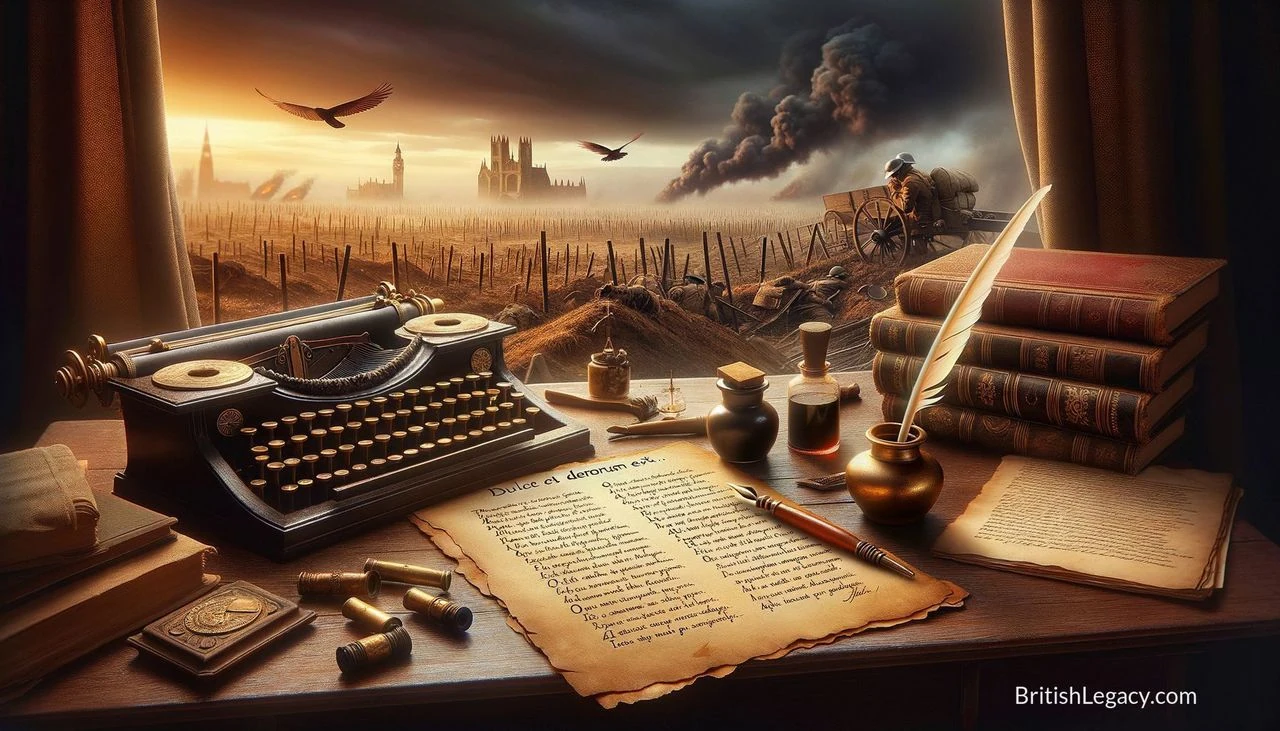
Wilfred Owen’s war poems put the suffering of soldiers against the language used to glorify battle. In “Dulce et Decorum Est”, the gas attack is not an abstract symbol of courage but a physical ordeal; “Anthem for Doomed Youth” asks what becomes of a funeral when guns have replaced church bells. Owen was killed in France a week before the Armistice. Much of the work that made him one of the defining English poets of the First World War appeared only after his death.
A poet in formation
Wilfred Edward Salter Owen was born on 18 March 1893 at Plas Wilmot, near Oswestry in Shropshire. He was the eldest of four children of Thomas and Susan Owen. His family moved several times during his childhood, living in Birkenhead and later returning to Shrewsbury. He attended the Birkenhead Institute and Shrewsbury Technical School.
Owen was raised in the evangelical Anglican tradition and was a devout believer in his youth. He later became disillusioned with the Church, in part through his experience as a lay assistant to the vicar of Dunsden, near Reading. From 1911 to 1913 he lived at the vicarage in return for lodging and some tuition, and attended classes at University College, Reading. He studied botany before taking free Old English lessons at the suggestion of the English department’s head. His poetic vocation dated to about 1904; the Bible and Romantic poets, particularly Wordsworth and Keats, were among his early influences.
After failing to gain the scholarship he needed to attend the University of London, Owen worked as a private tutor in France. He taught English and French at the Berlitz School of Languages in Bordeaux and later for a family. He met the French poet Laurent Tailhade and corresponded with him in French. When war broke out, Owen did not immediately enlist; he even considered joining the French army before returning to England.
From enlistment to the front
Owen enlisted in the Artists Rifles on 21 October 1915 and trained in Essex. In June 1916 he was commissioned as a second lieutenant in the Manchester Regiment. His experience of the army changed sharply after he went to the front. He suffered concussion after falling into a shell hole and was caught in a trench-mortar blast. After spending several days unconscious, he was diagnosed with neurasthenia, or shell shock, and sent to Craiglockhart War Hospital in Edinburgh.
At Craiglockhart, Owen met Siegfried Sassoon, whose example and friendship helped transform his poetry. Owen’s doctor, Arthur Brock, encouraged him to turn experiences and recurring dreams into verse; Sassoon showed him how realism and satire could work in poetry. Owen brought those approaches together with the Romantic inheritance already present in his writing. The result was not simply a record of combat, but a poetry shaped by pity for the people caught in it.
After leaving Craiglockhart, Owen undertook light duties and spent time in Scarborough and Ripon. He wrote or revised poems including “Futility” and “Strange Meeting”. Sassoon, meanwhile, encouraged Owen’s work and helped promote it. Owen returned to active service in France in July 1918. His decision to go back reflected his conviction that the realities of war still needed to be told.
On 1 October, near Joncourt, Owen led men of the Second Manchesters in an attack on German positions. When his company commander became a casualty, he took command, resisted a counter-attack and used a captured machine gun. He was awarded the Military Cross for his conduct. The citation was published after his death.
Poems against the romance of war
Owen’s best-known poems include “Dulce et Decorum Est”, “Anthem for Doomed Youth”, “Futility”, “Insensibility” and “Strange Meeting”. Their subjects and forms differ, but the violence of battle is never made safely distant. In “Dulce et Decorum Est”, the men’s exhaustion and a gas attack overturn the poem’s bitterly invoked Latin phrase, traditionally rendered as it is sweet and fitting to die for one’s country. “Anthem for Doomed Youth” turns the rituals of mourning into the sounds of guns, rifles and shells.
Owen’s poetry drew on his religious background as well as his military experience. “Anthem for Doomed Youth” reimagines funeral ceremony on the battlefield, while “Exposure” registers a crisis of belief. His work also developed technically: he used pararhyme extensively, drawing on assonance and near-rhyme to create unsettling echoes. Only five of his poems had been published before he died, one in fragmentary form. Most appeared posthumously, beginning with Poems in 1920.
Sassoon’s advocacy was central to Owen’s early reputation, alongside support from Edith Sitwell and the fuller 1931 edition prepared by Edmund Blunden. A renewed interest in the 1960s brought the poems to a wider public. Their reach has continued beyond the page: Benjamin Britten’s War Requiem, first performed in 1962, uses Owen’s poetry extensively. His work has also been kept in public view through plays, novels, films and other adaptations.
A death close to the Armistice
Owen was killed on 4 November 1918 while British forces crossed the Sambre–Oise Canal in northern France. He was 25, and the Armistice followed exactly a week later. His mother received the telegram announcing his death on Armistice Day, as bells rang in Shrewsbury. Owen was buried at Ors Communal Cemetery. The inscription on his gravestone, adapted by his mother from his poetry, reads: “SHALL LIFE RENEW THESE BODIES? OF A TRUTH ALL DEATH WILL HE ANNUL”. He was promoted to lieutenant the day after his death.
Owen’s manuscripts, letters and photographs have helped preserve the working life behind the poems. In 1975 his sister-in-law donated material owned by her late husband to the English Faculty Library at the University of Oxford, including Owen’s personal library and an almost complete set of The Hydra, the Craiglockhart hospital magazine he edited. His papers also found a lasting public home in memorials and collections. In 1985, he was among sixteen First World War poets commemorated in Westminster Abbey’s Poet’s Corner. The stone’s inscription, taken from his preface to his poems, states: “My subject is War, and the pity of War. The Poetry is in the pity.”
Why Wilfred Owen deserves a place in British Legacy
Owen’s place in British literary history rests on the precision with which he made the costs of war visible. He wrote as a soldier who had experienced the front, but his poems are more than eyewitness records: they bring together physical detail, formal craft and a moral challenge to easy claims about glory. “Dulce et Decorum Est” and “Anthem for Doomed Youth” remain powerful because their language makes readers confront what slogans about sacrifice leave out. Their attention to individual suffering has helped give remembrance a human as well as a military dimension.
His influence also has a concrete history. Sassoon helped bring the poems to readers, later editors prepared fuller collections, and Britten placed Owen’s words within one of the most significant British musical responses to war. Memorials in Westminster Abbey and elsewhere, together with the preservation of his letters and manuscripts, keep both the poems and the experiences behind them accessible. Owen’s British legacy is therefore not just a matter of national recognition: it lies in a body of work that has shaped literature, music and public remembrance, and that still gives readers a way to measure the human consequences of conflict.
Sources
Wilfred Owen — revision 1379807071 · Wilfred Owen
Adapted in part from Wilfred Owen by Wikipedia contributors, under CC BY-SA 4.0. Text has been edited and combined with the existing article; this adapted text is shared under the same licence. Contributor history.
.jpg)