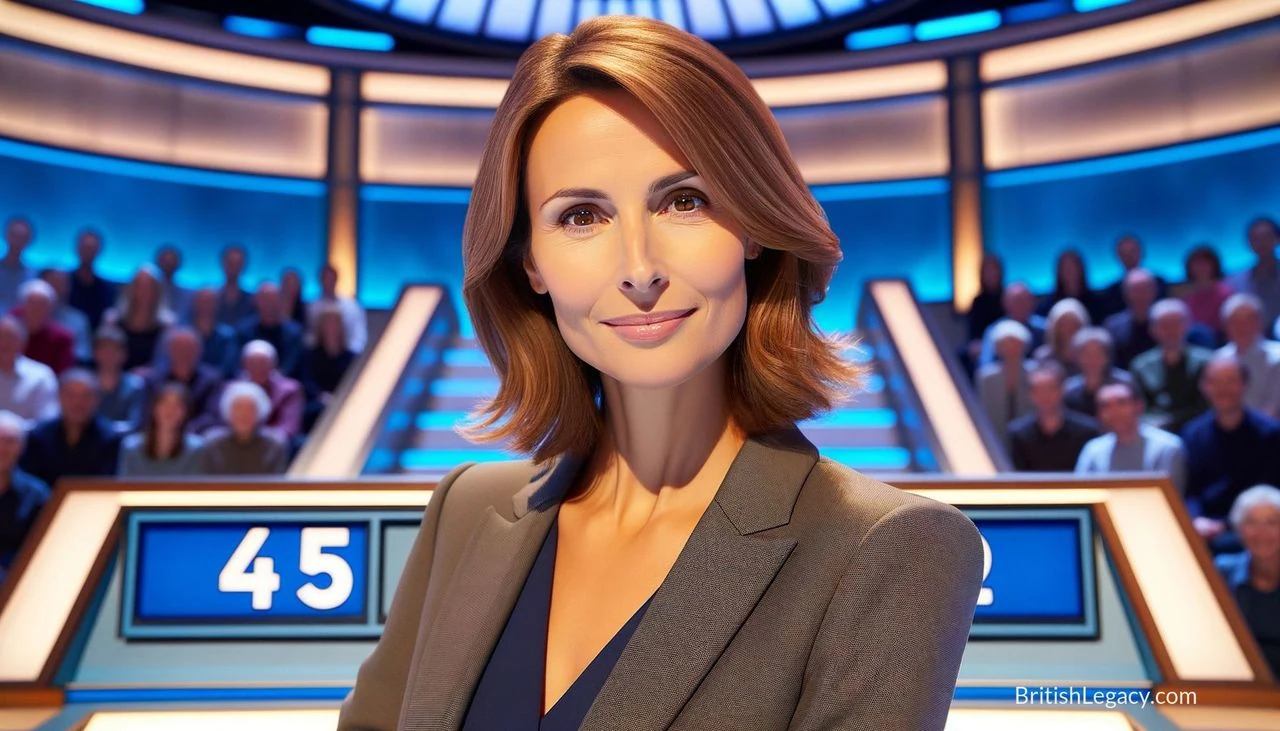
For 26 years, Carol Vorderman made mental arithmetic one of the most recognisable features of British television. As the numbers-game specialist on Channel 4’s Countdown, she turned rapid calculation into a daily broadcast performance, helping make a game built around letters and numbers familiar to millions of viewers. The programme was the beginning, not the limit, of a career spanning television, radio, writing and educational projects.
From Prestatyn to Cambridge
Carol Jean Vorderman was born in Bedford on 24 December 1960. Her parents separated shortly after her birth, and her Welsh mother took the family to Prestatyn in North Wales, where Vorderman grew up with her brother and sister. She attended Blessed Edward Jones Catholic High School in nearby Rhyl. In 1978, aged 17, she began studying engineering at Sidney Sussex College, Cambridge, graduating with a third-class degree. She later described the result as disappointing.
Her first jobs were in engineering and technical communication, rather than television. Vorderman worked as a junior civil engineer at Dinorwig Power Station in Llanberis, then as a graduate management trainee in Leeds. In the mid-1980s, she also worked part-time in the Information Services Department of the UK Atomic Energy Authority, principally making in-house video programmes. For a time, she sang backing vocals with the Leeds-based group Dawn Chorus and the Blue Tits, fronted by radio DJ Liz Kershaw. These early roles give context to a career that would move between technical subjects and mass-audience entertainment.
The numbers game on Countdown
Vorderman joined Countdown when it launched on Channel 4 in 1982. Her mother had spotted an advertisement in The Yorkshire Post seeking a woman with strong mathematical skills for a new quiz show and submitted an application on her daughter’s behalf. Vorderman was 21. At first, she handled the numbers game as one of a five-person presentation team, billed among the programme’s “vital statisticians”. As the team was reduced, her role grew: she began handling the letter tiles as well as the numbers.
The format gave her a distinctive on-screen task. When contestants could not reach an exact solution, she demonstrated fast, accurate arithmetic to find one. She appeared with Richard Whiteley from the programme’s beginning until his death in 2005, then continued alongside Des Lynam and Des O’Connor. Vorderman declined an invitation to take over as the main presenter after Whiteley died. On 25 July 2008, it was announced that she would leave the show; she later said she had resigned after failing to agree terms for a new contract. Her last programme was broadcast on 12 December 2008. By then, she had appeared on Countdown for 26 years and in 4,832 episodes.
That long run made her work more than a recurring television job. The programme put mathematical calculation in front of a broad audience, and Vorderman’s visible role gave the numbers round a presenter as well as a puzzle. Her public profile grew alongside the show, but it did not confine her to one format.
A career across television and radio
While on Countdown, Vorderman took on a succession of other presenting roles. She co-presented the children’s programme How 2 from 1990, presented the home-improvement series Better Homes, and began hosting ITV’s Pride of Britain Awards in 1999. She also guest-presented programmes including Have I Got News for You and The Sunday Night Project, and presented the food series Food Glorious Food in 2013.
From 2011 to 2014 she presented ITV’s Loose Women. She took part in the second series of Strictly Come Dancing in 2004 and finished second to leave the competition. In 2016, she competed in I’m a Celebrity...Get Me Out of Here!, finishing eighth. In 2020, she won The Great Stand Up to Cancer Bake Off. Her television work has also included a Welsh-language journey: on S4C’s Iaith ar Daith, she learned Welsh and completed challenges in the language. These varied appearances extended her public presence beyond the calculation that first made her famous.
Vorderman’s broadcasting later included radio. She was a presenter on BBC Radio Wales before leaving in 2023. She went on to present her own show on LBC from 2023 to 2024. That year, she announced that she would leave following a health scare. Across these changes in medium, she remained a familiar presenter whose career had begun on a newly launched channel and continued across several generations of television and radio.
Mathematics beyond the studio
Vorderman’s engineering education and television role informed a parallel career in writing and educational work. She has written books on mathematics and school subjects, including titles in the Maths Made Easy, English Made Easy and Science Made Easy series. Her work has ranged from children’s learning materials to books about the internet and Sudoku. She has also written newspaper columns and books on other topics.
In 2010, she launched the MathsFactor, an online mathematics coaching system intended for children aged four to 12. It carried her familiar subject into a different setting: instead of demonstrating calculations on a game show, the project aimed to help children practise mathematics through an online learning service. The current account described the launch as taking place in 2011; the year given in the Wikipedia article is 2010. Vorderman also served on an advisory panel for the Conservative Party’s review of mathematics teaching in early-years settings and primary schools.
Her work in this area is best understood through its specific activities: television demonstrations of arithmetic, books and learning materials, an online tutoring system, and participation in a policy review. The available evidence does not establish broader claims about the scale of the project’s impact or its reach among children, so its significance need not be inflated to recognise the practical connection between Vorderman’s public profile and mathematics education.
Service, recognition and public life
Vorderman was appointed a Member of the Order of the British Empire in the 2000 Birthday Honours for services to broadcasting. In 2014, she became an ambassador for the Royal Air Force Air Cadets and received the honorary rank of group captain in the Royal Air Force Volunteer Reserve (Training Branch). The honorary appointment was extended in 2017. She was also elected an honorary fellow of Bangor University and received an honorary MA from the University of Bath in 2000. In 2021, the Institution of Engineering and Technology awarded her an honorary fellowship in recognition of her contribution to the engineering profession.
Charitable work has included her support for the Cleft Lip and Palate Association, of which she is a patron. In 2005, she won ITV’s Gameshow Marathon; the programme raised £60,000 for the association. She has also taken part in fundraising connected with cancer charities and the RAF Association. These activities sit alongside her broadcasting and educational work, rather than being evidence for the wider, general claims of advocacy sometimes attached to celebrity profiles.
Why Carol Vorderman deserves a place in British Legacy
Vorderman’s place in British broadcasting rests on a particular and lasting achievement: she made mathematical calculation a visible part of an entertainment programme for more than a quarter of a century. On Countdown, arithmetic was not hidden behind a score or a voice-over. Viewers saw a presenter work through the numbers round, and the programme made that activity part of the shared language of popular television. Her 26-year run, from the show’s launch in 1982 to her departure in 2008, links her career to the development of Channel 4 and to a distinctive British quiz format.
That legacy also extends beyond the studio. Vorderman carried her association with mathematics into books, children’s learning materials and the MathsFactor online coaching system, while her later work continued across television and radio. Her honorary fellowship from the Institution of Engineering and Technology recognises another important strand: she studied engineering and remained publicly associated with quantitative subjects even as her work broadened into general entertainment. The strongest case for remembering her is therefore specific rather than ceremonial. She connected technical ability with accessible broadcasting, and used the attention earned on television to develop further educational work. Together, those contributions show how a presenter can make a specialised skill part of everyday popular culture in Britain.
Sources
Carol Vorderman — Wikipedia revision 1378255424
Adapted in part from Carol Vorderman by Wikipedia contributors, under CC BY-SA 4.0. Text has been edited and combined with the existing article; this adapted text is shared under the same licence. Contributor history.