
Siegfried Sassoon knew the Western Front as a serving officer before he made his protest against the war public. Decorated for bravery, he also wrote poems that set trench suffering against patriotic rhetoric. His story is not simply that of a soldier who became a poet: he was a forceful critic of the conflict, an editor and novelist, and a writer whose work moved between the experience of war and the memory of English country life.
A Kent childhood and a change of direction
Sassoon was born in Matfield, Kent, on 8 September 1886. He was the second of three sons of Alfred Ezra Sassoon, from the wealthy Baghdadi Jewish Sassoon family, and Theresa, whose family included the sculptor Hamo Thornycroft. His parents separated when Siegfried was four; his father died of tuberculosis in 1895. Sassoon attended New Beacon School in Sevenoaks, Marlborough College and Clare College, Cambridge, where he read history from 1905 to 1907. He left without taking a degree and spent the years that followed hunting, playing cricket and writing verse.
His early writing included the privately published parody The Daffodil Murderer (1913). War changed its direction. Sassoon joined the Sussex Yeomanry on 4 August 1914, the day Britain declared war on Germany, but a serious riding injury delayed his departure from England. Commissioned into the Royal Welch Fusiliers in 1915, he was sent to France that November. There he met Robert Graves, whose ideas about gritty realism helped shape Sassoon’s sense of what poetry could confront.
Bravery on the Western Front
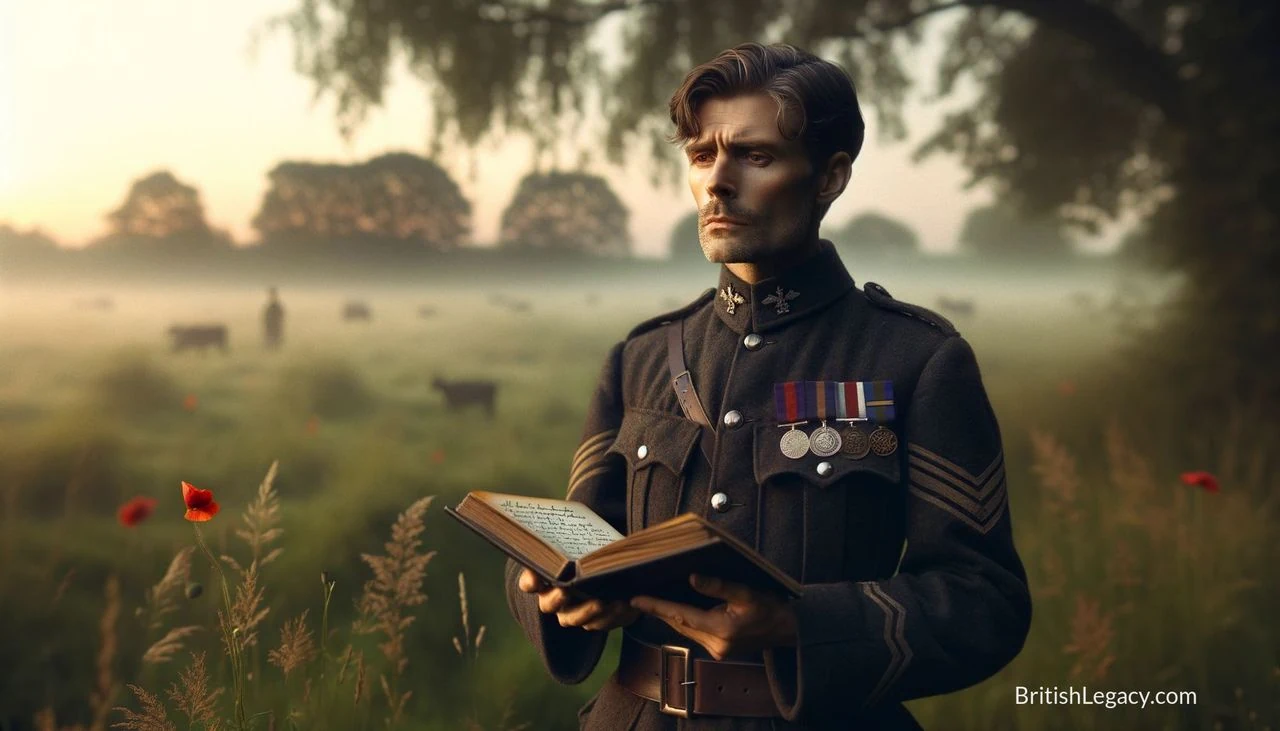
Sassoon’s service brought both distinction and deepening disillusionment. He took part in dangerous night raids and was known among his men for his courage. On one occasion he entered a German trench alone; rather than summon reinforcements, he sat down to read a book of poems before returning. In July 1916 he received the Military Cross. Its citation recognised his courage and determination in remaining under fire to bring in the wounded and dead.
The war altered his writing as well as his view of military service. Sassoon’s poems rejected the comforting language of heroic sacrifice and patriotic certainty, attending instead to the ugliness and suffering of the trenches. The Old Huntsman, published in 1917, marked his growing reputation as a war poet. Counter-Attack and Other Poems followed in 1918. The title poem conveys the disorientation of a gas attack in the sudden urgency of its opening: “Gas! GAS! Quick, boys! – An ecstasy of fumbling”. His verse made the cost of battle difficult to set aside, without pretending that a poem could undo it.
The Soldier’s Declaration and Craiglockhart
In July 1917 Sassoon made his opposition formal in “Finished with the War: A Soldier’s Declaration”. He objected to the continuation of a conflict he had entered believing it to be a war of defence and liberation. His letter reached the press and was read in the House of Commons. Rather than court-martial him, the authorities judged him unfit for service and sent him to Craiglockhart War Hospital near Edinburgh, where he was treated for what was then called neurasthenia.
At Craiglockhart he met Wilfred Owen. Sassoon encouraged Owen’s ambition as a poet and annotated a manuscript of “Anthem for Doomed Youth”; their connection became an important part of both men’s literary histories. Owen returned to France and was killed in 1918, a week before the Armistice. Sassoon also returned to active service, later serving in Palestine and France. Wounded in the head in July 1918, reportedly by friendly fire, he spent the rest of the war in Britain. He relinquished his commission on health grounds in March 1919, retaining the rank of captain.
Writing beyond the trenches
After the war, Sassoon’s work widened beyond poetry. In 1919 he became literary editor of the socialist Daily Herald, commissioning work from writers including Arnold Bennett and Osbert Sitwell and employing reviewers such as E. M. Forster and Charlotte Mew. He also supported the composer William Walton, who dedicated the overture Portsmouth Point to him.
Prose brought Sassoon another readership. Published anonymously in 1928, Memoirs of a Fox-Hunting Man introduced George Sherston, a mild-mannered fictional version of its author, and won the James Tait Black Award for fiction. Sassoon continued the character’s story in Memoirs of an Infantry Officer (1930) and Sherston’s Progress (1936). Together, the books trace a journey from country pursuits to the army and war. He later wrote three volumes of autobiography, returning directly to his youth and early adulthood.
In 1933 Sassoon married Hester Gatty. Their son, George, was born in 1936. The couple separated in 1945, and Sassoon lived in seclusion at Heytesbury in Wiltshire while remaining in touch with literary friends. In 1957 he converted to Catholicism. He died of stomach cancer on 1 September 1967, aged 80, and was buried at St Andrew’s Church, Mells, in Somerset. He had been appointed a Commander of the Order of the British Empire in 1951.
A record preserved and read
Sassoon’s legacy is carried not only by published poems and books but by the records that illuminate how he wrote and served. His papers include Western Front and Palestine diaries, a draft of the 1917 declaration, school notebooks and post-war journals. Cambridge University Library acquired the family papers in 2009 with support from the National Heritage Memorial Fund and other donors. An exhibition at the university in 2010 brought his life and archive to a wider public.
His place among the writers of the First World War was also marked at Westminster Abbey. In 1985, Sassoon was one of 16 Great War poets commemorated in Poet’s Corner. The inscription, taken from Wilfred Owen’s preface to his poems, reads: “My subject is War, and the pity of War. The Poetry is in the pity.” Sassoon’s Military Cross was later bought by the Royal Welch Fusiliers for display at its museum in Caernarfon.
Why Siegfried Sassoon deserves a place in British Legacy
Siegfried Sassoon deserves a place in British Legacy because his writing joined firsthand experience of war to a sustained challenge to the language used to justify it. He served in the British Army, was decorated for courage, and then risked disciplinary consequences by objecting publicly to the continuation of the conflict. His poems, including those in Counter-Attack and Other Poems, gave readers an unsparing account of fear, injury and death in the trenches. That record matters: it offers a way to encounter the human cost of war through the work of someone who had served in it, rather than through abstract claims about glory or sacrifice.
His contribution is not confined to his wartime verse. Sassoon encouraged Wilfred Owen, helped bring Owen’s work to wider attention after his death, and later wrote the Sherston books and autobiographies, extending his record of war into a broader account of memory and change. His work as an editor and his support for William Walton also show a literary life connected to other artists and institutions. The preservation of his papers at Cambridge and his commemoration at Westminster Abbey make that legacy accessible beyond the printed page. Together, the poems, prose and surviving archive help later generations examine both the experience of the First World War and the difficult choices of a writer who had witnessed it.
Sources
Siegfried Sassoon (revision 1379807043)
Adapted in part from Siegfried Sassoon by Wikipedia contributors, under CC BY-SA 4.0. Text has been edited and combined with the existing article; this adapted text is shared under the same licence. Contributor history.
.jpg)