
Wilfred Owen’s poems brought the noise of battle into direct conflict with the language of honour and glory. In “Dulce et Decorum Est”, a gas attack becomes a scene of terror; in “Anthem for Doomed Youth”, guns and shells take the place of church bells and funeral prayers. Owen did not live to see most of his best-known work published. Killed in France a week before the Armistice, he left poems that would later become central to how readers encountered the First World War’s human cost.
From Shropshire to France
Wilfred Edward Salter Owen was born on 18 March 1893 at Plas Wilmot, near Oswestry, Shropshire. He was the eldest of four children of Thomas and Susan Owen. His childhood took the family between Shropshire and Birkenhead: after his grandfather died, they left the house where Owen was born and lodged in Birkenhead, later moving back to Shrewsbury. He attended the Birkenhead Institute and Shrewsbury Technical School.
Owen had begun writing poetry long before he became a soldier. He later dated his poetic beginnings to a holiday at Broxton by the Hill when he was ten. His early reading included the Romantic poets, particularly Wordsworth and Keats. He was also raised as an evangelical Anglican, a religious inheritance that would remain present in his poetry even as his experiences led him to question belief and the Church’s response to human need.
After working as a lay assistant to the vicar of Dunsden, near Reading, Owen taught English and French in France. He was there when war broke out. Rather than rushing to enlist, he considered joining the French army before returning to England. On 21 October 1915 he enlisted in the Artists Rifles; in June 1916 he was commissioned as a second lieutenant in the Manchester Regiment and went to France.
Experience, treatment and a changed poetic voice
Owen’s war service brought him into contact with shellfire and its consequences. After falling into a shell hole and suffering concussion, he was caught in the blast of a trench mortar. He spent several days unconscious and was later diagnosed with neurasthenia, or shell shock. Sent to Craiglockhart War Hospital in Edinburgh, he encountered Siegfried Sassoon, whose poetry and friendship would help change the direction of his writing.
At Craiglockhart, Owen worked on poems shaped by the experiences he relived in dreams. His doctor, Arthur Brock, encouraged him to turn those experiences into verse, while Sassoon offered an example of satire and unsparing realism. Owen’s developing style joined that realism to elements of his earlier, more romantic writing. His verse made room for what he called “the pity of war”: not an abstract judgement, but attention to suffering, fear and the lives caught in battle.
After leaving Craiglockhart, Owen spent time in Scarborough and Ripon. He composed or revised poems there, including “Futility” and “Strange Meeting”. In July 1918 he returned to active service in France. On 1 October, near Joncourt, he led men of the Second Manchesters in an attack on German positions. He was awarded the Military Cross for his courage and leadership. The citation described how, after his company commander became a casualty, Owen assumed command and resisted a counter-attack.
Poems against the language of glory
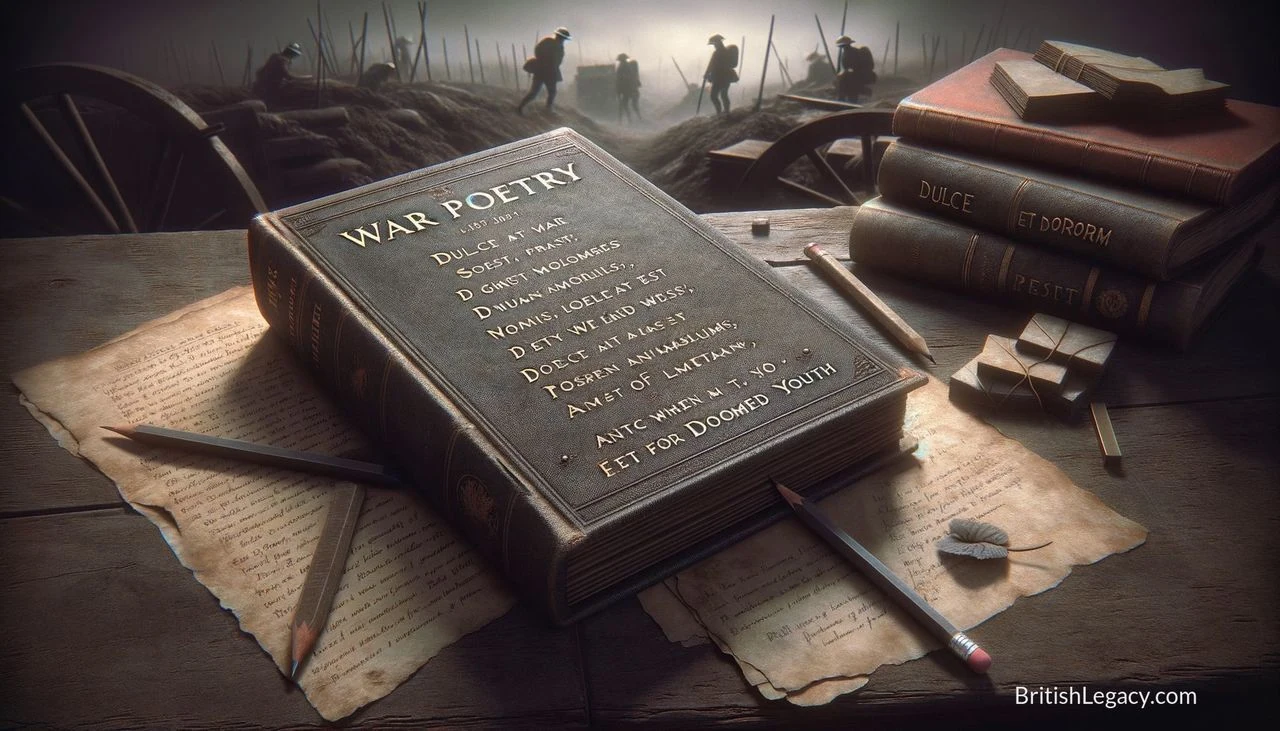
“Dulce et Decorum Est” turns on the bitter irony of its Latin title, taken from the claim that it is sweet and honourable to die for one’s country. Its gas-attack scene refuses any such comfort, directing the reader towards the suffering of a dying soldier. “Anthem for Doomed Youth” asks what funeral rites remain for men killed in battle. Its answer is the noise of guns and shells, while the mourning that might have taken place at home is suggested through the faces and gestures of those left behind.
Owen’s poetry was not formed by war alone. His early Romantic influences, religious inheritance and friendship with Sassoon all contributed to it. Sassoon’s influence is evident in some of Owen’s best-known poems, but Owen’s voice developed in its own direction. His use of pararhyme, often drawing on assonance, became one feature of that distinctive sound. He wrote far more than the handful of poems published during his lifetime: most of his best-known work appeared after his death.
Owen had planned a volume of verse and written a preface, but did not see that book in print. His poems appeared in collections after his death, including Poems in 1920 and a fuller edition prepared by Edmund Blunden in 1931. Sassoon’s advocacy helped bring Owen’s work to readers, as did the work of Edith Sitwell and later editors. Interest revived in the 1960s, carrying his poetry beyond a relatively restricted readership.
A death close to the Armistice
Owen was killed in action on 4 November 1918 during the crossing of the Sambre–Oise Canal in France. He was 25. His family received the telegram on Armistice Day, as bells rang in Shrewsbury to mark the end of the fighting. He was buried at Ors Communal Cemetery. The words on his gravestone, adapted by his mother from his poetry, read: “SHALL LIFE RENEW THESE BODIES? OF A TRUTH ALL DEATH WILL HE ANNUL”.
His posthumous recognition took several forms. In 1985, Owen was among sixteen Great War poets commemorated in Westminster Abbey’s Poets’ Corner. The stone’s inscription comes from his preface: “My subject is War, and the pity of War. The Poetry is in the pity.” Memorials and collections also mark places associated with his life and work, including Shrewsbury, Oswestry and Craiglockhart. The Wilfred Owen Association, formed in 1989, has promoted his poetry through public memorials, readings, talks and other events.
His work has also travelled through music, theatre and film. Benjamin Britten’s War Requiem, first performed in 1962, makes extensive use of Owen’s poetry. Stephen MacDonald’s play Not About Heroes centres on Owen’s friendship with Sassoon. These different forms of remembrance have carried his words to audiences who may first encounter them outside a poetry collection.
Why Wilfred Owen deserves a place in British Legacy
Owen’s place in British literary history rests on more than the force of individual lines. He made the gap between public language and lived experience impossible to ignore. “Dulce et Decorum Est” challenges a familiar claim about patriotic sacrifice by making a reader confront the suffering of a soldier in a gas attack. “Anthem for Doomed Youth” recasts the rituals of mourning through the sounds and images of the battlefield. Together, the poems show how form, sound and carefully chosen detail can expose what celebratory language leaves out.
His legacy also records how poetry is shaped and carried forward. Owen’s time at Craiglockhart, his exchange with Sassoon and his work during recovery helped form a voice that joined realism to elements of his earlier writing. He died before most of his poems reached readers, but posthumous editions and Sassoon’s advocacy helped secure their audience. The later use of his poetry in Britten’s War Requiem, alongside public memorials and the work of the Wilfred Owen Association, demonstrates its continuing life in British culture. That is a specific and lasting contribution: Owen gave readers language for the suffering of war, and his poems continue to be encountered, discussed and remembered across generations.
Sources
Wilfred Owen — revision 1379807071 · Wilfred Owen
Adapted in part from Wilfred Owen by Wikipedia contributors, under CC BY-SA 4.0. Text has been edited and combined with the existing article; this adapted text is shared under the same licence. Contributor history.
.jpg)