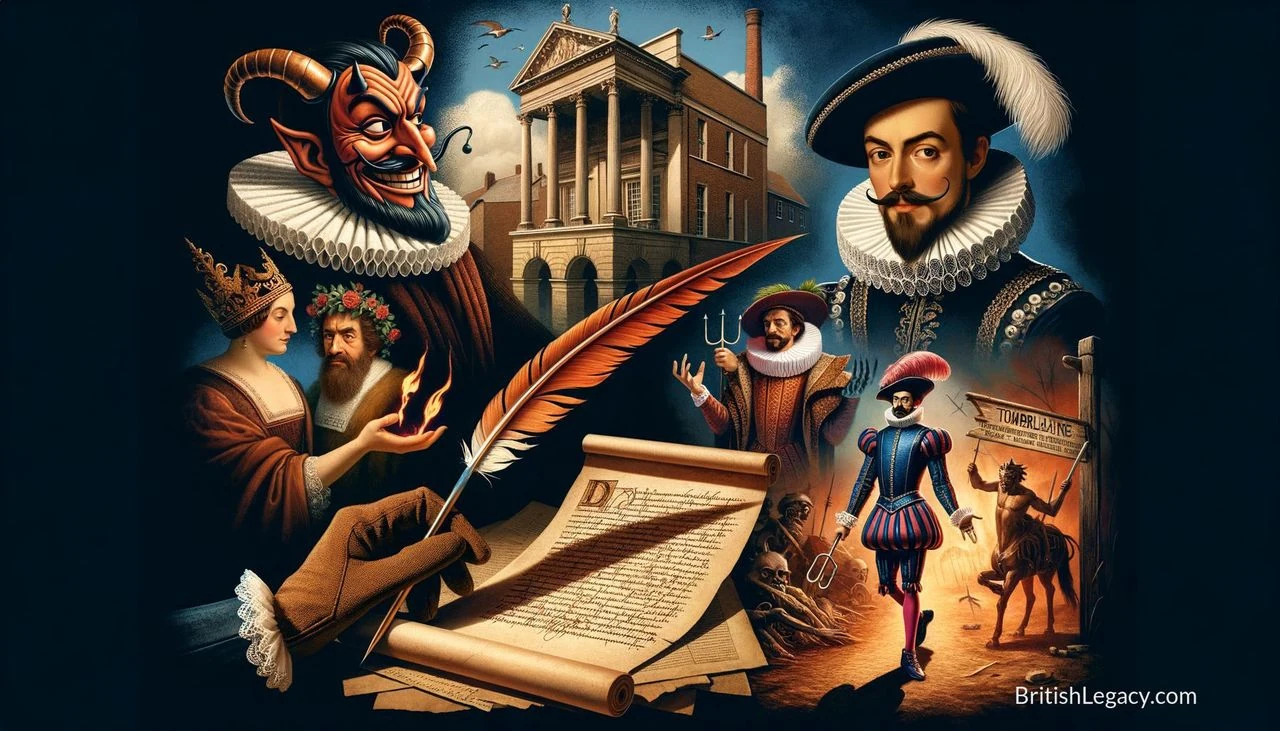
Christopher Marlowe’s plays gave the English stage a new kind of ambition: protagonists who reach for power, knowledge and desire on a scale that threatens to consume them. In Tamburlaine the Great, Doctor Faustus and Edward the Second, that dramatic energy was carried by blank verse, which Marlowe helped make a defining instrument of Elizabethan theatre. His career lasted only a few years. His influence, recognised by fellow writers during his lifetime and studied ever since, outlived him by centuries.
A Canterbury education and a London career
Marlowe was born in Canterbury, the son of John Marlowe, a shoemaker, and Katherine Marlowe. He was baptised at St George’s Church on 26 February 1564; his birth was probably a few days earlier. He attended The King’s School in Canterbury on a scholarship and, by 1580, was studying at Corpus Christi College, Cambridge. He received his Bachelor of Arts degree in 1584.
His time at Cambridge was not entirely routine. In 1587 the university hesitated over awarding his Master of Arts degree amid a rumour that he intended to join an English Catholic seminary in Rheims. The Privy Council intervened, commending his “faithful dealing” and “good service” to the Queen, and the degree was awarded. The council did not specify what that service involved. Its wording has encouraged speculation that Marlowe worked as a government agent, but the surviving record does not establish what he did. He began his literary career in 1587, after leaving the university.
Little is securely known about his adult life beyond literary evidence and official records. In 1592 he was arrested in Flushing, in the Netherlands, on suspicion of involvement in the counterfeiting of coins. He was sent back to England and faced no resulting charge or imprisonment. The episode, like the Privy Council’s intervention over his degree, has fed theories about espionage, but it does not settle them. Claims about his politics, religious beliefs and private life were also recorded in circumstances that make them difficult to assess. The evidence supports a portrait of a writer whose life became the subject of argument, not a single confident explanation of his motives.
Blank verse and overreaching heroes
Marlowe’s first major theatrical success was Tamburlaine. Its first part was performed in London in 1587, and its central figure—a conqueror driven by unbounded ambition—helped establish a larger, more forceful mode of stage writing. The two parts use blank verse, unrhymed iambic pentameter, with a scale and verbal energy that made the form suited to commanding speeches and characters intent on remaking their world. Marlowe was the first playwright to achieve a critical reputation for his use of blank verse; the form became standard in Elizabethan drama.
The play’s reception was immediate. Its many imitations led modern scholars to regard Marlowe as the foremost dramatist in London in the years just before his death. The lead actor Edward Alleyn may have played Tamburlaine and went on to perform the title roles in Doctor Faustus and The Jew of Malta. Marlowe’s plays became a foundation of Alleyn’s company, the Admiral’s Men. Their success depended not only on poetic ambition but also on the force of a stage character who could hold an audience’s attention.
Doctor Faustus takes that ambition inward. Its scholar makes a pact with the devil in pursuit of knowledge and power, then confronts the consequences of a bargain he cannot undo. The play draws on the Faust legend but gives its protagonist a dramatic struggle between repentance and damnation. Its surviving versions, printed after Marlowe’s death, differ substantially, and scholars continue to debate how far each represents his original play. The central story, however, remains one of his most durable theatrical achievements: a human appetite for more set against the cost of getting it.
In The Jew of Malta, Marlowe turned to Barabas, a protagonist marked by calculation and a drive for wealth and revenge. In Edward the Second, he brought political power into close contact with the king’s private life and his relationship with Piers Gaveston. The play’s treatment of a king’s attachments and the political consequences around them was bold for its time. Marlowe’s work does not reduce to a single type of hero: across these plays, ambition, authority and vulnerability take different forms, while the verse gives each conflict a sharp public voice.
Poetry, influence and an early death
Marlowe wrote poetry as well as plays. His unfinished narrative poem Hero and Leander was completed by George Chapman and printed in 1598. His lyric The Passionate Shepherd to His Love became popular, and he translated the first book of Ovid’s Amores and Book One of Lucan’s Pharsalia. Copies of the Ovid translation were publicly burned in 1599 during a crackdown on material considered offensive. Much of this poetic work was published after his death.
Other writers acknowledged his power soon after he died. George Peele remembered “Marley, the Muses’ darling”; Ben Jonson later praised “Marlowe’s mighty line”. Shakespeare’s As You Like It quotes a line from Hero and Leander, and modern scholars have identified wider signs of Marlowe’s influence in Shakespeare’s work. That influence is not the same as proof that Marlowe and Shakespeare collaborated. A modern attribution of the three Henry VI plays to a Shakespeare–Marlowe collaboration remains disputed, and the theory that Marlowe faked his death and wrote under Shakespeare’s name is rejected by academic consensus.
Marlowe was killed in Deptford on 30 May 1593, aged 29. The coroner’s inquest, held two days later, records that he had spent the day at a house owned by Eleanor Bull with Ingram Frizer, Nicholas Skeres and Robert Poley. According to the witnesses, Marlowe and Frizer argued over a bill; Marlowe took Frizer’s dagger, and Frizer stabbed him above the right eye during the struggle. The jury ruled that Frizer had acted in self-defence, and he was pardoned within a month. Marlowe was buried in an unmarked grave in the churchyard of St Nicholas, Deptford.
The official account did not end later questions about the death. It was discovered in 1925, and scholars have questioned the reliability of the witnesses and whether the inquest report settles the circumstances. Numerous explanations have been proposed, but the evidence does not establish a definitive alternative. Marlowe’s death remains a historical uncertainty; it should not be confused with the documented fact of his killing or turned into proof of a particular conspiracy.
A writer remembered in Canterbury and beyond
Marlowe’s name remains closely associated with Canterbury. A bronze sculpture of the Muse of Poetry, referring to Marlowe and his work, was erected in the city in 1891 and now stands outside the Marlowe Theatre, named for him in 1949. In 2002, a memorial window was unveiled at Poets’ Corner in Westminster Abbey. A question mark added to the generally accepted date of his death prompted subsequent objections from writers and scholars who argued that the documentary evidence supports the date.
His plays have continued to return to British stages. The Royal Shakespeare Company has staged works including Tamburlaine, Edward II, The Jew of Malta and Doctor Faustus; Shakespeare’s Globe and the National Theatre have also presented his plays. These productions have allowed later audiences to encounter not only the celebrated verse but also the different political and human conflicts in the plays. The range of continuing performance and study is one reason Marlowe’s reputation is more than a story about a contemporary of Shakespeare: his writing remains part of the working repertoire of English theatre.
Why Christopher Marlowe deserves a place in British Legacy
Christopher Marlowe deserves a place in British Legacy because his work helped change what English drama could sound like and whom it could place at its centre. Through blank verse, he gave the stage a medium capable of sustaining forceful argument, elaborate ambition and emotional conflict. Tamburlaine helped establish a new scale for commercial theatre; Doctor Faustus made the pursuit of knowledge and power into a tragic contest; and Edward the Second joined royal authority to intimate human relationships. These are specific achievements, not merely a claim that he was an important writer. They contributed to the development of Elizabethan drama and shaped the conditions in which later playwrights, including Shakespeare, wrote.
His British legacy is also visible in places and institutions that keep the work available: the theatre named for him in Canterbury, the memorial at Westminster Abbey and repeated productions by leading British companies. Those performances make a writer of the 1580s and 1590s part of a living theatrical culture, open to new interpretations rather than confined to a literary list. Marlowe’s short career, disputed biography and uncertain death should not eclipse what can be said clearly about his writing. He left plays and poems that test ambition, authority and desire, and a dramatic language that helped English theatre develop. Remembering him in British Legacy connects a Canterbury-born writer to both the history and continuing practice of the national stage.
Sources
Christopher Marlowe — Wikipedia revision 1379717986
Adapted in part from Christopher Marlowe by Wikipedia contributors, under CC BY-SA 4.0. Text has been edited and combined with the existing article; this adapted text is shared under the same licence. Contributor history.