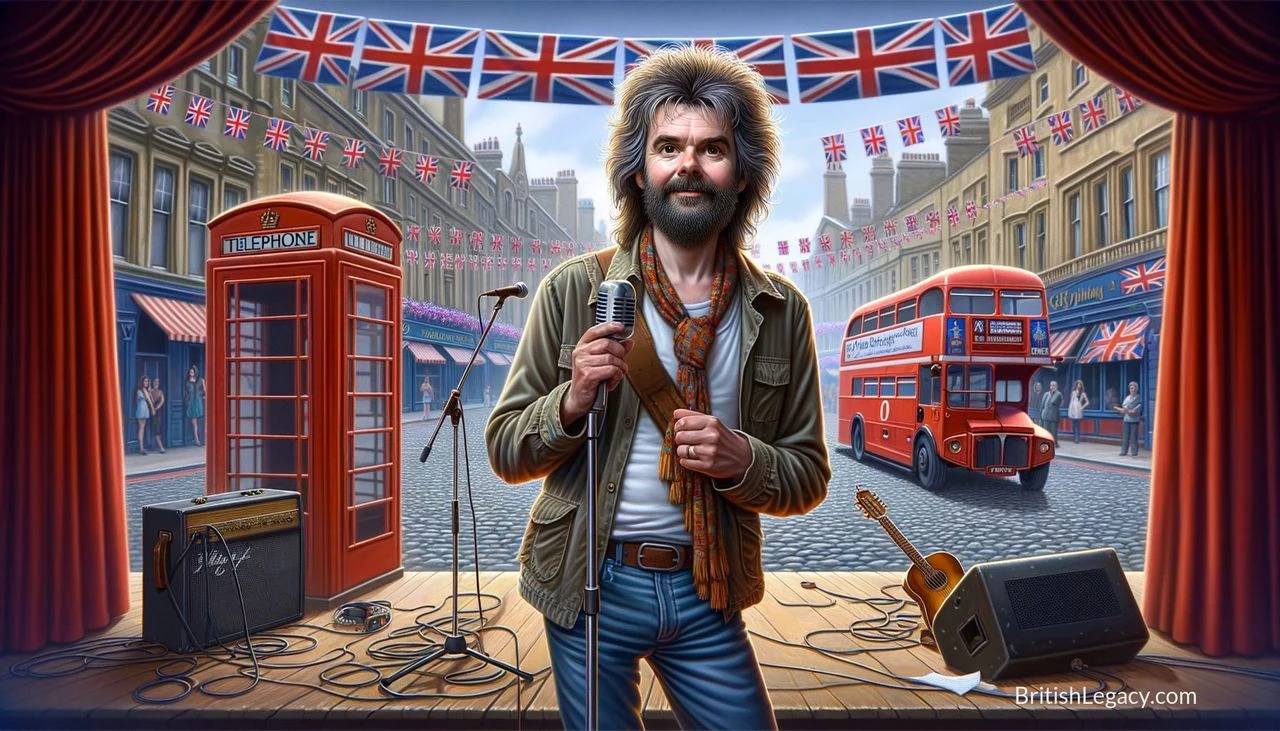
Bill Bailey’s comedy often begins with a musical idea: a familiar tune shifted into an unlikely style, a melody interrupted by a joke, or an instrument brought into a performance for comic effect. That approach has carried him from small-scale live comedy into television, arena shows and a Strictly Come Dancing victory. It has also made his work difficult to separate neatly into comedy and music: the two have been in conversation throughout his career.
A musician finds his comic voice
Mark Robert Bailey was born on 13 January 1965 in Keynsham, Somerset, and spent much of his childhood there. He attended King Edward’s School in Bath, where he studied music and played in the school band. His music teacher gave him the name Bill after hearing him play “Won’t You Come Home Bill Bailey” on guitar. Bailey began a degree in English at Westfield College, University of London, but left after a year; he later received an Associate Diploma from the London College of Music.
His route into comedy was not a sudden switch from one career to another. Bailey formed the double act the Rubber Bishops with Toby Longworth in 1984. The act helped him develop a style that combined musical parodies with twists on conventional jokes. After Longworth left in 1989, Martin Stubbs joined Bailey. In 1994, Bailey performed Rock at the Edinburgh Festival Fringe with Sean Lock, a show about an ageing rock star and his roadie. Its audiences were small, and Bailey came close to leaving comedy for a telesales job.
Instead, he went solo the following year with Bill Bailey’s Cosmic Jam. It brought together post-modern jokes, music and a rambling, whimsical performance style. Bailey supported Donna McPhail in 1995 and won a Time Out award; his return to Edinburgh in 1996 earned a Perrier Comedy Award nomination. He received the Best Live Stand-Up award at the British Comedy Awards in 1999.
Television: from Manny to team captain
Bailey’s television career included both scripted comedy and panel shows. He played Manny Bianco, the assistant to Dylan Moran’s bookshop owner Bernard, in Channel 4’s Black Books. Commissioned in 2000, the sitcom ran for three series. Bailey had earlier appeared in television comedy and panel programmes, but his role as a regular team captain on Never Mind the Buzzcocks brought him a particularly prominent place on British television. He took over from Sean Hughes in 2002 and left the series in 2008.
The music quiz gave Bailey room to make musical knowledge part of the joke, but it was one strand of a much wider television career. He became a frequent guest on QI and appeared on Have I Got News for You. He also acted in programmes including Spaced and Skins, and in films including Hot Fuzz and Nanny McPhee and the Big Bang. On Wild Thing I Love You, he presented a series focused on protecting British wild animals, including work to rehome badgers, owls and water voles. His natural-history interests also led him to present Bill Bailey’s Jungle Hero, travelling in Indonesia and Borneo to explore the work of naturalist Alfred Russel Wallace.
Live shows built around music
Bailey’s stage work has kept the interaction between music and comedy at its centre. In Bewilderness, he brought together songs, monologues, parodies and comic treatments of television themes. Part Troll, first performed at the Edinburgh Festival Fringe in 2003, went on to the West End and toured in the UK, Australia, New Zealand and the United States. Later shows included Steampunk, Tinselworm and Qualmpeddler. Tinselworm reached large UK venues, including Wembley Arena.
Bailey plays numerous instruments, among them keyboards, guitar, theremin, kazoo and bongos, and incorporates music from classical, jazz, rock and other traditions into his routines. The musical playfulness is not confined to stand-up. In 2007 he performed with the BBC Concert Orchestra and Anne Dudley in Cosmic Shindig; the Queen Elizabeth Hall performance was broadcast on BBC Radio 3 as part of Comic Relief. The following year, he presented Bill Bailey’s Remarkable Guide to the Orchestra with the same orchestra at the Royal Albert Hall.
His travels as a performer have included tours in Britain and overseas, while his screen work has introduced his mixture of verbal and musical comedy to audiences beyond the live stage. In 2020, he won the eighteenth series of Strictly Come Dancing with professional partner Oti Mabuse. Aged 55, he became the oldest winner in the show’s history at that time.
Conservation, causes and recognition
Bailey’s television work has included wildlife and conservation as well as entertainment. He is a patron of International Animal Rescue and has supported the organisation’s campaign to rescue dancing bears; he has also campaigned for the Sumatran Orangutan Society. His interest in conservation was recognised in 2014 with an honorary doctorate in conservation and sustainability from the University of the Sunshine Coast in Australia. The University of Bath awarded him an honorary doctorate in 2018.
He has also raised money and awareness for cancer-related causes. The Wikipedia account records a 100-mile walk to raise funds for cancer in honour of his mother, who died in 2005, as well as public awareness work concerning prostate cancer. In 2023, Bailey worked with Channel 4 to create the Sean Lock Comedy Award, honouring his late friend and former collaborator. In 2024, he became a patron of the Musical Comedy Awards.
Bailey has written books including Bill Bailey’s Remarkable Guide to British Birds, Bill Bailey’s Remarkable Guide to Happiness and My Animals, and Other Animals. These projects sit alongside his performances and television presenting: different ways of following interests in music, the natural world and comic observation.
Why Bill Bailey deserves a place in British Legacy
Bailey’s place in British entertainment rests not simply on his visibility on television, but on the distinctive method he has carried from the stage into broadcast comedy. He uses musical skill as part of the structure of a joke: parody, arrangement and changes of style become comic material in their own right. That approach is evident in his live shows, his years on Never Mind the Buzzcocks, and his orchestra performances at the Queen Elizabeth Hall and Royal Albert Hall. His career also shows a sustained ability to move between forms without abandoning that central combination of music and humour, from Black Books to arena tours and Strictly Come Dancing.
There is a wider public dimension to that record. Bailey has presented programmes about British wildlife and Alfred Russel Wallace, supported animal-rescue and conservation campaigns, and raised funds and awareness for cancer causes. His work with Channel 4 to establish the Sean Lock Comedy Award extended his contribution to comedy beyond his own performances, creating a means of recognising another comedian’s legacy. These are specific links between entertainment and public engagement, rather than general claims about national character. Together, his inventive musical comedy, range across British television and live performance, and documented conservation and charitable activity make his career a meaningful part of Britain’s cultural story.
Sources
Bill Bailey — Wikipedia, revision 1378530183
Adapted in part from Bill Bailey by Wikipedia contributors, under CC BY-SA 4.0. Text has been edited and combined with the existing article; this adapted text is shared under the same licence. Contributor history.