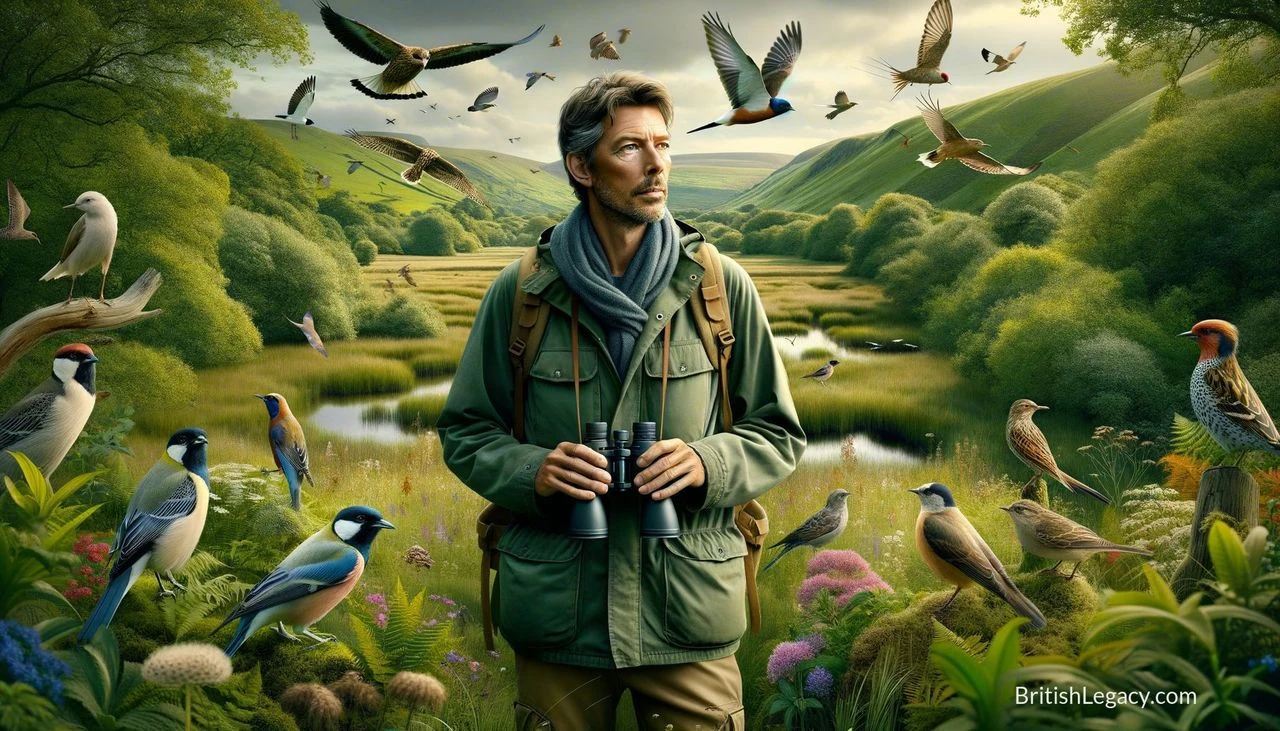
Bill Oddie built two conspicuous careers from interests that were never far apart. As a Cambridge performer, he helped make comedy for radio and television; as a birder, writer and presenter, he made British wildlife television lively, accessible and closely observed. His work on Springwatch brought birds and other animals into viewers’ homes, but his natural-history career began decades earlier, with birdwatching and writing about the wildlife around Birmingham.
A young birder from Birmingham
William Edgar Oddie was born in Rochdale, Lancashire, on 7 July 1941, and moved to Birmingham when he was young. He grew up there and attended Lapal Primary School, Halesowen Grammar School and King Edward’s School, Birmingham, where he captained the rugby union team. At Pembroke College, Cambridge, he studied English literature and graduated in 1963. Birdwatching was already a serious interest: his observations appeared in the West Midland Bird Club’s annual report in 1956, and in 1962 he wrote for it about birdlife at Bartley Reservoir.
Cambridge also gave Oddie a route into performance. He appeared in Footlights productions, including the revue A Clump of Plinths, which became Cambridge Circus and transferred to London before travelling to New Zealand and Broadway. From 1964 to 1973 he was a central performer in the BBC radio comedy I’m Sorry, I’ll Read That Again. He wrote and sang comic songs for the programme, as well as performing characters and impressions.
Oddie’s comic career extended across radio, records and television. With Tim Brooke-Taylor and Graeme Garden, he co-wrote and performed in The Goodies, which ran from 1970 to 1982. He wrote and performed songs for the group, including “The Funky Gibbon”, and later joined Brooke-Taylor and Garden on a successful Australian tour in 2005. The trio’s comedy made him widely recognisable; it did not displace his parallel interest in birds.
From field notes to wildlife television
Oddie’s natural-history work developed over years of observation, writing and broadcasting. He contributed to specialist bird publications, and in 1976 was involved in identifying Britain’s first recorded Pallas’s reed bunting on Fair Isle. His early television appearances included Animal Magic in 1977. A 1985 Nature Watch special followed him birdwatching at locations including Bartley Reservoir, Upton Warren, Titchwell Marsh and Blakeney Point.
He went on to present a varied run of wildlife programmes. Birding with Bill Oddie began in 1997, followed by series including Bill Oddie Goes Wild, Wild in Your Garden and Bill Oddie’s How to Watch Wildlife. He also wrote books about birds and birdwatching; some featured his own paintings and drawings. The range of work joined practical observation to explanation, whether the subject was garden wildlife or birds encountered further afield.
Britain Goes Wild, broadcast on BBC Two in 2004, marked a turning point in the scale of his television audience. It drew 3.4 million viewers in its 8 pm slot, according to the account of the programme’s record audience. Renamed Springwatch the following year, it became a major wildlife series, attracting more than four million viewers. Oddie co-presented it from 2005 to 2008 and also presented Autumnwatch from 2006 to 2008. The programmes brought seasonal changes and wildlife behaviour into the home as events to follow, rather than distant subjects reserved for specialist natural-history audiences.
Conservation beyond the screen
Oddie’s conservation involvement included leadership and advocacy as well as broadcasting. He became president of the West Midland Bird Club in 1999, having served as its vice-president since 1991, and was a former member of the council of the Royal Society for the Protection of Birds. He also served as president of the League Against Cruel Sports and vice-president of the British Trust for Conservation Volunteers. These roles place his public enthusiasm for birds alongside work with organisations concerned with wildlife and the natural environment.
In 2003, he set up a half-marathon in Rochdale, the town where he was born, to raise money for wildlife charities. His publications included Bill Oddie’s Introduction to Birdwatching, Bill Oddie’s How to Watch Wildlife and the memoir Tales of a Ludicrous Bird Gardener. He continued to appear in wildlife-related television, including the 2011 programme Snares Uncovered: Killers in the Countryside.
Honours and later years
Oddie received an OBE for services to wildlife conservation in 2003. In 2005, the British Naturalists’ Association gave him the Peter Scott Memorial Award, recognising his contribution to understanding natural history and conservation. He also received the RSPB Medal. The honours reflected work that spanned field observation, public communication and involvement with conservation bodies.
Oddie died on 25 July 2026, aged 85. His career crossed comedy and natural history, but the two strands shared a talent for drawing an audience in. In comedy, he helped turn songs, characters and an inventive sense of the absurd into popular entertainment. In wildlife broadcasting, his long-standing interest in birds gave him more than a presenter’s enthusiasm: it was rooted in years of watching, recording and writing about them.
Why Bill Oddie deserves a place in British Legacy
Oddie’s place in British Legacy rests on the connection he made between specialist natural-history knowledge and a broad television audience. Springwatch and its predecessor, Britain Goes Wild, made wildlife a recurring public subject, presented through the changing seasons and the familiar landscapes of Britain. The scale of the programmes’ audiences shows how far that work reached. Oddie’s contribution was not confined to the screen: he had written about birds since his student years, published guides for birdwatchers and helped bring detailed observation to viewers who might otherwise never encounter it.
His record also joins communication with sustained participation. He led the West Midland Bird Club, served on the RSPB council and held roles with the League Against Cruel Sports and the British Trust for Conservation Volunteers. The Rochdale half-marathon he established raised money for wildlife charities, giving his birthplace a direct link to his conservation work. Taken together, these achievements show why his legacy is more specific than general affection for wildlife television: Oddie helped make natural history popular while remaining connected to the organisations, writing and observation that support conservation. His career also carried a distinctly British cultural breadth, moving from Cambridge comedy and the BBC to programmes about the birds and wildlife of the British countryside.
Sources
Bill Oddie (revision 1378706894) · Bill Oddie
Adapted in part from Bill Oddie by Wikipedia contributors, under CC BY-SA 4.0. Text has been edited and combined with the existing article; this adapted text is shared under the same licence. Contributor history.