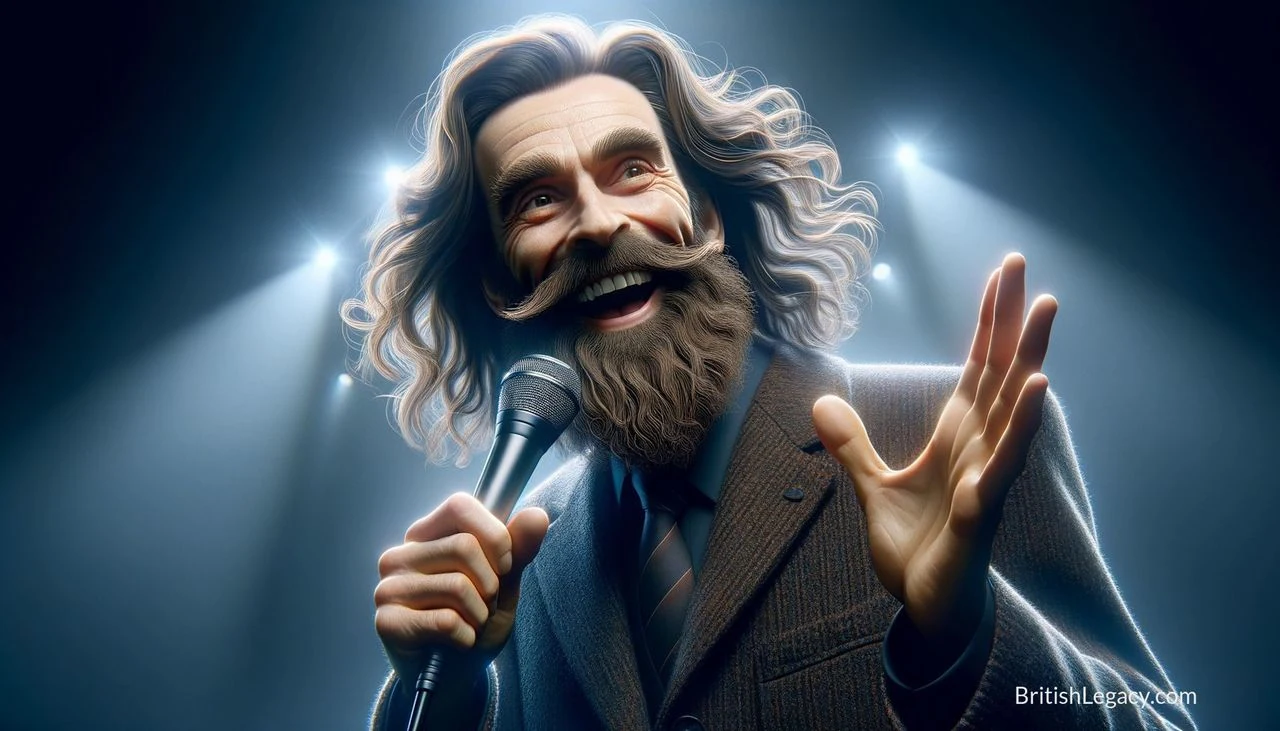
Billy Connolly’s route to the stage began in Glasgow’s shipyards. He was a boilermaker before folk music took him towards a new career; as a singer, his humorous introductions grew until comedy became his principal work. His voice, stories and irreverent performances carried him from Scottish folk clubs to British television and international stages, while acting and, later, visual art widened a career that lasted more than five decades.
Growing up in Glasgow
Connolly was born in Anderston, Glasgow, on 24 November 1942. His mother left the family when he was four, while his father was serving in the Royal Air Force in Burma. Connolly and his older sister, Florence, were cared for by their father’s sisters. His early home life was difficult, but it would be misleading to reduce the origins of his comedy to hardship alone: his later work drew on the speech, places and everyday characters he knew, as well as on his experience of work and performance.
He attended St Peter’s Primary School and St Gerard’s Secondary School. At 14, he began to take an interest in music; at 15, he left school with engineering qualifications and worked first as a book-delivery cyclist and then as a bakery van driver. He became an apprentice boilermaker at Alexander Stephen and Sons in Linthouse, completing his apprenticeship before leaving shipyard work in his mid-twenties. He later recalled the yard as a place where he learnt how men spoke to one another and encountered the sharp Glasgow humour that left a mark on him.
The nickname “The Big Yin” grew from a family distinction. His father was known as Big Billy and the younger Connolly as Wee Billy; as Connolly grew up, the nickname changed. It became a familiar shorthand for a performer whose work retained a strong connection to Glasgow, even as his audiences spread far beyond it.
From folk singer to comedian
Connolly’s first professional direction was music. In the mid-1960s, he formed the Humblebums with Tam Harvey. Gerry Rafferty joined in 1969, and the group recorded for Transatlantic Records. Connolly sang and played banjo, guitar and autoharp. He was not yet principally a comedian, but the spoken introductions to songs gave him room to improvise and play with an audience.
The Humblebums broke up in 1971. Connolly returned to performing as a folk singer, but the comic introductions grew longer. Transatlantic’s Nat Joseph encouraged him to concentrate on comedy, recognising that the stage talk was becoming a distinctive part of his act. Connolly made his theatrical debut in 1972 in Connolly’s Glasgow Flourish at the Cottage Theatre in Cumbernauld, and performed at the Edinburgh Festival Fringe. That year he also released Billy Connolly Live!, a mixture of songs and short comic monologues.
A live double album, Solo Concert, recorded at the Tudor Hotel in Airdrie and released in 1974, helped take him from a Glasgow following to a wider British audience. One of its routines, “The Crucifixion”, drew on religious imagery and the speech of Glasgow pub life; some radio stations banned the recording. Connolly’s comedy was often bawdy and direct, but its effect depended on more than provocation. He built extended stories from familiar situations, shifting from detail to digression and back again in a manner that made the performance itself feel unpredictable.
Television and a wider audience
In 1975, Connolly appeared on BBC television’s Parkinson. His willingness to tell a risqué joke on a Saturday-night chat show made a strong impression and helped bring a new audience to his work. He returned to the programme repeatedly, appearing 15 times, including on one of its final broadcasts in 2007. His live success grew alongside his television profile: he sold out Glasgow’s Pavilion Theatre in 1974 and went on to perform for audiences in Australia, New Zealand and Canada.
Music remained part of his career during this transition. In 1975, his comic version of “D.I.V.O.R.C.E.” reached number one in the UK singles chart. He continued to release live recordings and comic songs, but gradually made stand-up the centre of his work. In 1979, he joined The Secret Policeman’s Ball, a benefit show for Amnesty International. Sharing the bill with established performers helped present him to audiences beyond those who already knew his television and stage work.
Connolly’s route to American audiences took longer. He appeared on Elton John’s 1976 US tour, but his accent and references did not connect easily with the audiences there. Wider recognition followed the HBO special Whoopi Goldberg and Billy Connolly in Performance in 1990, and he later appeared in American television, including the final season of Head of the Class. His career was not confined to stand-up: his film roles included John Brown in Mrs Brown (1997), for which he received a BAFTA nomination for best actor, and Sergeant Zebulon Gant in The Last Samurai (2003).
Travels, films and later work
Travel became a subject and setting for several BBC programmes. World Tour of Scotland, broadcast in 1994, followed Connolly around Scotland; later series took him to Australia, England, Ireland and Wales, and New Zealand. Their format made room for more than jokes: Connolly met people, visited places and connected the journey with the histories and daily lives he encountered. In A Scot in the Arctic (1995), he spent a week alone in the Arctic Circle.
His acting work ranged across comedy, drama and animation. Alongside Mrs Brown and The Last Samurai, he voiced Ben in Disney’s Pocahontas and King Fergus in Pixar’s Brave (2012). He appeared as Wilf in the British film Quartet the same year, and played Dáin II Ironfoot in The Hobbit: The Battle of the Five Armies (2014). These roles brought him to audiences who might not have encountered his stand-up, without replacing the comic voice that had made him known.
Connolly announced his retirement from comedy in 2018. He had been diagnosed with early-stage prostate cancer and the initial symptoms of Parkinson’s disease in 2013. In later years, he established a separate public practice as an artist. His first art exhibition opened in 2018, and he described art as giving him a new lease of life. He has published collections of his work, and a sculpture inspired by his experience as a welder was released in 2020. His autobiography, Windswept and Interesting, appeared in 2021.
Honours and recognition
Connolly’s honours include a BAFTA Lifetime Achievement Award in 2002 and appointment as a Commander of the Order of the British Empire in 2003 for services to entertainment. In 2017, he was knighted for services to entertainment and charity. The same year, Glasgow marked his 75th birthday with three portraits by Jack Vettriano, John Byrne and Rachel Maclean, later incorporated into the city’s mural trail. Glasgow made him a Freeman of the city in 2010. In 2022, BAFTA awarded him its Fellowship for his lifetime contribution to film and television.
These distinctions sit alongside the work itself: records, tours, television programmes and films made across changing stages of his career. They also reflect the particular place Glasgow has held in his public identity. Connolly carried its language and comic sensibility into national and international entertainment without presenting them as curiosities to be translated away.
Why Billy Connolly deserves a place in British Legacy
Billy Connolly’s place in British Legacy rests first on the way he changed the scale and setting of his comedy. He moved from Glasgow folk clubs to a British television audience while keeping the rhythms and references of his home city audible in his work. The shift from singer to comedian was not a clean break: the songs, spoken introductions and live improvisation fed into one another, giving his stand-up a musical performer’s sense of timing and a storyteller’s ability to hold an audience through a long narrative. His breakthrough on Parkinson helped make a more candid, bawdy style part of mainstream British television.
His contribution also crossed media and borders. Connolly’s tours and BBC travel series brought a Scottish performer’s perspective to audiences in Britain and overseas; his film and voice roles introduced him to people who might never have bought a comedy recording. His later turn to art, after retiring from comedy, extended rather than erased the range of his creative life. Honours including a knighthood for services to entertainment and charity, and the BAFTA Fellowship, recognise a career that connected popular performance with a distinctive Scottish voice. His legacy is not a general claim about national character: it is the lasting body of work he made, and the audiences it reached.
Sources
Billy Connolly — Wikipedia, revision 1378530403
Adapted in part from Billy Connolly by Wikipedia contributors, under CC BY-SA 4.0. Text has been edited and combined with the existing article; this adapted text is shared under the same licence. Contributor history.