Cara Delevingne’s career has moved between fashion, film, music and theatre without being confined to any one of them. She became internationally recognisable on the catwalk, where her strong eyebrows and distinctive look helped make her a defining model of the 2010s. She then built a screen career encompassing romantic drama, fantasy and comic-book films, and later took the role of Sally Bowles in the West End production of Cabaret. The through-line is a willingness to work across forms: Delevingne has modelled, acted, sung, played instruments and written for young readers.
London beginnings and a route into modelling
Born Cara Jocelyn Delevingne in Hammersmith, London, on 12 August 1992, she grew up in Belgravia. Her father, Charles Hamar Delevingne, is a property developer, and her mother is Pandora Stevens Delevingne. She has two older sisters, Chloe and Poppy, and a paternal half-brother, Alexander Jaffe. From 2003 to 2009 she attended Bedales School, where she found school challenging in part because of dyspraxia and depression.
Delevingne’s first modelling work came early: at ten, she appeared in an editorial for Vogue Italia. After working in the industry for a year, she went through two seasons of castings before securing a paying job. In 2009 she left school and signed with Storm Management. Her first runway appearance came at London Fashion Week in 2011, when she walked for Burberry Prorsum’s autumn/winter collection. Burberry designer Christopher Bailey had scouted her, and the label became an early platform for a career that soon extended across Paris, Milan and New York.
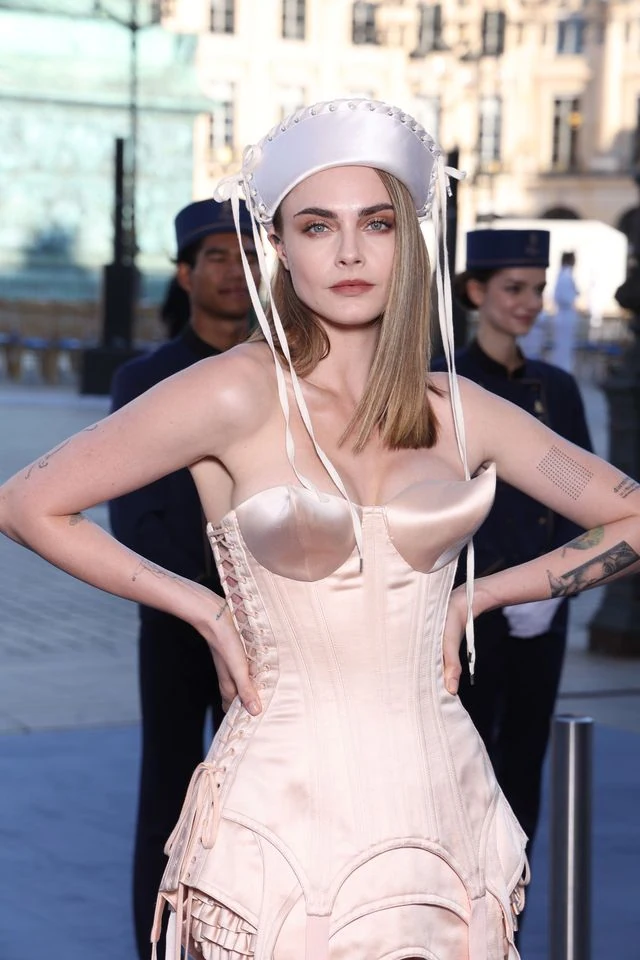
Her look stood out in an industry often shaped by narrow expectations of beauty. Delevingne’s naturally thick eyebrows became her signature and were credited with helping popularise bold brows as a beauty trend during the 2010s. She worked with major fashion houses, developed a lasting association with Chanel and appeared in the Victoria’s Secret Fashion Show in 2012. In 2013, Karl Lagerfeld staged Chanel’s “Paris-Édimbourg” collection at Linlithgow Palace in Scotland, with Delevingne among the models.
A fashion career with its own terms
Delevingne’s rise was recognised at the British Fashion Awards, where she won Model of the Year in both 2012 and 2014. Her profile extended beyond runway shows: she appeared in advertising campaigns for labels including Chanel, Dior, Burberry, Marc Jacobs and Saint Laurent, and became one of the faces of Rimmel in 2016. Magazine covers and high-profile campaigns made her familiar to audiences far beyond the fashion press.
She also took on design work. Her DKNY capsule collection, described by the brand as mostly unisex, brought together sporty streetwear pieces, while her work with Mulberry produced four collections of bags and accessories. By 2015, she had become more selective about runway appearances, citing both her growing acting work and a desire not to treat professional success as a measure of personal worth. That change did not mean leaving fashion behind; it marked a shift in how she chose to take part in it.
Building a screen and stage career
Delevingne began acting with a small role as Princess Sorokina in Joe Wright’s 2012 film adaptation of Anna Karenina. She went on to appear in the British psychological thriller The Face of an Angel and in the coming-of-age drama Paper Towns (2015), playing Margo Roth Spiegelman. The latter brought her a leading film role and drew favourable comment from some critics, though the film itself received mixed reviews.
In 2016 she played the Enchantress in Suicide Squad, and in 2017 starred as Laureline opposite Dane DeHaan in Luc Besson’s science-fiction film Valerian and the City of a Thousand Planets. Her other screen work includes the films Pan, Tulip Fever and London Fields, and the television series Carnival Row, in which she played Vignette Stonemoss. In 2022 she joined the second season of Only Murders in the Building as Alice Banks.
Her career also brought her to live theatre. In 2024 she made her stage debut as Sally Bowles in the West End production of Cabaret at the Kit Kat Club, the Playhouse Theatre. The role placed her in a demanding musical tradition as well as extending a career that had already crossed from fashion photography to film and television.
Music, writing and public voice
Music has been part of Delevingne’s work alongside modelling and acting. She sings and plays drums and guitar, and recorded music with manager Simon Fuller before turning down a record deal because it would have required her to change her name. Later projects included an acoustic duet with British singer-songwriter Will Heard and “CC the World”, recorded with Pharrell Williams for a Chanel short film. She also released “I Feel Everything”, a song associated with Valerian and the City of a Thousand Planets, and contributed backing vocals to recordings by other artists.
In 2017, Delevingne published Mirror, Mirror, a young-adult novel co-written with British writer Rowan Coleman. Its story includes themes of friendship and identity, including an LGBT theme. The book added a writing collaboration to a creative career already spanning commercial fashion, screen roles and recorded music.
Delevingne has spoken publicly about depression, which she said began when she was 15, and about the difficulty of her school years. In 2017 she also said that she had ADHD. Her public comments have included discussions of sexuality and mental health, subjects that can be difficult for people to address openly. In 2022 she presented the BBC Three series Planet Sex with Cara Delevingne, exploring sexuality in different settings and drawing on her own experience. Her visibility in fashion and entertainment has given those conversations a public platform, while her work remains varied rather than defined by advocacy alone.
Why Cara Delevingne deserves a place in British Legacy
Cara Delevingne’s British legacy is grounded in a career that connects London’s fashion industry with international popular culture. Her first major runway appearance was at London Fashion Week for Burberry Prorsum; she later won the British Fashion Awards’ Model of the Year title twice and appeared in a Chanel collection shown at Linlithgow Palace. These are specific contributions to the public profile of British fashion, not simply a matter of nationality. Her recognisable look became influential well beyond the runway, while her work for British brands and at British fashion events kept her connected to the industry in which her career took shape.
Her significance also lies in the breadth of her work. Delevingne has moved from modelling into film, television and West End theatre, published a novel with British writer Rowan Coleman, and recorded music with British singer Will Heard. That range offers a visible example of a contemporary British creative career crossing established boundaries between industries. Her public conversations about depression, ADHD and sexuality have also brought personal subjects into mainstream entertainment and media, and her BBC Three series made sexuality its explicit subject. Taken together, these achievements show a British performer and model whose influence comes from both her presence in global fashion and her continuing participation in several forms of creative work.
Sources
Adapted in part from Cara Delevingne by Wikipedia contributors, under CC BY-SA 4.0. Text has been edited and combined with the existing article; this adapted text is shared under the same licence. Contributor history.