
Charles Jeffrey’s fashion grew out of a place where clothes were made, worn and tested among people gathered to dance. The club night LOVERBOY, which he began in East London while studying at Central Saint Martins, became the starting point for a label that joins theatrical design with queer community and Scottish references. Jeffrey’s work has since moved from student presentations to solo runway shows, exhibitions and a commission to redesign the hospitality uniforms at Theatre Royal Drury Lane.
From Bellshill to Central Saint Martins
Jeffrey was born on 1 August 1990 in Bellshill, North Lanarkshire. His family moved frequently because his father was in the British Army, and Jeffrey lived in Germany, England and Wales before spending his teenage years in Cumbernauld. He drew from a young age and became interested in fashion as a teenager. At eighteen, he moved to London.
At Central Saint Martins, Jeffrey studied an Art Foundation BA and an MA in Fashion. His tutor Louise Wilson encouraged him to examine his personal style and record his daily outfits; those self-reflective images later informed the foundations of LOVERBOY. While a student, he also spent four months interning in Dior’s haute couture ateliers in Paris.
The club night that gave the label its name began at Vogue Fabrics in Dalston in 2014. Jeffrey started it to help fund his MA, but it became more than a source of income. He has described the club as a place where he learnt about being queer and where the clothes were made. Its creative energy offered a setting for fashion, performance and social life to inform one another.
A label takes shape
Jeffrey developed the Charles Jeffrey LOVERBOY label during his MA. His graduation show at Central Saint Martins in 2015 attracted the attention of Fashion East director Lulu Kennedy. That February, his work was selected for the MAN presentation platform, a joint Fashion East and Topman initiative, at London Collections: Men. He showed through the platform for three seasons before presenting his first solo LOVERBOY show in June 2017.
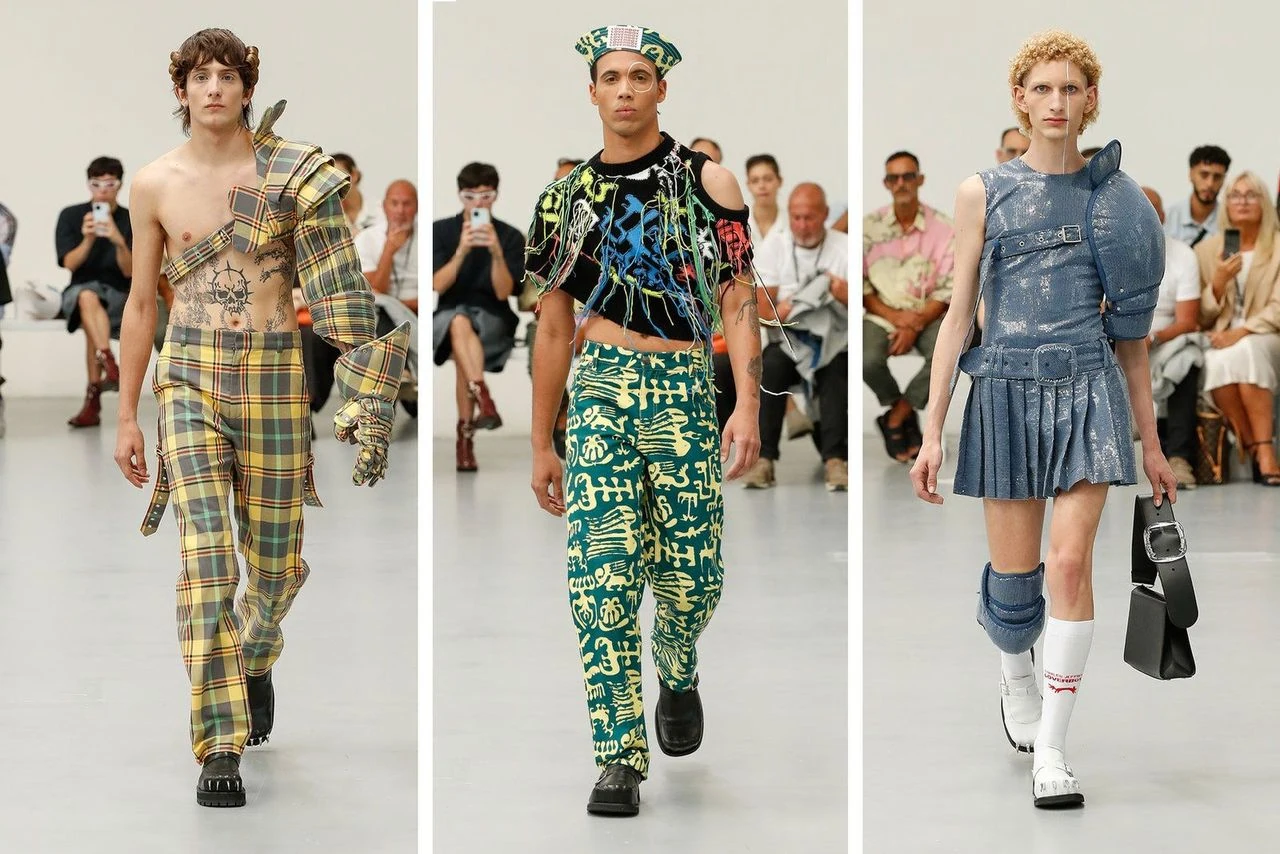
The label’s early development was closely tied to the club night, which Jeffrey has called a “no-rules nocturnal laboratory”. He has cited 1980s clubs such as Blitz and Taboo, as well as queer performers Leigh Bowery and Boy George, among its inspirations. These references sit alongside his own Scottish heritage. Kilts, tartan and Scottish traditions recur in the collections; in 2017, he designed a signature LOVERBOY tartan, which debuted in the Autumn/Winter 2018 collection, Tantrum.
His shows have also developed as theatrical events, bringing fashion into conversation with theatre and dance. The 2017 show Tantrum, made with director Theo Adams, was one example. Jeffrey’s regular collaborators have included make-up artist Lucy Bridge, visual artist and theatre director Theo Adams, set designer Gary Card, musician Tom Furse, and photographers Tim Walker and Thurstan Redding. Their contributions form part of a collective way of working that makes performance and setting integral to the label’s presentation.
Collections, exhibitions and public work
After his first solo show in June 2017, Jeffrey presented collections twice a year. Titles including Art of Noise, Portal, Gloom and The Healing signal the range of worlds he built around the clothes. The following year, LOVERBOY launched its first womenswear capsule, Awrite Hen?, exclusively for Matches Fashion.
Jeffrey’s practice has extended beyond the runway. In November 2017, his first solo exhibition, THE COME UP, opened at NOW Gallery in Greenwich. It combined illustrations with large sculptural pieces suspended from the gallery ceiling, presenting the LOVERBOY label and club night as an interactive, three-dimensional environment. He has also contributed as an editor and creative director to several editions of LOVE magazine and worked on a Vivienne Westwood archive story for Another Man.
In 2020, when London Fashion Week held its first digital edition during the COVID-19 pandemic, Jeffrey organised a livestreamed fundraiser from the basement of Vogue Fabrics. The event raised money for UK Black Pride and spotlighted Black artists, performers and fashion designers from his wider queer community. The choice of venue linked the fundraiser to the club night’s beginnings, while its focus gave that shared creative space a practical purpose.
In 2021, Andrew and Madeleine Lloyd Webber commissioned Jeffrey to redesign the hospitality staff uniforms for Theatre Royal Drury Lane as part of the venue’s restoration. The staff, known as the Red Coats, received a red tartan frock coat to wear with trousers or a kilt and a white shirt. Jeffrey said the design drew on the theatre’s art collection, including costume illustrations by Cecil Beaton, and explored the use and meaning of red.
Recognition and design principles
Jeffrey’s awards mark the growth of a career that has moved between fashion, performance and visual art. In 2015, he was named Fashion Graduate of the Year at the Scottish Fashion Awards, followed by the same awards’ Young Designer of the Year title in 2016. He received the British Fashion Award for Emerging Talent: Menswear in 2017, was a finalist for the LVMH Prize in 2018 and won GQ’s Breakthrough Designer award that year.
At the heart of his design approach is an interest in identity and the ways clothes can express, unsettle or challenge it. Jeffrey has described his career as a journey of his own identity, and his work frequently questions conventional gender norms. His Scottish references are not merely decorative: kilts and tartan provide material through which he can explore how clothing is read in different social settings. The collections also draw on the Festival of the Horse on South Ronaldsay in Orkney; its elaborate costumes partly inspired the Autumn/Winter 2020 collection, Hell Mend You.
That approach connects personal expression to collective creation. Jeffrey’s account of LOVERBOY places its community at the centre of the label, while his collaborators and the theatrical form of the shows make that shared authorship visible. The club night did not simply precede the fashion house; its atmosphere and relationships helped shape what the clothes and presentations could become.
Why Charles Jeffrey deserves a place in British Legacy
Charles Jeffrey deserves a place in British Legacy because his work gives a distinctive shape to several strands of contemporary British culture. He has brought the energy of an East London queer club into a fashion label without severing it from its beginnings. LOVERBOY’s development from a monthly night at Vogue Fabrics into a house presenting twice-yearly collections shows how a social space can become a lasting creative platform. Its theatrical shows, exhibitions and collaborations extend fashion beyond garments alone, linking design with performance, image-making and community.
His work also makes Scottish heritage an active element of contemporary design. Jeffrey has drawn on tartan, kilts and local traditions, then placed those references in new contexts, from the LOVERBOY collections to the red tartan uniforms at Theatre Royal Drury Lane. His 2020 fundraiser for UK Black Pride further demonstrates how the club community around his label could be mobilised to support artists and performers. Together, these achievements offer a specific British legacy: a designer whose practice connects London’s club culture and queer creativity with Scottish references, while making room for collaboration and self-expression in fashion.
Sources
Charles Jeffrey (fashion designer), revision 1372407363
Adapted in part from Charles Jeffrey (fashion designer) by Wikipedia contributors, under CC BY-SA 4.0. Text has been edited and combined with the existing article; this adapted text is shared under the same licence. Contributor history.
.jpg)