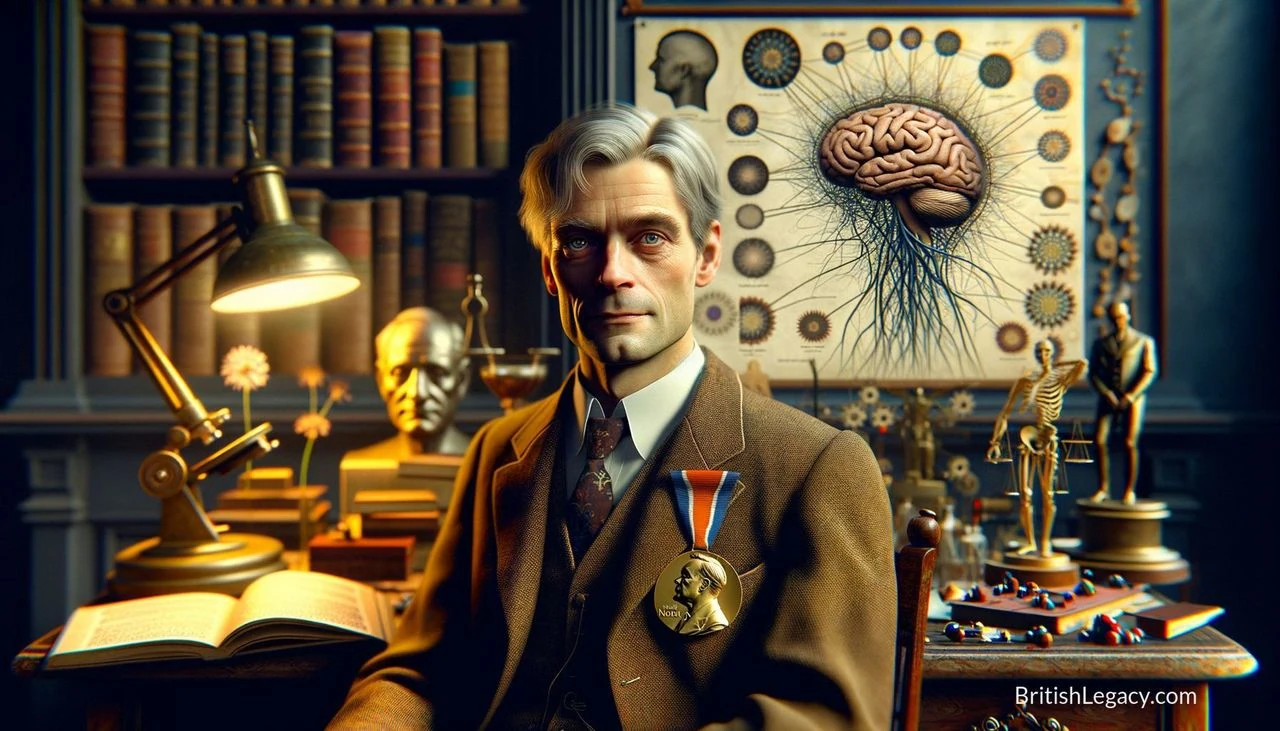
Charles Scott Sherrington’s science began with a practical question: how does the nervous system make a body act as a coordinated whole? Through experiments on reflexes and the connections between nerve cells, he helped reshape physiology’s answer. His work gave the word “synapse” to the meeting point between neurons, and his 1906 book, The Integrative Action of the Nervous System, brought together a new account of how signals and reflexes organise movement.
Education shaped by science and medicine
Sherrington was born in Islington on 27 November 1857. He attended Ipswich School from 1871, where the poet and teacher Thomas Ashe encouraged his interest in classical literature and travel. He was also introduced early to physiology: Caleb Rose, with whom he grew up in Ipswich, gave him Johannes Müller’s Elements of Physiology. Sherrington later recalled that Rose had directed him towards medicine.
His training crossed the Royal College of Surgeons and Gonville and Caius College, Cambridge. He began at St Thomas’ Hospital in 1876, then entered Cambridge as a non-collegiate student in 1879 and joined Caius the following year. Physiology became his principal subject. He studied under Michael Foster, a leading British physiologist, and also learned from Walter Holbrook Gaskell and John Newport Langley, whose interests included the relationship between anatomical structure and physiological function. Sherrington gained first-class honours in both parts of the Natural Sciences Tripos and qualified in medicine in 1885.
His first published paper grew from a dispute about whether particular functions were localised in the brain. At the 1881 International Medical Congress in London, Friedrich Goltz argued against localisation, while David Ferrier defended it. Langley and Sherrington examined a dog’s brain as part of a committee investigating the question; their findings, reported in 1884, formed Sherrington’s first paper. The episode placed careful examination of tissue at the start of a career that would bring experimental physiology and anatomy into close conversation.
From pathology to the integrated reflex
Sherrington’s early work ranged widely. He travelled to Strasbourg to work with Goltz, and later joined an investigation of a claimed cholera vaccine in Spain. With colleagues C. S. Roy and J. Graham Brown, he reported to the Royal Society after examining the claim. He went on to Berlin, where Rudolf Virchow directed him to Robert Koch. Sherrington remained with Koch for a year, working in bacteriology and building experience in physiology, morphology, histology and pathology. In 1886 he travelled to Italy to investigate another cholera outbreak.
In 1891 he became superintendent of the Brown Institute for Advanced Physiological and Pathological Research at the University of London. There he studied the sensory roots of the spinal nerves, mapped sensory regions of the skin and, in 1892, identified muscle spindles as the origin of the stretch reflex. The institute’s facilities allowed research on animals of different sizes, including apes. His experiments helped turn the reflex from a simple stimulus-and-response diagram into a problem of coordination across the nervous system.
Appointed Holt Professor of Physiology at the University of Liverpool in 1895, Sherrington concentrated on the nervous system. His experiments led him to argue that reflexes were integrated activities of the organism, rather than isolated actions of separate reflex arcs. He also examined reciprocal innervation: when one group of muscles is excited, its opposing group is inhibited. This relationship helped explain how movement could be coordinated rather than produced by competing muscular actions. His research on reflexes and reciprocal innervation was brought together in his 1897 Croonian lecture.
The synapse and a landmark book
Sherrington’s most influential synthesis appeared in 1906 as The Integrative Action of the Nervous System, based on lectures he had delivered at Yale. The book discussed neuron theory, communication between nerve cells and the organisation of reflexes. It presented the nervous system as coordinating the body’s parts, with reflexes among the simplest expressions of that co-ordination. The term “synapse”, which Sherrington introduced in 1897, gave a name to the connection between neurons; the word itself had been suggested by the classicist A. W. Verrall.
The book also set out how excitation and inhibition work in opposition. Sherrington’s account treated a reflex not as a mechanical arc acting alone, but as part of a wider system in which sensory input, connections and muscular response interact. That change in emphasis is captured in the title: nervous activity was integrative. The work helped establish important foundations of modern neurophysiology and was the central scientific achievement recognised by his Nobel Prize.
In 1913 Sherrington moved to Oxford as Waynflete Professor of Physiology at Magdalen College. He taught students who included John Eccles, Ragnar Granit and Howard Florey, all of whom later became Nobel laureates. His influence extended beyond his own laboratory: he introduced Wilder Penfield to the study of the brain and also influenced the American neurosurgeon Harvey Williams Cushing. He argued that universities should teach not only what was already known, but also the right attitude towards what remained unknown.
Oxford, public service and a wider intellectual life
Sherrington’s Oxford career was interrupted by the First World War. With his teaching reduced to a small class, he worked at a shell factory, studying fatigue, particularly industrial fatigue. His working week was long: the account of his wartime routine records days beginning at 7.30 in the morning and ending at 8.30 in the evening on weekdays. In 1916 he supported the admission of women to Oxford’s medical school. He retired from the university in 1936.
His books reflected interests beyond laboratory physiology. Mammalian Physiology: a Course of Practical Exercises appeared in 1919. In 1925 he published The Assaying of Brabantius and other Verse, a collection including poems written during the war. He later developed his Gifford lectures, delivered at Edinburgh in 1937–38, into Man on His Nature (1940; revised 1951), a philosophical work concerned with the mind, human existence and natural theology. These writings show a scholar whose work on the nervous system sat alongside sustained engagement with poetry and ideas.
Sherrington held prominent roles in British scientific life. He became a Fellow of the Royal Society in 1893 and served as its president from 1920 to 1925. His honours included the Royal Medal in 1905, the Copley Medal in 1927, the Order of Merit in 1924 and appointment as a Knight Grand Cross of the Order of the British Empire in 1922. He shared the 1932 Nobel Prize in Physiology or Medicine with Edgar Adrian for their discoveries concerning the functions of neurons. In 1944 he became president of Ipswich Museum, having earlier served on its committee.
After retiring, he returned to Ipswich, where he built a house and continued corresponding with former pupils and colleagues. He died in Eastbourne on 4 March 1952, aged 94. His wife, Ethel Mary Wright, whom he married in 1891, had died in 1933; their son was Charles, known as Carr. A blue plaque was unveiled at Sherrington’s former Oxford home in 2022.
Why Charles Sherrington deserves a place in British Legacy
Sherrington’s place in British Legacy rests first on the precision and reach of his scientific contribution. By studying reflexes as coordinated activity, rather than as isolated responses, he helped build a framework for understanding how the nervous system connects sensation and movement. His introduction of “synapse” supplied a concise name for a fundamental relationship between neurons, while The Integrative Action of the Nervous System gathered his experimental thinking into a work that shaped neurophysiology. These are specific achievements, not simply signs of distinction: they changed the concepts and language with which scientists could investigate the nervous system.
His British legacy also lies in the institutions and students through which scientific knowledge was carried forward. He worked at the University of London, Liverpool and Oxford, led the Royal Society, taught generations of physiologists and encouraged attention to questions that remained unanswered. His students included future Nobel laureates; his support for women’s admission to Oxford’s medical school connected his university service with widening access. Beyond physiology, his writing in poetry and philosophy records the breadth of a life spent asking how bodies, minds and ideas fit together. Recognising Sherrington in a British collection honours both a landmark body of research and the teaching, institutional service and intellectual curiosity that sustained it.
Sources
Adapted in part from Charles Scott Sherrington by Wikipedia contributors, under CC BY-SA 4.0. Text has been edited and combined with the existing article; this adapted text is shared under the same licence. Contributor history.