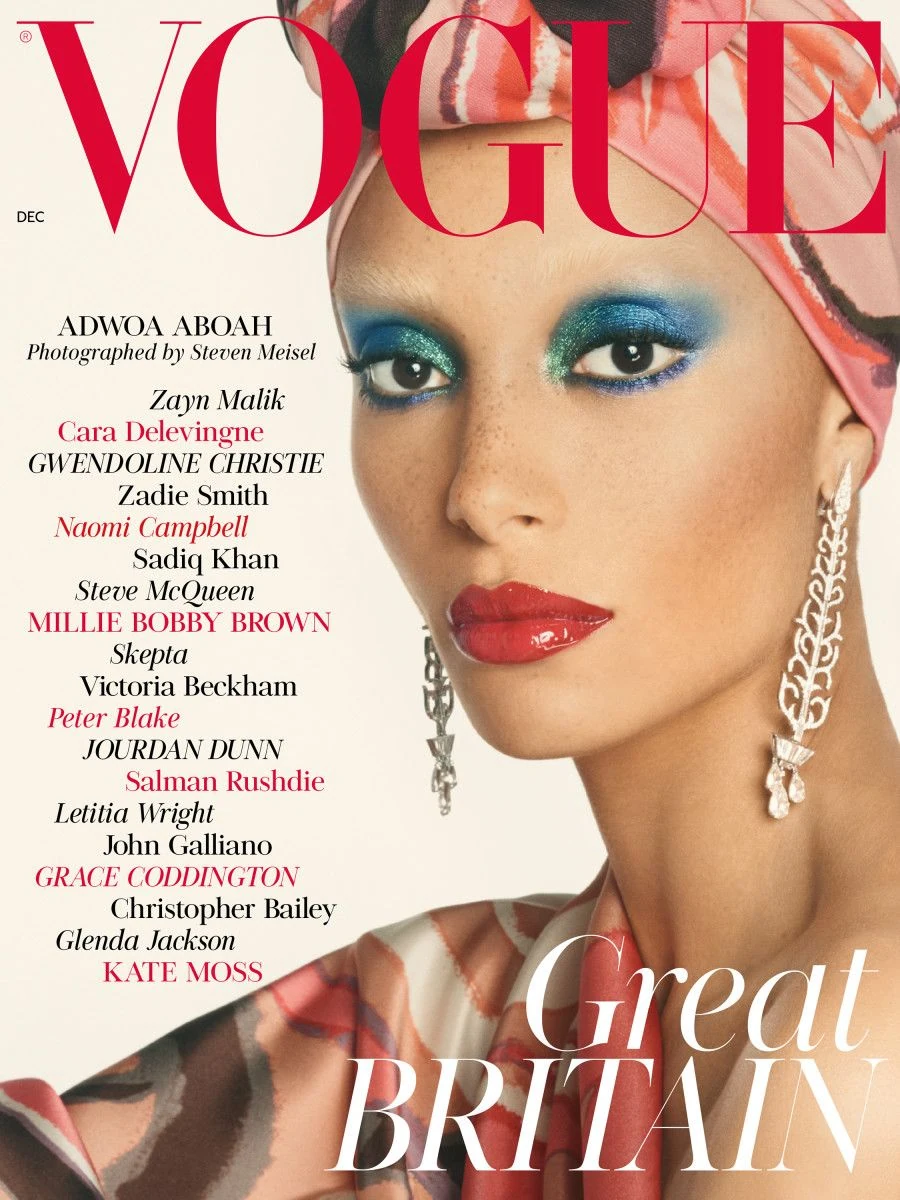
Adwoa Aboah’s career connects the international fashion industry with a more personal form of public advocacy. A British model and actor, she has appeared on the covers of several major fashion magazines, worked with leading brands and founded Gurls Talk, a platform offering young women and girls resources and space to discuss mental health. Her work in fashion has brought visibility; her advocacy has given that visibility a practical purpose.
Growing up between fashion and education
Aboah was born in Westminster, London, on 18 May 1992, to Camilla Lowther and Charles Aboah. Her parents worked in the fashion industry: her mother as a photography agent and her father as a location scout. Her father was born and raised in Ghana before moving to England. Aboah’s name, Adwoa, means “Monday born woman” in Akan, the language of the Akan people of Ghana; she was born on a Monday.
She attended Millfield and later studied Modern Drama at Brunel University, graduating in 2013. Her sister, Kesewa Aboah, is also a model. This background places Aboah’s story within both British fashion and a family history that connects England and Ghana, rather than reducing her identity to the industry in which she works.
A model with an international profile
Aboah has modelled for brands including Calvin Klein, Fendi, DKNY, Alexander Wang, H&M, Topshop, Simone Rocha and Erdem. She has also worked with Marc Jacobs and appeared in campaigns, including one for Revlon’s PhotoReady Insta-Filter Foundation in 2018. The range of labels in her career reflects the breadth of her work across fashion houses and commercial campaigns. Her association with Burberry, noted in earlier coverage, also connects her career to a prominent British fashion name.
Magazine covers have marked important moments in that profile. Aboah appeared on the cover of British Vogue in December 2017, and has also appeared on the covers of American Vogue, Vogue Italia, Vogue Poland and i-D. In 2017, the fashion industry voted her Model of the Year in the models.com awards. The distinction, and her continued work in fashion, established her as more than a familiar face in individual campaigns: she became a figure recognised across the industry.
Her work has not been confined to modelling. In 2017 she appeared in the film Ghost in the Shell as Lia. She later acted in television, playing Scorpia in Willow and Becks in Top Boy. These roles widened her work into screen performance, adding acting to a career already divided between editorial fashion, advertising and public advocacy.
Gurls Talk and mental-health advocacy
Aboah founded Gurls Talk after her own experiences of depression and drug addiction, and concern about the lack of mental-health resources for young women. Launched in 2017, the organisation provides resources and a space for young women and girls to discuss mental health. Its remit also includes subjects such as body image, sexuality and self-esteem. It is a different kind of platform from a fashion campaign: it centres participants’ experiences and discussion rather than a product or an image.
Aboah has spoken about depression, addiction and bipolar disorder, and about becoming sober. Her openness gives context to the motivation behind Gurls Talk, without making her personal experience a substitute for the organisation’s work. The platform’s events, workshops and online discussions encourage young women to share experiences and support one another. During the COVID-19 pandemic, Aboah also created the #CreativeTogether initiative, intended to use creativity to connect people and address some of the anxiety surrounding lockdown.
That combination of public candour and organised activity matters. Conversations about mental health can be difficult to begin, particularly when young people have limited access to resources or supportive spaces. Gurls Talk’s stated purpose is to help make those conversations possible. Aboah’s role brings public attention to the issue, while the organisation’s resources and discussions provide a route for participation beyond following her career.
Fashion, public life and creative work
Aboah’s place in British fashion is not only a matter of working with designers or appearing in magazines. She is also a British Vogue contributing editor, a role that brings her into the publication’s work from a position beyond modelling. In 2019, she was one of fifteen women on the cover of the magazine’s September issue, guest-edited by Meghan, Duchess of Sussex. In 2020, she appeared on the Powerlist of influential Black British people across industries.
These recognitions sit alongside her screen work and Gurls Talk, rather than replacing them. They show how a fashion career can create opportunities to contribute to wider cultural conversations, while also making clear that Aboah’s work extends beyond being photographed or appearing on a runway. Her professional life has moved between modelling, acting, editorial work and advocacy, with each strand reaching a different audience.
Why Adwoa Aboah deserves a place in British Legacy
Adwoa Aboah deserves a place in British Legacy because her career shows how British figures can shape international culture while addressing issues with immediate significance at home and beyond. Born in London to a Ghanaian-born father and a mother working in fashion, she brings a specific family and cultural history to a global industry. Her work with British Vogue, her recognition among influential Black Britons and her appearances for fashion houses connect her to the development and reach of contemporary British fashion.
Her legacy is not limited to representation in magazines or on the runway. By founding Gurls Talk, Aboah has helped create a platform where young women and girls can find resources and discuss mental health, body image, sexuality and self-esteem. Its events, workshops and online discussions give that advocacy a practical form. Her willingness to speak about her own experiences helps explain why the work matters to her, but the organisation’s value lies in opening space for other people’s voices as well. Alongside her acting and editorial work, this makes her career a record of influence used in several ways: to work creatively, to broaden who is visible in fashion and to encourage conversations that can help young people feel less alone.
Sources
Adwoa Aboah — Wikipedia revision 1369440595 · Adwoa Aboah — Wikipedia
Adapted in part from Adwoa Aboah by Wikipedia contributors, under CC BY-SA 4.0. Text has been edited and combined with the existing article; this adapted text is shared under the same licence. Contributor history.