Phoebe Philo’s career connects a London design education with leadership at two major French fashion houses and the creation of her own label. At Chloé and Céline, she built collections around clear shapes, practical elegance and a distinctive point of view. Her work brought international attention to a designer whose professional roots and later studio were in Britain.
From Paris to Central Saint Martins
Philo was born in Paris in 1973 to British parents, and returned to Britain with her family when she was two. She grew up in Harrow, London. At 14, after receiving a sewing machine from her parents, she began customising her clothes. The interest became a profession when she studied at Central Saint Martins in London, graduating in 1996.
Her final collection was noted for its Latino influence and large gold jewellery. After graduating, she moved to Paris to work at Chloé as Stella McCartney’s design assistant for ready-to-wear. Philo became the house’s creative director in 2001. The role brought her an early opportunity to shape a complete fashion identity, rather than work on a single collection.
Finding a voice at Chloé
At Chloé, Philo developed an approach that brought together contrasting elements: boyish and girlish, retro and contemporary. Her designs included babydoll dresses set against substantial leather accessories, among them the Paddington bag. The combination of softness and structure helped distinguish the collections without relying on a single silhouette or mood.
Philo also commissioned architect Sophie Hicks to develop a concept for Chloé’s stores in 2002. The work extended her role beyond clothes to the surroundings in which customers encountered the brand. In 2006 she left Chloé and moved back to London to be with her family. She had her second child around this period. During her Chloé years, she became the first designer at a major fashion brand to take an official extended maternity leave.
A new chapter at Céline
In 2008, LVMH offered Philo the role of creative director and board member at Céline, the French fashion house. She accepted on the condition that she could continue working in London while showing collections in Paris. For the first year she concentrated on rebuilding the business, establishing a design studio in a derelict Georgian townhouse on Cavendish Square. Her debut collection followed in 2009.
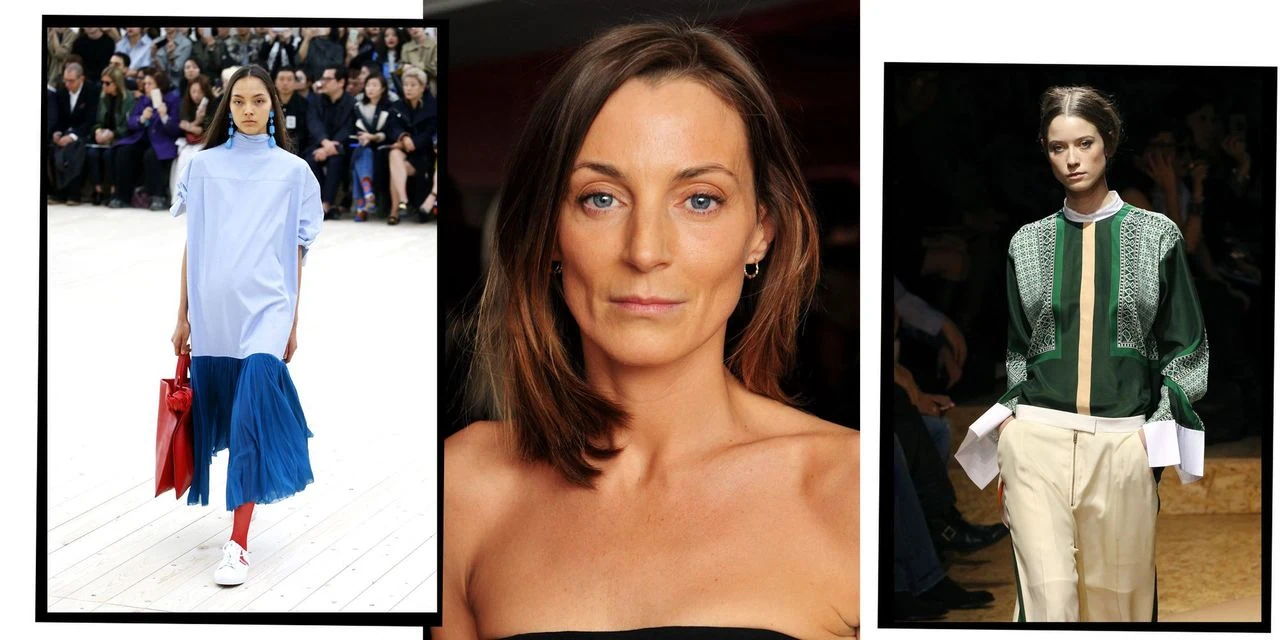
At Céline, Philo made clean lines, minimal forms and tonal colour palettes central to the label’s identity. Her work asked what women wanted to wear, balancing polish with ease rather than treating luxury as display alone. The collections helped make Céline newly prominent. Fashion critic Vanessa Friedman later wrote that Philo had “made Céline matter in a way it never had before”.
Accessories became an important part of this chapter. Bags including the Luggage and Trapeze totes and the slim Trio cross-body gained wide recognition. Philo’s work also extended to footwear: in 2013 she created a sandal inspired by a classic Birkenstock, with a mink-covered footbed. The range of objects, from bags to shoes, showed how her design language could be carried through different parts of a wardrobe.
She brought the same attention to presentation and image. Céline’s first advertising campaign under Philo did not show the models’ heads, directing attention towards the clothes and bags. For the 2015 campaign, photographer Juergen Teller photographed writer Joan Didion. For the Spring/Summer 2017 collection, Philo worked with artist Dan Graham on a glass, S-shaped pavilion, Showing off the body, which served as the setting for the Paris Fashion Week show in 2016.
Leaving Céline and building her own label
After ten years at Céline, Philo announced in 2017 that she would leave following the Pre-Fall 2018 collection. Her departure concluded a period in which she had reshaped the house’s identity and established a recognisable visual approach. The collection of her work across the two French houses also demonstrates the range of her design practice: at Chloé, a mix of retro and contemporary contrasts; at Céline, a more pared-back emphasis on form and tone.
In 2021, Philo announced plans to launch a brand under her own name. She and her husband became the business’s majority owners, with LVMH as a minority shareholder. The label launched its first collection in October 2023, selling it through its own website. It later began working with selected retailers, including Dover Street Market in London and Paris. Its headquarters are in Ladbroke Grove, extending Philo’s professional connection with London into this new phase of her career.
Recognition and influence
Philo’s work has received recognition in Britain and internationally. She was named British Designer of the Year by the British Fashion Council in 2005 and 2010, and received its International Designer of the Year award in 2011. In 2014 she was appointed an Officer of the Order of the British Empire for services to fashion. That year, Time included her among its 100 most influential people.
Her design language is often associated with minimalism, but the clothes and accessories at Chloé and Céline show that this did not mean a single, unchanging formula. The contrast of dress and leather at Chloé, and the variety of shapes in Céline’s bags, gave the work definition within those broader, restrained approaches. Her own label carries that career forward, while its London base anchors the latest chapter in a city where she studied, grew up and later worked.
Why Phoebe Philo deserves a place in British Legacy
Phoebe Philo’s place in British Legacy rests on a specific connection between British training and international achievement. She studied at Central Saint Martins in London, developed her career in the fashion capitals of Paris and later established a design studio in London while leading Céline. Her experience shows how a British design education can inform work that reaches far beyond the country, without reducing that work to a national style. At Chloé, she developed a distinctive mix of retro and contemporary elements; at Céline, she rebuilt the house’s identity around clear forms, tonal colour and clothes designed for use as well as appearance.
That contribution is visible in more than the clothes themselves. Philo gave attention to bags, footwear, retail spaces, advertising and the setting of a runway show, treating a fashion house as a connected design environment. Her London-based work at Céline and her own label’s headquarters in Ladbroke Grove make the British part of that story concrete. British honours and British Fashion Council awards recognise the place of her achievements in the country’s fashion life. Taken together, her education, professional practice and influence at major houses make her a significant figure in the continuing exchange between British design talent and international fashion.
Sources
Phoebe Philo — Wikipedia revision 1379116450 · Phoebe Philo — Wikipedia
Adapted in part from Phoebe Philo by Wikipedia contributors, under CC BY-SA 4.0. Text has been edited and combined with the existing article; this adapted text is shared under the same licence. Contributor history.