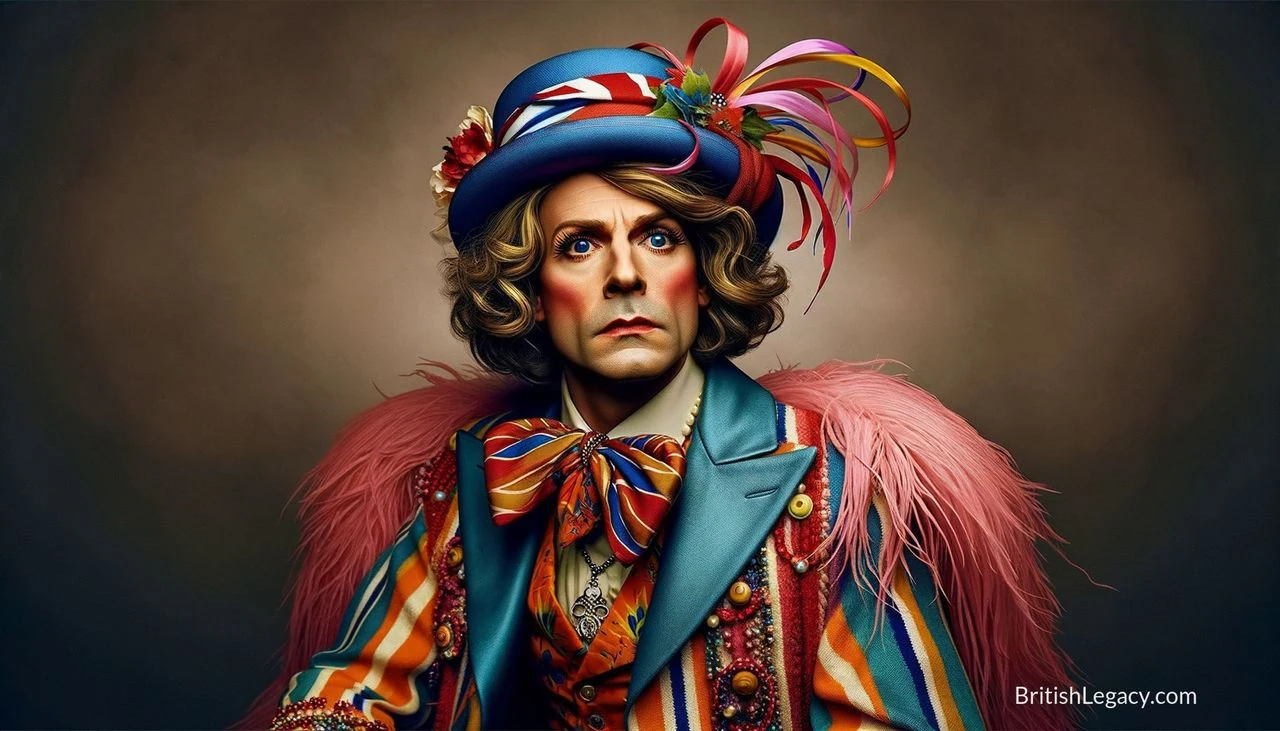
Eddie Izzard built a distinctive comedy from ideas that seem, at first, to have little connection: history, religion, language and the everyday routines of modern life. In performance, a thought can turn into a detour, then return transformed by an unexpected association. That apparently wandering delivery became a recognisable voice on British stages and television, while Izzard’s work as an actor and activist carried her beyond comedy clubs. Her career also includes a remarkable feat of endurance: in 2009 she ran 43 marathons in 51 days for Sport Relief.
A childhood shaped by loss and movement
Izzard was born Edward John Izzard on 7 February 1962 in Aden, then part of the Aden Colony and now in Yemen. Her parents, Dorothy and Harold Izzard, were English; her father was working for British Petroleum in Aden. The family moved to Bangor in Northern Ireland when Izzard was a year old, then to Skewen in Wales when she was five. Her mother died of cancer when Izzard was six. Izzard and her older brother, Mark, made a model railway while their mother was ill; they later donated it to Bexhill Museum.
After the family’s move to Wales, Izzard attended schools in England, including St John’s School in Newton, St Bede’s Preparatory School in Eastbourne and Eastbourne College. She later studied drama at the University of Sheffield. The combination of a changing home life and formal education is part of the chronology of her early years, but it does not need to be turned into a neat explanation for her later comic imagination.
From street performance to the comedy stage
Izzard began trying out comedy at university with friend Rob Ballard. They took their act to the streets, including London’s Covent Garden district. After they went their separate ways, Izzard spent much of the early 1980s street-performing in Europe and the United States. She has described talking to audiences during solo escape acts as one way she developed her comic voice.
She subsequently moved into Britain’s stand-up venues. Her first stage appearance at the Comedy Store in London came in 1987; she refined her material through the 1980s and began to gain recognition for improvisation in the early 1990s, including at her own Soho club, Raging Bull. A breakthrough followed in 1991, when her “raised by wolves” routine appeared on the televised Hysteria 3 AIDS benefit.
Izzard’s stand-up often takes the form of whimsical, apparently rambling monologues, shifting between subjects rather than following a conventional argument. She has described this kind of delivery as an oral tradition. The subjects can include popular culture, religion and language, while the humour moves between surrealism, observation and satire. Monty Python has been identified as a major influence; John Cleese once called Izzard “the lost Python”. In 1997, the comic idea extended to Cows, a Channel 4 sitcom featuring actors dressed in cow suits.
Her tours brought this style to audiences over several decades, from Live at the Ambassadors and Definite Article in the 1990s to Dress to Kill, Circle, Stripped, Force Majeure and Wunderbar. The 2000 comedy special Dress to Kill won two Primetime Emmy Awards: for individual performance and writing in a variety or music programme.
Expression, theatre and screen work
Izzard’s public presentation has been part of her career, but she has also explained that wearing dresses is not simply a theatrical device. In 2014, she said it was about expressing herself, rather than performance or a sexual fetish. She has described herself as genderfluid and, in 2020, requested she/her pronouns for an appearance on Portrait Artist of the Year, saying she wanted to be based in “girl mode” from then on. In 2023 she announced that she would use the name Suzy in addition to Eddie, while keeping Eddie Izzard as her public name because it was more widely recognised. Her account of her identity has changed and developed over time; her own words offer a more accurate description than reducing it to a comic costume.
Acting became another substantial part of Izzard’s working life. Her West End drama debut came in 1994 as the lead in David Mamet’s The Cryptogram, followed by a role in 900 Oneonta. She played the title character in Christopher Marlowe’s Edward II in 1995 and later took on roles in Lenny, A Day in the Death of Joe Egg and the Broadway production of that play, which received four Tony Award nominations. In 2010, she appeared on Broadway in Mamet’s Race.
Her screen roles range from the crime expert Roman Nagel in Ocean’s Twelve and Ocean’s Thirteen to General Erich Fellgiebel in Valkyrie. Other work includes the television series The Riches and Hannibal, and voice performances in films including Five Children and It, The Wild and Cars 2. In 2014, she portrayed radar pioneer Robert Watson-Watt in the BBC drama film Castles in the Sky. She has continued to return to the stage, including in a one-person version of Hamlet in 2024, adapted by her brother Mark.
Running, politics and public causes
In 2009, Izzard undertook 43 marathon runs in 51 days for Sport Relief, despite having no significant prior experience of long-distance running. The route crossed the United Kingdom, running from London to Cardiff, Belfast and Edinburgh before returning to London. She covered more than 1,100 miles, generally running at least 27 miles a day, with Sundays off. BBC Sports Personality of the Year gave her a special award that year.
In 2016, she completed a second ambitious challenge: 27 marathons in 27 days across South Africa, raising more than £1.35 million. The number recalled the 27 years Nelson Mandela spent in prison. Izzard had attempted the project in 2012 but withdrew for health reasons. In 2021, she undertook another month-long challenge, combining 31 marathons with 31 stand-up performances to raise money for several charities; the marathons raised more than £275,000.
Her activism has also included sustained political engagement. Izzard joined the Labour Party in 1995 and has campaigned for European integration and electoral reform, among other positions. She sought election to the party’s National Executive Committee in 2016 and 2018; after Christine Shawcroft resigned in 2018, Izzard took her place as the next runner-up, but did not secure re-election. In 2022 she sought selection as Labour’s candidate for Sheffield Central, and in 2023 for Brighton Pavilion. She was not selected in either members’ ballot. These campaigns show a practical dimension to her public life: political participation, rather than an abstract claim to speak for others.
Why Eddie Izzard deserves a place in British Legacy
Izzard’s place in British cultural life rests first on a body of comedy with a clear and individual method. Her free-ranging monologues bring history, religion, language and popular culture into the same performance, using associative leaps and surreal turns rather than conventional punchline-by-punchline construction. The recognition for Dress to Kill, alongside decades of tours and performances, shows how that approach travelled from the British comedy circuit to international audiences. Her work in theatre, film and television adds range without erasing the stand-up voice that made her distinctive.
There is also a specific public legacy in the combination of visibility and effort. Izzard has spoken about gender expression in her own terms, helping make a personal experience part of public conversation without needing to present it as a simple story of triumph. Her marathons for Sport Relief turned performance into fundraising: 43 runs across the UK in 51 days, followed by 27 in 27 days in South Africa and a further month of running alongside live shows. These are concrete achievements, not generic symbols of resilience. Together, her comedy, acting, public self-expression and charitable challenges form a British legacy grounded in work: making an unconventional voice heard, carrying it across different stages, and using public attention to support causes and organisations.
Sources
Eddie Izzard — Wikipedia revision 1379581837
Adapted in part from Eddie Izzard by Wikipedia contributors, under CC BY-SA 4.0. Text has been edited and combined with the existing article; this adapted text is shared under the same licence. Contributor history.