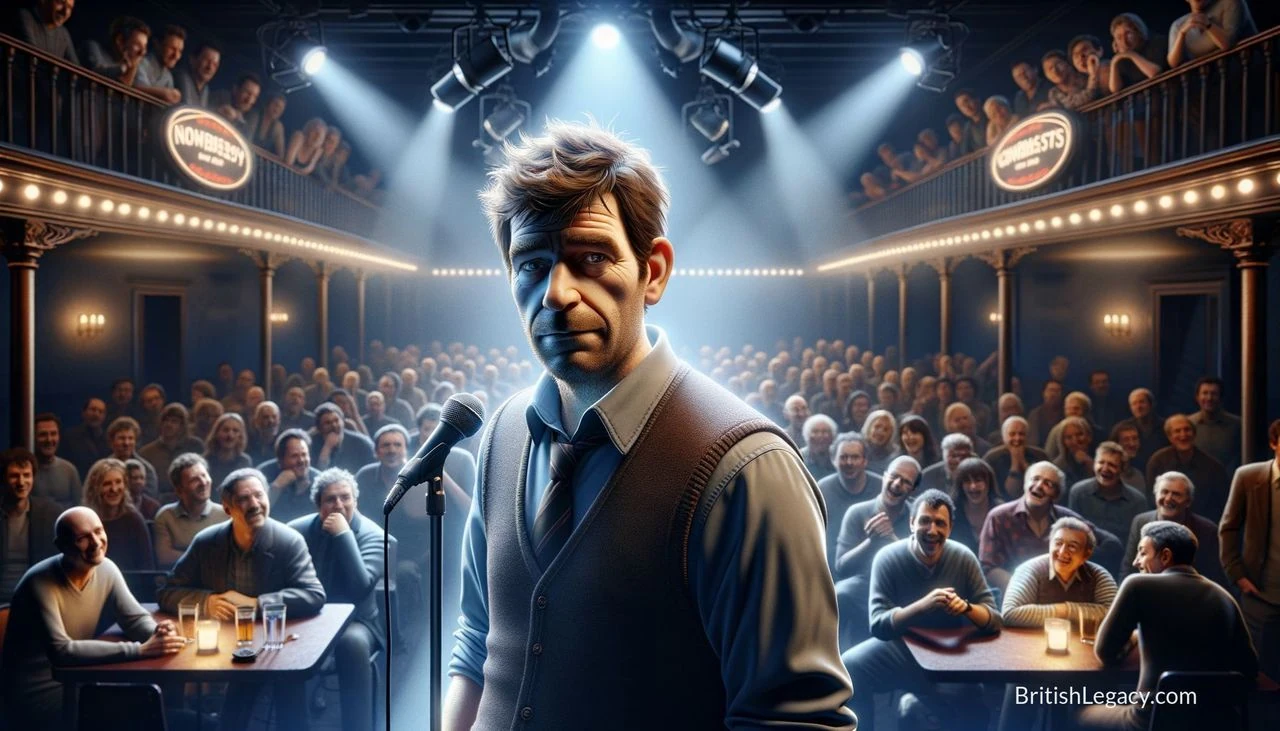
Micky Flanagan’s route to professional comedy ran through Billingsgate Fish Market, furniture making and a return to education as an adult. Born in Whitechapel and raised in Bethnal Green, he became a professional comedian in 1997, after taking a comedy course in north London the previous year. His stand-up draws on the places, social distinctions and everyday experiences he knows, turning them into stories that travelled from comedy clubs to large touring venues.
East End beginnings and a return to study
Flanagan was born Michael John Flanagan in Whitechapel, east London, on 7 October 1962, and grew up in Bethnal Green. His father, Jim, worked as a welder and later as a fish porter. Through his father, Flanagan got his first job at Billingsgate Fish Market. He left school at 15 without qualifications, having become disengaged from his studies and begun truanting.
In 1981, he spent the summer on Fire Island, New York, working as a kitchen porter. Back in London, he worked as a furniture maker for several years. When that business failed, he returned to Fire Island for another summer. These were working years rather than a direct passage into entertainment; comedy came later, after he made a deliberate effort to resume his education.
At 25, Flanagan began studying again, starting with a GCSE in English. He went on to a foundation course in arts and social sciences, then began a degree at City University at 29. He also trained as a teacher through a postgraduate certificate in education, but chose not to make teaching his career. He later described that year as deeply unhappy and criticised the school system he encountered.
From comedy course to the Edinburgh Fringe
Flanagan attended a comedy course at Jacksons Lane in north London in 1996 and became a professional comedian the following year. The timing marked a late start by the standards of a career that would eventually include television, radio and major British tours. Early work included appearances at comedy clubs, among them Balham’s Banana Cabaret and the Bearcat Comedy Club.
In 2001 he performed as one of four headline acts in the Big Value Comedy Show at the Edinburgh Fringe. He co-headlined a show with Nina Conti in 2003 and, in 2006, presented his first full-length solo show, What Chance Change? The following year he was nominated for Best Newcomer at the Edinburgh Comedy Awards. These milestones show the gradual development of a stage career: club performances and festival work preceded the solo tours for which he later became widely known.
His stand-up relies on narrative as much as on individual punchlines. Flanagan builds comic situations from recognisable distinctions in social life and from details of everyday behaviour. One of his best-known routines gives a name to different kinds of evenings out: “out out” is the full night on the town, rather than a more casual excursion. The phrase and the idea behind it became closely associated with his stage act.
Television, radio and touring
Flanagan’s work reached audiences beyond the comedy club. He was a regular performer on Radio 2’s Out to Lunch in 2008 and appeared on Michael McIntyre’s Comedy Roadshow in 2009. In 2010 he presented a four-part Radio 4 series, Micky Flanagan: What Chance Change?, and appeared on Live at the Apollo, Stand Up for the Week and the Royal Variety Performance. He also appeared on Mock the Week in 2010 and again in 2011.
Television brought his “out out” routine into a dispute over the use of the phrase. In 2009, his agent complained to the Advertising Standards Authority about a 118 118 directory-enquiries advert featuring an animated character using the phrase in a nightclub setting. The authority acknowledged the similarity but said the matter was outside its remit. The episode illustrates how a stage catchphrase can acquire a life beyond its original performance, while also making clear that the complaint did not lead to regulatory action.
His tours gave the routines a sustained live platform. The Out Out Tour ran in 2010 and 2011, followed by Back in the Game in 2013 and An’ Another Fing in 2017. The published tour record lists 82 dates for The Out Out Tour, 58 for Back in the Game and 43 for An’ Another Fing. The latter was filmed at London’s O2 Arena; the earlier tours were filmed at Southend’s Cliffs Pavilion and the Hackney Empire respectively.
Further television work included appearances on A League of Their Own, 8 Out of 10 Cats and Was It Something I Said? He captained teams on the Channel 4 programme The Mad Bad Ad Show in 2012 and the BBC One series I Love My Country in 2013. In 2015, he took a year’s sabbatical, citing work-related stress and a need to relax. He later returned to touring with If Ever We Needed It..., which ran in 2023–24.
Comedy rooted in familiar experience
Flanagan’s material often works through the gap between how people describe themselves and how they behave. His East End background informs the settings and social observations of his comedy, but his subject is not restricted to one neighbourhood. The routines turn familiar experiences—going out, changing one’s circumstances, or negotiating class and place—into extended comic narratives. That approach helps explain why the work could move from a local comedy-club setting to radio, television and nationwide tours without losing its conversational character.
His career has also included formats beyond stand-up. He appeared as a panellist on the BBC1 game show Epic Win in 2011, presented the Radio 4 series bearing the title of his first solo show, and appeared on programmes ranging from panel comedy to celebrity quiz television. In 2011, he signed a publishing deal to write an autobiography. These appearances widened the settings in which audiences encountered him, while the touring shows remained the clearest record of his development as a live performer.
Why Micky Flanagan deserves a place in British Legacy
Micky Flanagan deserves a place in British Legacy because his career gives a distinctive stage to stories shaped by working-class life in east London. His route to comedy was not a conventional professional progression: he left school without qualifications, worked at Billingsgate and as a furniture maker, then returned to education before entering comedy in his thirties. That chronology matters to the comedy itself. His routines draw on the texture of ordinary work and social life, and make those experiences material for audiences well beyond the East End.
He also built a substantial British career through live performance and broadcasting. From his first solo show, What Chance Change?, through The Out Out Tour, Back in the Game and An’ Another Fing, he developed stories for the stage and took them to audiences across the country. Radio 4, Radio 2 and programmes such as Live at the Apollo and Mock the Week extended that work to other audiences. His legacy is not a claim that one comedian speaks for a whole class; it lies in giving particular voices, places and habits a memorable comic form, and in helping make those stories a recognisable part of contemporary British popular culture.
Sources
Micky Flanagan (revision 1378546090) · Micky Flanagan
Adapted in part from Micky Flanagan by Wikipedia contributors, under CC BY-SA 4.0. Text has been edited and combined with the existing article; this adapted text is shared under the same licence. Contributor history.